He didn’t ask, but nonetheless, I gave Andrew the morning off from our usual whirlwind of travel and exploration. I think he was quietly grateful for the break—happy to spend a few hours in our room watching Spanish-language TV and playing on his Nintendo. He’d been quite worried that his DS system wouldn’t charge in Chile, but with the help of Google Translate, we managed to buy a compatible Chilean cable from a local tech store and—voilà!—he was back in business. Phew! This trip might have gone very differently without the occasional video game fix!
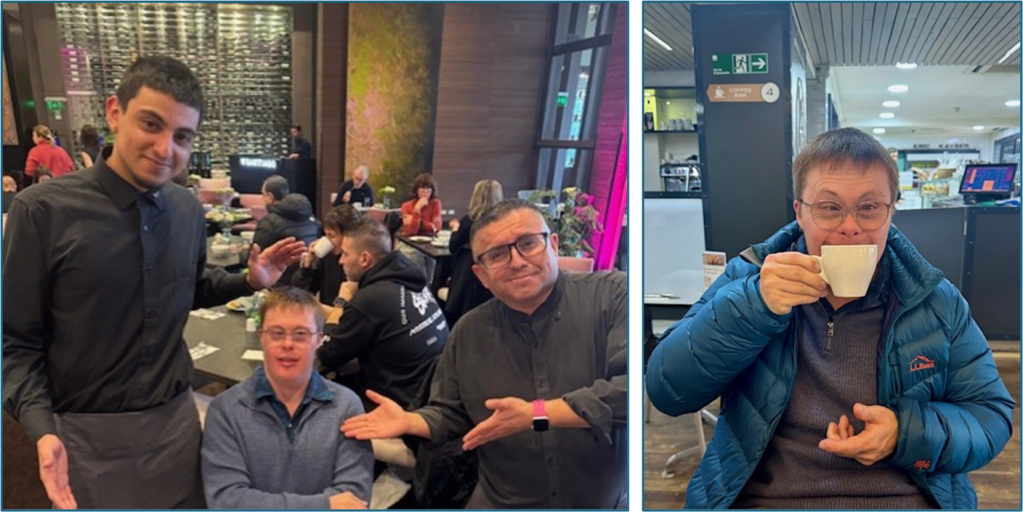
We enjoyed a final breakfast at the hotel, where the servers, Juan Pablo and Sebastian, continued to fuss over Andrew. I think they were genuinely surprised when I shook their hands and asked for a photo with them. They eagerly agreed but returned a few minutes later with unexpected parting gifts: Chilean lapel pins and a very nice bottle of local wine! I can’t say enough about the friendliness and hospitality of the Chilean people.
To be honest, my decision to hole up in the hotel that morning was just as much for my own benefit. That afternoon, I was scheduled to pick up a rental car and drive to Rancagua, a town a couple of hours away, to meet my colleague Jason, who manages our Chilean business. Having observed Santiago’s driving culture from the back seat of several Ubers, I wasn’t exactly brimming with confidence. I consider myself a capable driver and have driven in many countries around the world—but I had the sense that this city could present some particular challenges.
After one last obligatory espresso and croissant, we set off for the Hertz office, about 15 minutes away. Thanks again to Google Translate (how did we ever travel without it?), the pickup process was surprisingly smooth—far easier than in some other countries.
The car they gave me was a clean, white, compact SUV from a brand I didn’t recognize. Curious, I asked the Hertz rep—via Google Translate—what it was. “JAEWOO,” she said, a Chinese brand.
I was impressed. When you hear “Chinese car,” it’s easy to conjure images of the old Moskvitch, the notoriously awful Soviet vehicle. But this was nothing like that. The JAEWOO was sleek, modern, and exceptionally well-equipped. My colleague Jason would later tell me it sells for about half the price of a comparable Hyundai in Chile.
My head briefly filled with thoughts about global trade, Chinese innovation, and geopolitical shifts—but with a challenging drive ahead of me, I pushed those musings aside. With a deep breath, a touch of apprehension, and both hands firmly on the wheel, I plunged into the flow of Santiago traffic.
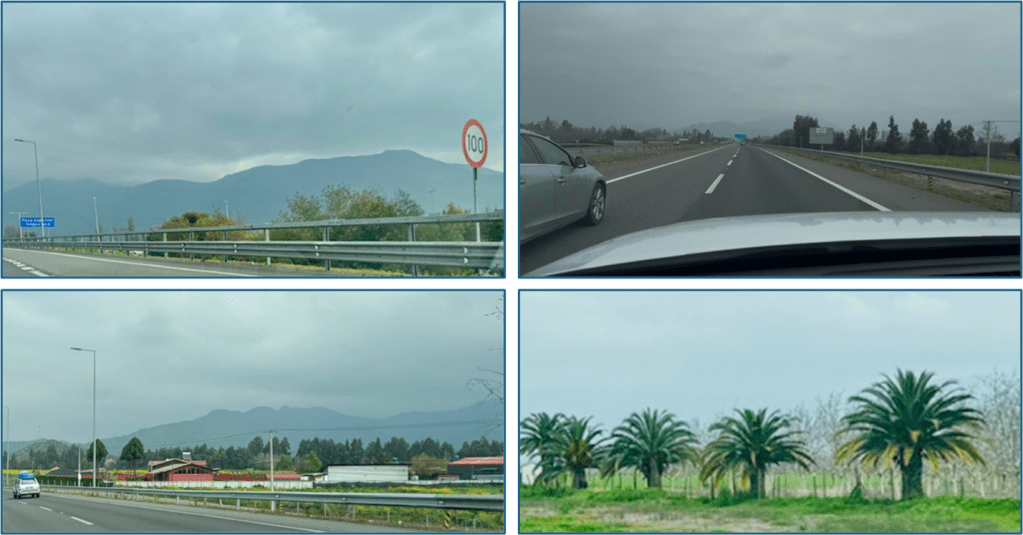
Fortunately, it was a Sunday afternoon, so I didn’t have to contend with the typically hectic weekday traffic in the city. When driving in a new country, my game plan is simple: stick rigidly to the rules of the road, stay in the inside lane, and let the locals battle out their madness in the fast lanes. So, proceeding with the requisite caution, I successfully navigated Santiago’s inner road network and soon found myself on the main highway heading south toward Rancagua.
I couldn’t help but reflect that this road—the R5—is part of the legendary Pan-American Highway. Had I turned left instead, heading north, I’d be on a route that—if not for the 100-mile-wide Darién Gap—could take me all the way to Prudhoe Bay, Alaska, nearly 12,000 miles away. Continuing south for another 2,000 miles would bring me to Punta Arenas, deep in the Patagonian region of southern Chile. An almost continuous route spanning over 14,000 miles.
It made me wonder: why hasn’t the Darién Gap been bridged yet? Surely, in this day and age, the delay isn’t due to engineering limitations. More likely, it’s the lawlessness—the bandits, drug cartels, and dense jungle—that still dominate the region.
I was relieved—and more than a little proud of myself—when, an hour and a half later and without incident, I arrived at the gas station Jason had chosen for our meeting. I’ve known him for many years, though the great distance between us means we rarely meet in person. His welcome was warm and sincere. He doesn’t get many visitors from up north!
Jason began his international journey with the Peace Corps in Honduras in the early ’90s. Coming from farming stock, he eventually found his way into our industry. Impressively, he moved to Chile in 2003 with nothing but a one-way ticket, some documentation about our products, and instructions to start a business in the region. Twenty-three years later, he’s built a thriving company that employs 35 people and enjoys a level of credibility in the Chilean agricultural industry that’s second to none. On top of that, he’s a fine gentleman with a wonderful family, including three now-grown sons who are all highly accomplished. It was truly good to see him again.
We stayed at Jason’s place for a couple of nights, and to be honest, it felt like a sanctuary. Navigating Santiago had been exciting, adventurous, and fun—but it was a real comfort to be in the company of someone who speaks the language, knows the country intimately, and could shoulder some of the responsibility.
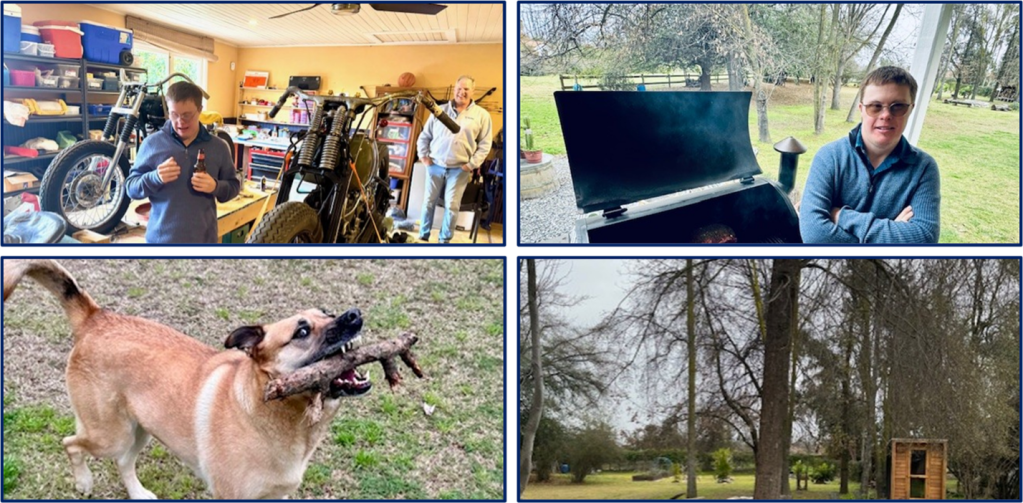
We enjoyed his hospitality, from the simple pleasure of strolling through his garden and throwing sticks for his dog, Maple, to sharing a remarkably good Chilean-style barbecue. I’m no biker, but even I could appreciate the two motorcycles Jason is restoring: a 1931 Harley VL and a 1952 Harley K. He’s a remarkably handy man.
For the first time in four days, I truly relaxed.
 What! Scotland Qualified!!!