Don’t you always hate the last day of a holiday? By definition, you’re still there, but your mind is already in departure mode—packing, farewells, and travel looming ahead. Yes, we enjoyed one last leisurely breakfast overlooking the Pacific, followed by a final walk along the shore, but in spirit, we were already in the car, heading back to Santiago. In situations like this, my approach tends to be “vámonos”—let’s go—and just get on with it. So, luggage was loaded, goodbyes were said to the staff we had gotten to know so well in such a short time, and we were off.
But we weren’t heading directly to Santiago. We had opted for the direct freeway to the city—nothing like the cross-country adventure we’d taken on the way there. To keep things interesting, I’d asked my trusty travel companion, ChatGPT, for recommendations on places to stop along the way. Much to my delight, I discovered that our route passed through one of Chile’s most prominent wine regions, centered around the Casablanca Valley (the white house, as someone pointed out. In all my years thinking of the movie and the city in Morocco, I’d never realized the translation!).
Andrew had picked up a few Spanish words during the trip, cerveza being one of them. He’s more of a beer man than a wine guy, but with a little persuasion, I convinced him to detour to a winery so that Dad could indulge. He’d mentioned several times throughout the trip that he wanted “experiences,” and so, after a little convincing, he agreed that a winery tour would be just another side of Chile to explore.
Our destination was Casas del Bosque, highly recommended by Ms. GPT for its wine—typical of the region—but especially for the tour and restaurant. It was almost exactly halfway between Concon and Santiago, and after an hour or so, we pulled off the freeway and, guided by GPS, navigated through the quaint rural town of Casablanca, which gave the region its name. The day was perfect: a crisp blue sky, temperatures in the low 80s Fahrenheit, and the lightest breeze stirring the pine trees as we drove out of town. After a few miles, orchards gave way to neatly ordered rows of grapevines.
As we got deeper into the rural roads, I began to wonder if we were headed in the right direction—especially when the route led us to a heavy metal gate guarding the entrance to the winery. With a hint of hesitation, I thought we might be turned away for trespassing, but the security guard approached us, asked to see my driver’s license, noted down a few details, and then pressed a button to open the gate. We were in.
It was like entering a theme park: on one side of the gate, the ordinary world; on the other, a picturesque fantasy world of perfectly manicured driveways, immaculate gardens, and beautiful Spanish colonial-style buildings. Despite my perhaps unfair expectations of a winery in the developing world, this place was on par with anything I’d seen in Napa or Tuscany. To emphasize this, a signpost proudly pointed to the world’s famous wine regions, including Bordeaux, Napa, and Tuscany.
It was clear that Casas del Bosque had made an effort to cater to international visitors, with nearly every staff member fluent in English—from the security guard to the people checking us in for the tour, to the restaurant staff and the guide. This was, by far, the easiest experience we had in Chile, thanks to the attentive and helpful team.
We toured the vineyard, though the grapes, still dormant, wouldn’t emerge for weeks. We learned about the terroir—granite-based soil cooled by sea breezes, only 12 miles away. This climate is ideal for varieties like Chardonnay, Sauvignon Blanc, and Pinot Noir. By Chilean standards, Casas del Bosque isn’t a large estate, producing only 1.3 million liters per year (some estates produce ten times that), but it felt impressively scaled as we toured the vat rooms and cellars, learning about the winemaking process. Pleasingly, Andrew was deeply interested and engaged.
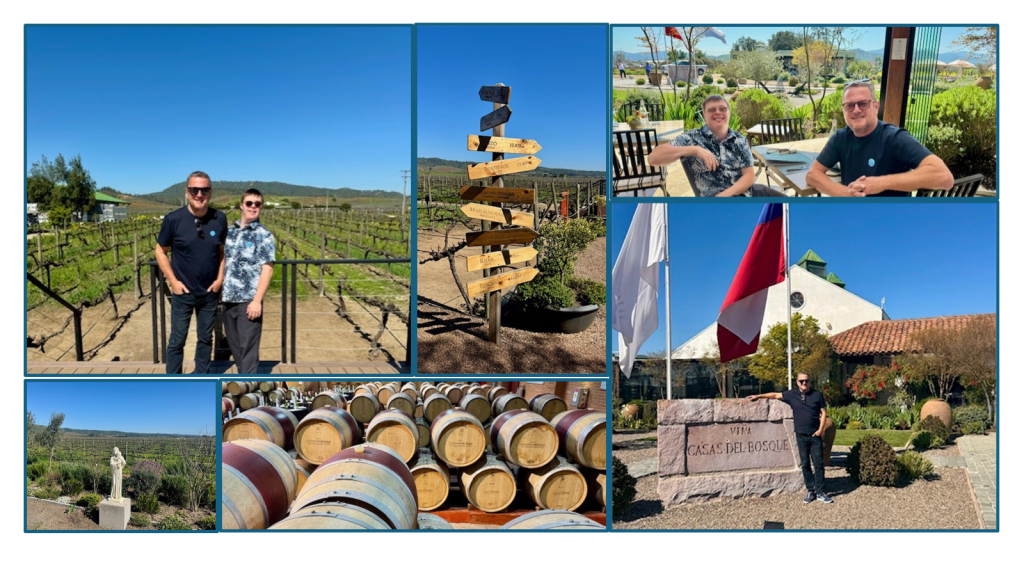
Funny how quickly a random group can come together. We were only with our fellow tourists for an hour, but we had all bonded, likely aided by the free-flowing wine! Our group included a family from Shenzhen, China—a place I know well—another family from southern Chile who had chosen the English-language tour to practice their skills, and an Australian woman who was attending a conference of bariatric surgeons in Santiago. She took a particular shine to Andrew and sat with us as we—well, mostly he—learned the finer points of wine tasting, working our way through six of the winery’s best vintages.
When she asked Andrew which wine he liked best, he confidently replied, “I really like the Chardonnay. But I quite liked the Pinot too.” Later, Andrew confessed to me that now, at the age of 35, he might start swapping his cerveza for wine more often!
I’m no sommelier—like Andrew, I only came to wine a little later in life—but I’d like to think I know my way around the major wine regions and varieties. So I was surprised to learn that I’d missed one. I had always associated Malbec with Chilean wine. But no—here, Carménère is king. Interestingly, the variety originated in Italy but was thought to have died out over a hundred years ago due to disease. In the 1960s, someone noticed that some vines in a Merlot vineyard in Chile didn’t look like Merlot. With the help of DNA analysis, it was discovered that these rogue vines were Carménère, likely shipped to the New World among a batch of Merlot cuttings before the blight wiped it out in Europe. Now, Carménère is widely grown in Chile—and in small amounts in California and Italy—and is the country’s signature grape.
Naturally, I had to have another glass of Carménère to accompany lunch at the winery’s terrace restaurant. Andrew, predictably, ordered Chardonnay. We savored a delicious and, considering the setting, surprisingly inexpensive lunch while sipping our wine and chatting with the knowledgeable servers. One of them, in particular, caught my attention. She spoke perfect English, but with an accent that wasn’t Spanish. She turned out to be Swedish by birth, having moved to Chile as a child when her mother remarried a Chilean man. In addition to English, Swedish, and Spanish, she spoke Portuguese and was learning Italian and German. I am in awe of people with such language skills—I’ve barely mastered English!
Casas del Bosque wasn’t part of our original plan, but what a pleasant surprise. A bonus treat in what had already been an enriching trip through Chile. We were very glad we took the detour, and equally glad we didn’t turn back when we first saw the imposing security gate. But eventually, it was time to leave and complete our drive back to Santiago. Hopefully, we would make it there before the Friday afternoon rush hour. I was proud that I had navigated through Chile without dinging the rental car, and I didn’t want to fail in the final miles.
I’m not typically one for superlatives, but I felt a quiet sense of triumph as we entered the outskirts of Santiago. Of course, in the grand annals of exploration, our little adventure would barely warrant a footnote. Chile—at least the parts we visited—is no remote wilderness or third-world backwater. But for us, in our own way, this was a frontier: navigating a foreign country, in a different language, with minimal support. Especially so for me, as I was Andrew’s lifeline throughout the trip.
I’ll admit it now: in the weeks leading up to our departure, and indeed throughout our time in Chile, I lived with constant anxiety. We had a wonderful experience—everything a father-son trip should be—but the “what ifs” loomed large. If something had gone wrong—if I’d been injured or suddenly taken ill—Andrew, to put it bluntly, would have been screwed – completely unprepared to cope with the situation on his own.
To ease my concern and have at least a basic fallback plan, I prepared small laminated cards for Andrew. On one side were emergency numbers—including my colleague Jason’s, who was at least somewhat local—and on the other, a miniature copy of his passport. I tucked it inside his phone case and instructed him that, if something went badly wrong, he should hand it to a friendly police officer or storeowner. Had it come to that, my faith in the kindness of strangers would’ve been well and truly tested.
Thankfully, it never did.
And so, we rolled into Santiago on a wave of quiet celebration—triumph might be too strong a word, but it felt close. One last glimpse of the majestic Andes, rising up to form their eternal backdrop to the city, and we knew the journey was nearly complete.
The final few miles were driven with more than a little caution—there was no way I was going to let anything happen now, not at the final hurdle. And so, just like that, the Jaiwoo—a pleasantly competent piece of Chinese engineering—was returned safely to Hertz. Not a scratch. Not a single ding.
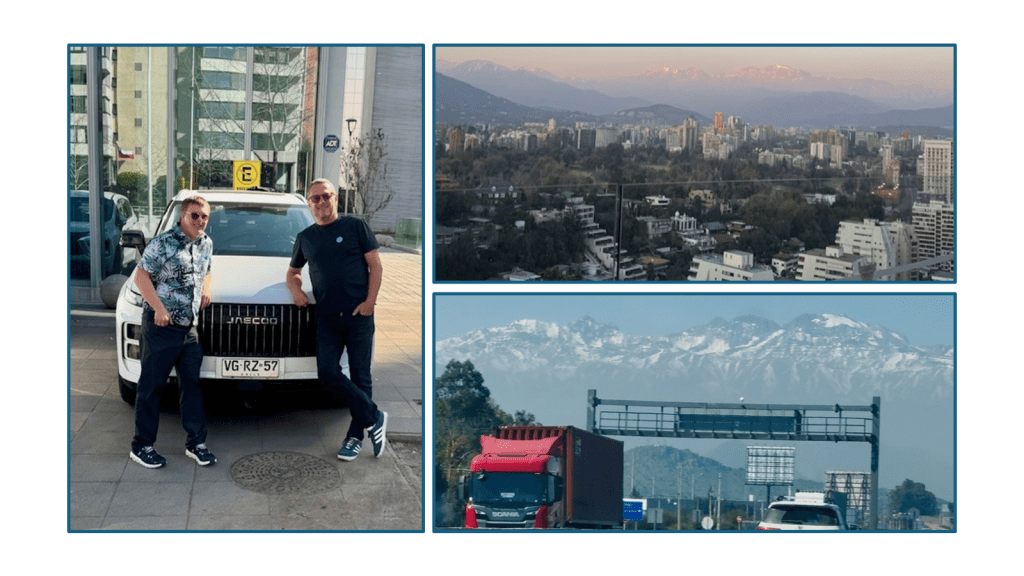
We checked back into the W—our sanctuary in the city. As I mentioned earlier, we’d pushed the boat out to stay here. I knew the W brand from other cities and wanted to ensure a certain level of comfort and service, especially given that both the city—and the country—were unknown quantities to us. And comfort and service we got, in abundance.
Yes, the W is one of Marriott’s top-tier properties, but even by those standards, the staff’s attentiveness stood out. At one point, I even had a quiet word with Daniella—who bore the wonderfully extravagant title of Whatever/Whenever Manager & W Insider (essentially, the customer service manager). I told her about our quest: to eat chili, in Chile, when it’s chilly. Once again, I had to explain what chili actually was—but Daniella was intrigued and as luck would have it, became genuinely invested in the mission.
As the sun began to set on our Chilean adventure, symbolically, we made our way to the roof top bar. It was closed to the public as a company – interestingly, a solar panel business – had bought out the venue for a very grand, private black-tie event. But the enterprising hostess had laid out a few small tables for us residents, behind the DJ station, beside the rooftop swimming pool, which, curiously, was drained empty. Watching the glamorous Santiaguinos in their finery, we felt, by comparison, rather shabby tucked in that corner, savoring a final carmenere and pina colada as we watched the final dance of the Chilean sunset on the magnificent Andean mountains.
“Let’s go get some dinner,” I said as night finally fell.
“Where are we going?” Andrew asked.
“Oh, as it’s the last night, I made a reservation at the lobby restaurant here in the hotel. Something simple and easy.”
We rode the elevator down and walked across to the host stand. As we approached, the host looked up with a smile and asked, “Mr. Nicol?”
I returned his knowing grin. “Yes.”
Salvador, the host, guided us to a table in the center of the lounge and took our drink order—yet another Carménère for me, and one last cerveza for Andrew.
Hungry as ever, Andrew began scanning the menu, which was—of course—devoid of anything resembling chili. No surprise there. After about ten minutes, he was getting impatient and announced he was ready to order: fish and chips.
“Hold on,” I said, trying to buy a little time. “Maybe the waiter will come and tell us about the specials.”
And right on cue, from the corner of my eye, I saw Santiago—the host—and a second waiter making their way toward us, carrying a tray. With his back to them, Andrew didn’t notice until they arrived at our table and placed it in front of him: a perfect bowl of piping-hot chili con carne, complete with a side of crunchy chips.
A picture paints a thousand words—and Andrew’s face was just that: a picture. Surprise, delight, and utter joy.
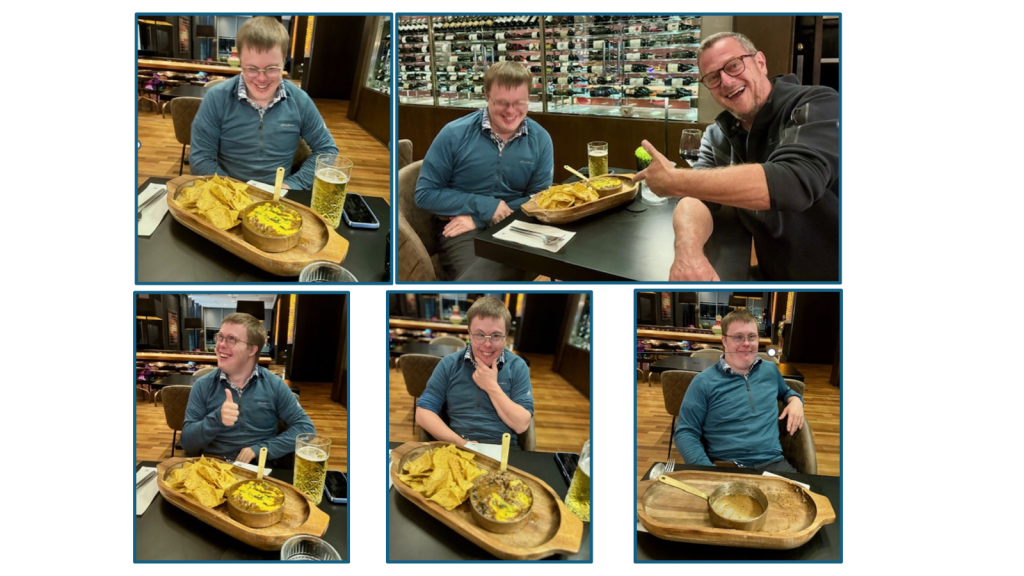
Mission accomplished.
It was Daniella—the ever-attentive customer care manager—who made it happen. When she’d learned about our quest to eat chili, in Chile, when it’s chilly, she was immediately on board. “I’m sure our chef would love to make that for you,” she’d said.
There was only one problem: the Chilean chef, wasn’t entirely sure what chili con carne was. Truly—the dish is practically unknown here.
So to be sure, I downloaded a Gordon Ramsay’s recipe, translated it into Spanish with the help of Google Translate, and emailed it to the chef.
He nailed it.
The result? Tender pieces of beef, slow-cooked in a rich tomato and vegetable sauce, studded with black beans and just the right amount of spice to make it zing.
The dish didn’t last long.
Between us, it was gone in minutes—though to be fair, I left most of it for Andrew. I called the waiter over to ask, hopefully, if there might be a little more in the kitchen. After a quick check, the answer came back—sadly, no. The chef had prepared just enough for that one perfect serving.
And maybe that made it even more special. Just that one bowl, made just for us, on that one night, never to be served again. A one-off moment, never to be repeated.
And do you know what?
To top it off, the hotel refused to charge us. “Too special,” they said. “We wouldn’t dream of taking your money.” Instead, they handed me a gift to mark our celebration: a lovely bottle of Chilean red. (Sadly, a Cabernet—not my new favorite Carménère—but a kind gesture all the same.)
Let’s be honest: going all that way to eat chili in Chile when it’s chilly was, well… silly. Just a throwaway line Andrew had been saying for years. But that silly little phrase became the spark, the catalyst, the reason for this extraordinary journey.
Of course, it was never really about the chili.
As Andrew said many times along the way, it was about the experience—of being in Chile. The rich culture, the staggering natural beauty, the warmth of its people. But more than that, it was about being traveling with my son. Something that, when he was a little boy, I never imagined would be possible.
And yet, here we were. Despite all the challenges over the years, he has grown into a curious, capable, independent young man. Watching that unfold, day by day, mile by mile, brought me immeasurable joy. It was, quite simply, a privilege to share this adventure with him.
Still… while the weather may have been unseasonably warm, it would have been a tragedy not to have eaten chili, in Chile, when it was chilly.
The completion of that silly, wonderful quest was, at least in our eyes, nothing short of a triumph.
 What! Scotland Qualified!!!