Even the RAGBRAI podcasts we’d listened to in the lead-up to the event had little to say about the route on Days 5 and 6. Straight, relatively flat, and heading east—most likely with the wind at our backs. Only (and yes, LOL, “only”) 90 miles over two days. Instead, the hosts focused on the towns we’d pass through and the endless variety of food vendors ready to tempt us along the way.
And so it was.
We carried on with the early morning routine we’d now settled into, and the river of riders flowed once more beneath a serene sunrise. But after the physical and mental grind of the previous two days, we unashamedly took full advantage of every pass-through and meeting town to embrace the other side of RAGBRAI.
And what an experience it was—encountering the most diverse and entertaining cast of characters you could ever imagine.
Take Danny for example…
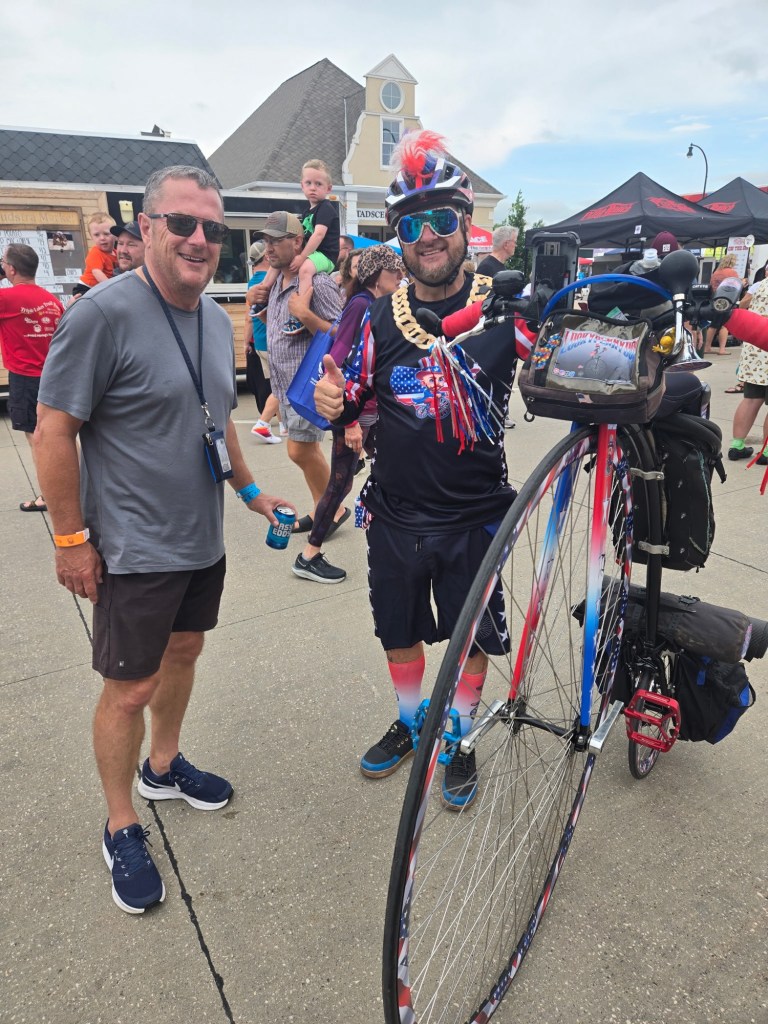
We first met Danny in Orange City on the Saturday evening before the ride began. But he’s a RAGBRAI stalwart, and our paths crossed several times over the days that followed.
Danny—who I later learned is one of those ultra-endurance athletes—rode the entire RAGBRAI route on a penny-farthing. Yes, a penny-farthing: one of those Victorian-era bicycles with a giant front wheel, a tiny rear wheel, and absolutely no gears. I’d seen his photo in some of the RAGBRAI materials before the ride but assumed it was a joke. Surely no one could ride 406 miles on a penny-farthing. But no—it was real. And he did it. The only time he walked was up one of the steepest, longest hills of the route, which I’ll describe in my blog about the final day.
Meeting Danny was a pleasure. He’s one of those rare people who radiate boundless energy and infectious enthusiasm. He wasn’t riding for glory—he was riding for a cause. His charity, Lucky Penny, raises money to buy bikes for kids, encouraging them to step away from screens and rediscover the joy of riding through their neighborhoods like we did when we were young.
We even met a family along the route whose little girl told Danny she’d always wanted a bike. A few weeks later, one showed up on her doorstep—courtesy of Lucky Penny.
Or these guys….
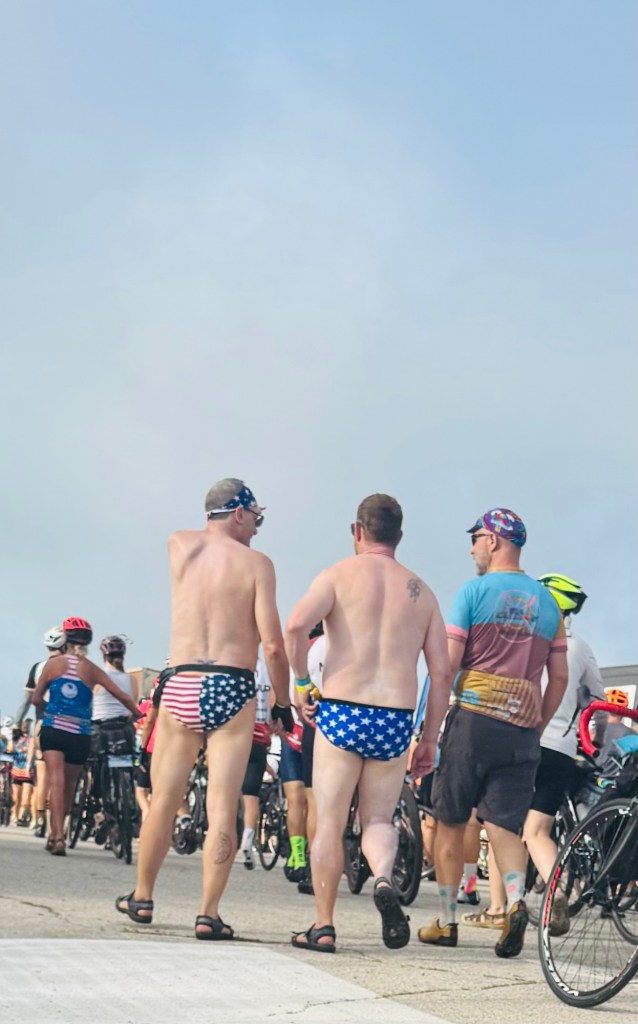
To be honest, I never quite summoned the courage to talk to them. It’s hard to look a man in the eye when he’s wearing a Speedo.
A couple of times I found myself behind them in one of those racing lines we discussed in an earlier blog—but I just couldn’t do it. I couldn’t look. Still, you have to admire anyone who can ride 406 miles in a Speedo. Just think of the chafing. Although, from what I gather, that was a secondary concern. Their main worry was sunburn— what with all that exposed flesh and all!
Somewhere in the RAGBRAI media coverage, I saw them acknowledge their sponsor: a sunscreen company that had kindly provided the lotion for the trip.
I’ll admit I’ve forgotten the name of the group, and the specific charity they were riding for, but like Lucky Penny, they’re RAGBRAI veterans—long-time participants who raise a lot of money for worthy causes. And while I may not have joined their pace line, I absolutely respect their dedication… and their bravery.
I cant go on without mentioning the food vendors we met along the way that provided the fuel fof our journey
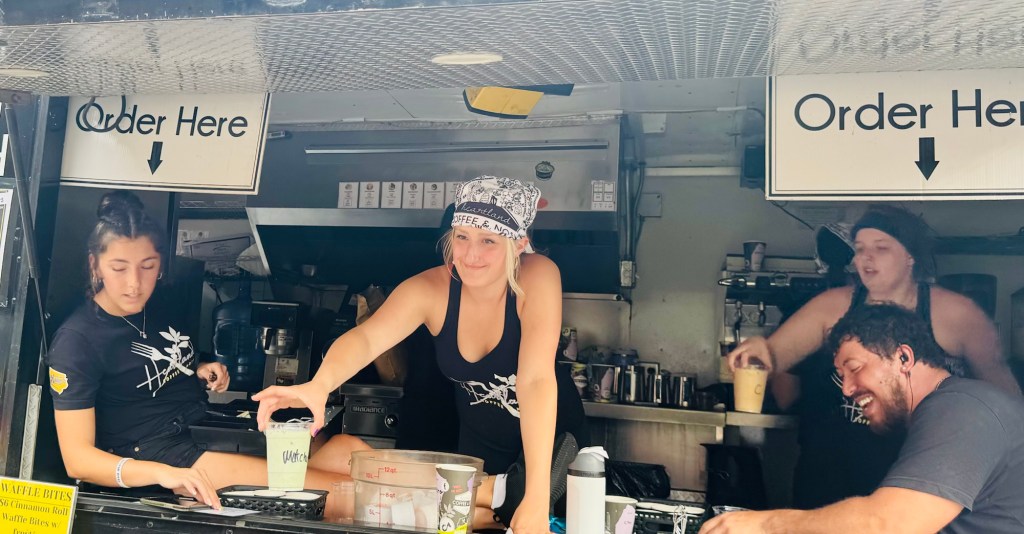
I never learned her name—she was far too busy for much conversation. But I’d say she was the coolest person on RAGBRAI. And she served the best food.
Her truck was Coffee and Nosh, and we made a point of finding her for breakfast at every one of the first pass-through towns we reached. She was always in the same spot, sitting in the window of the food truck with the cash register balanced on her lap, always calm, always pleasant.
Her coffee was excellent, and her freshly prepared steak and eggs were exactly what we needed to power through the rest of the day. A perfect combination of warmth, efficiency, and nourishment—she made those early mornings feel just a little easier.
And then there was Tony, Mr. Porchop
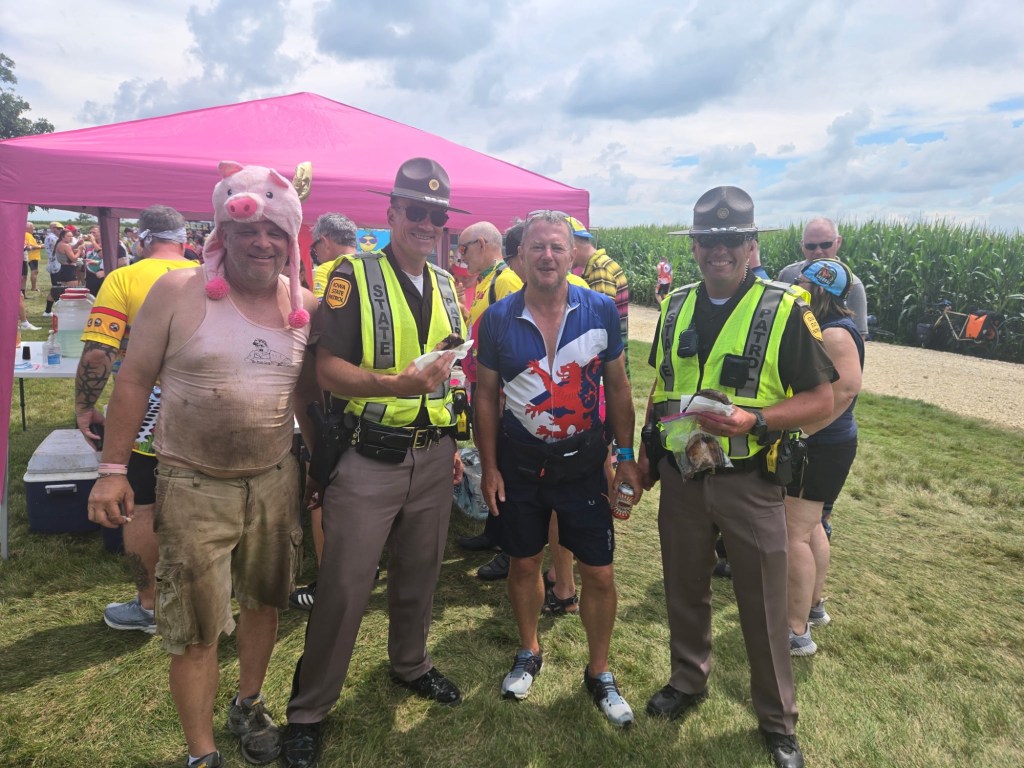
Or to be precise—Mr. Porkchop III, the grandson of the original. I’ve mentioned him in earlier blogs, but I truly believe Tony was the hardest-working man on RAGBRAI—cyclists included. Day after day, he toiled over those barbecue pits in the relentless heat, serving up thousands of perfectly grilled pork chops.
I got to know him a bit over the course of the week. He’d greet me with a cheerful “Hey, Scottie!” every time, always with a grin and a joke. His energy was infectious.
Tony cooked more than 5,000 pork chops that week—though honestly, I’m surprised it wasn’t more, given the size of the crowds. And despite my initial skepticism, I can say without hesitation: those chops absolutely lived up to the legend.
I don’t recall exactly why the police officers were in that photo with Mr. Porkchop III, but it gives me the opportunity to acknowledge the presence of all the first responders who worked tirelessly throughout the week to keep us safe. From blocking major intersections to allow cyclists to pass (often accompanied by energetic rock music blaring from their patrol cars) to responding to emergencies—of which, sadly, there were too many—their dedication was constant and deeply appreciated.
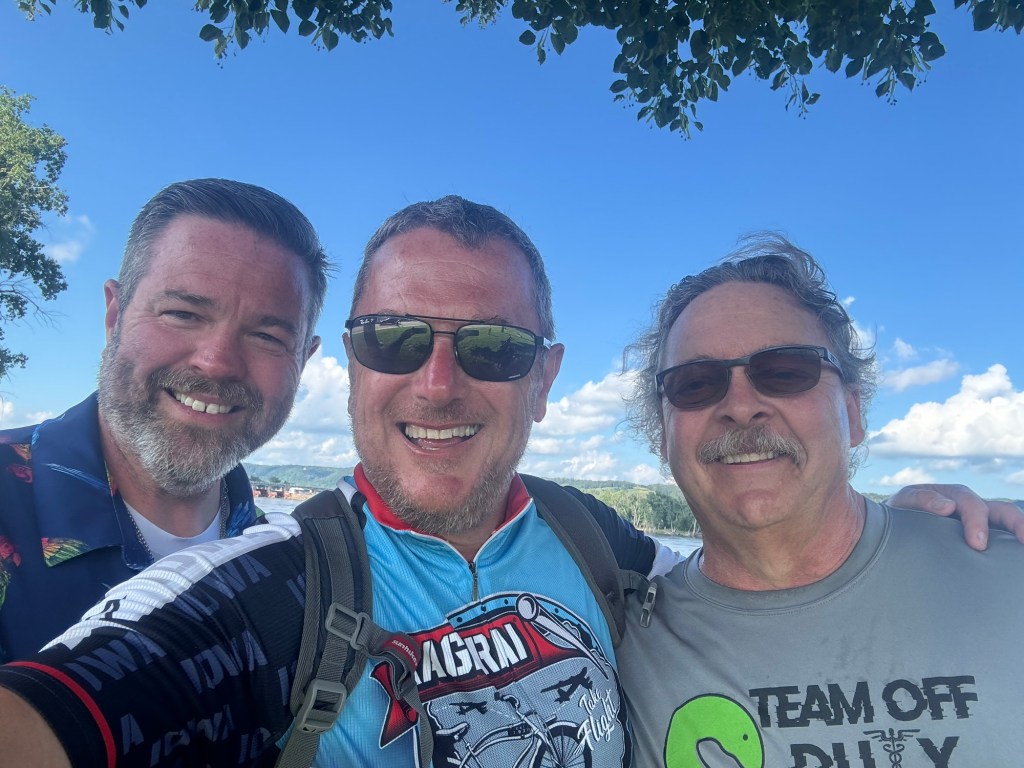
We met these two guys who were part of the EMT team that responded to a cardiac arrest we witnessed less than five miles into the first day, just outside Orange City. Thankfully, they reached the patient in time. He later required a quadruple bypass, but he survived—and lived to tell the tale. Sadly, not all were so fortunate. Two other riders lost their lives during RAGBRAI due to heart-related complications. It’s a sobering reminder that, for all the fun and festivities, this is still a serious physical challenge—not to be taken lightly.
And to round out the tribute to the support crew, here’s Matt—one of the many bike techs stationed along the route, working from dawn to dusk to keep us all rolling.
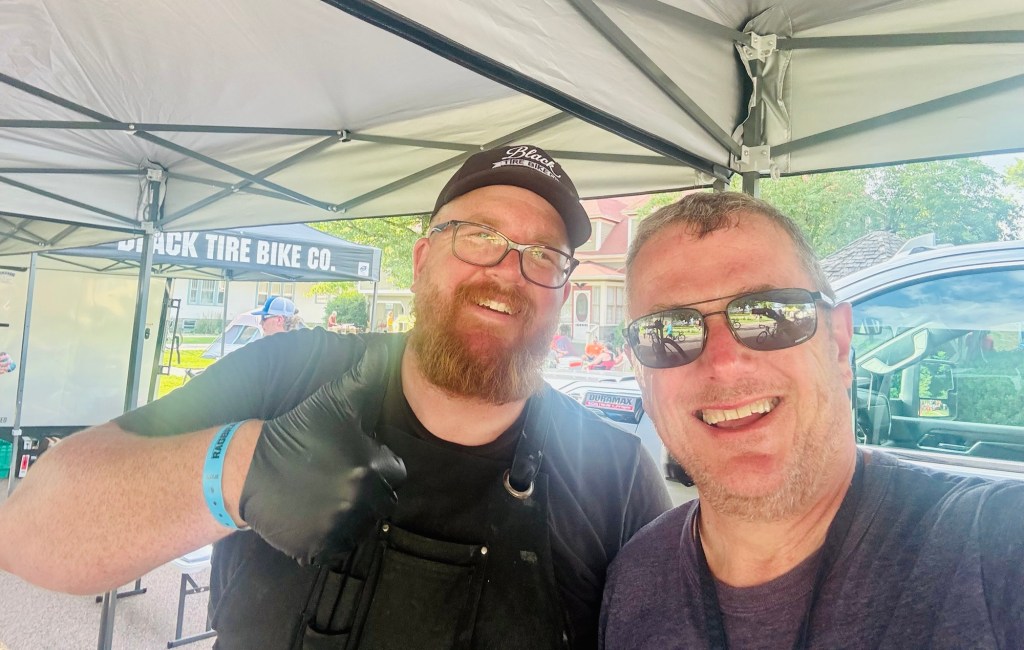
On the very first day, my bike developed a worrying grinding noise from the pedal crank. It sounded like someone had poured a bucket of nuts and bolts into it. I found Matt’s setup late in the afternoon, toward the end of what must have been a long, hot shift. But with characteristic good humor and no hesitation, he got to work. He stripped, cleaned, greased, and rebuilt the crank—and had me back on the road within half an hour.
These unsung heroes were every bit as essential as the riders. Without them, a lot of us wouldn’t have made it to the finish.
Oh! There’s one more group of support people I absolutely must mention. They’re easy to overlook—mainly because their work was done weeks before the ride even began, and we never actually saw them. But their impact was everywhere.
I’m talking about the folks at the Iowa Department of Transportation.
Remarkably, over the course of 437 miles, we didn’t encounter a single unpatched pothole, an unfilled crack, or even an uneven surface. In some areas, entire stretches of road had been freshly resurfaced with smooth blacktop—all to ensure that we riders had a safe, comfortable journey across the state.
Their work wasn’t loud or flashy. No cheering, no beer gardens, no water stations. But arguably, these unseen heroes contributed more than anyone else to the overall success of RAGBRAI. They laid the foundation—quite literally—for everything that followed.
So here’s to the unsung crew at the Iowa DOT: thank you for the smooth ride. We noticed.
And then their were the many friends we made along the way
Yesterday, I mentioned a memorable conversation I had in the beer garden during the height of the blistering afternoon heat. The man I was speaking with was from Belfast, Northern Ireland; I’m from Ayrshire, Scotland just across the Irish Sea. At one point, we both said the same thing, almost in unison: “On a clear day, I could see where you grew up!”
Damian later laughed because, within moments, we’d both slipped so comfortably back into our natural vernacular that no casual observer could possibly have understood a word we were saying.
He was an interesting guy. Years ago, he had up-sticks from his homeland and moved to Philadelphia, where he built a life as a carpenter and eventually started his own business, now employing several people. But it was his wife who truly caught my attention—or rather, her father.
She told me that her dad had paid his way through his first year of university by painting houses. But the work turned out to be so lucrative that he left school to focus on it full-time. He went on to build what became the largest domestic painting and decorating company in the country—employing 150 painters and generating $18 million in annual revenue.
My dad was a painter and decorator by trade, so her story really struck a chord. Over a couple of beers, we had a great conversation about her father’s business, the challenges of scaling it further, and the complexities of transitioning it to the next generation as he prepared for retirement.
My own dad passed away when I was 18. I remember, for a moment, wondering what might have happened if I’d taken over his business—if I could have built it the way her father did. But my path led me to university and, eventually, elsewhere.
Still, I was fascinated—and genuinely inspired—by what her father had accomplished.
We met this gracious elderly couple in the tiny town of Aplington—population just 1,116. They’d lived there their entire lives and spoke with quiet pride about their town’s identity as a “good Christian community,” which, despite its size, boasted six churches within its boundaries.
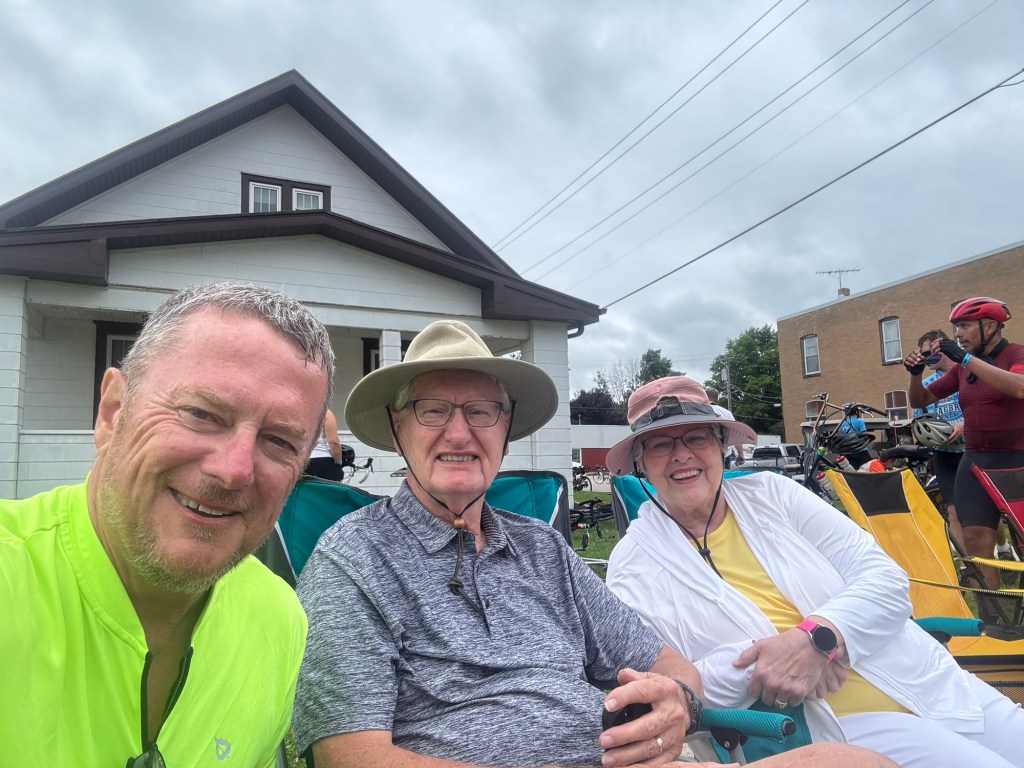
Like most in the area, they came from farming stock and had witnessed the industry evolve over the decades. They spoke wistfully about the decline of traditional family farms—once just a few hundred acres—now swallowed up by large corporations and merged into operations spanning 20,000 acres or more.
Still, they expressed satisfaction with the crop this year. A mix of heavy rains and warm sunshine had set the stage for a favorable yield. Inwardly, I smiled—a happy farmer is a rare thing. So I wasn’t entirely surprised when their optimism about the harvest quickly gave way to concern: despite the good growing season, they worried about their ability to sell the crop. Ongoing trade disputes and tariff wars with America’s usual trading partners cast a long shadow over an otherwise promising yield.
One of our Panda pals was Beard—a mild-mannered, softly spoken hipster whose name perfectly matched his bushy beard and tattooed appearance. One of the many delights of RAGBRAI is that, with everyone in “plain clothes,” it’s nearly impossible to pigeonhole anyone at a glance. So I was mildly surprised to discover that, despite his laid-back, countercultural vibe, Beard and I had quite a bit in common—and, surprisingly, so did he with the elderly farming couple we’d met in Aplington.
You see, Beard was a senior supply chain manager for one of the largest phosphate fertilizer companies in the Midwest. That revelation sparked a fascinating conversation about the global phosphorus market—a topic I knew a little about from a past project. We spoke about China’s dominance in phosphorus production, the rising importance of Morocco (which Beard had visited), and the ongoing investigations into alleged collusion among major producers in countries like Belarus and Israel. These dynamics, he explained, are partly responsible for the inflated fertilizer prices currently squeezing the competitiveness of small-scale American farmers—like those in Aplington.
I’m constantly amazed by the interconnectivity of the modern world. It’s sometimes worrying, yes—but mostly, I find it inspiring. That the operations of a phosphate producer in Morocco can indirectly, and probably unknowingly, impact the fortunes of a farmer in rural Iowa—that’s something worth reflecting on.
Thank you, Beard, for a fascinating conversation.
Speaking of collusion… just to be on the safe side, I’m going to change the name of the next character.
“John,” also dressed in plain clothes, looked like your typical nerdy bike rider—much like me, really. A nice enough guy. We ended up sharing a beer under the shade of a tree at that now-familiar roving beer garden.
But during the course of our conversation, I learned that he worked as an analyst at the Securities and Exchange Commission—the SEC—in Washington, D.C.
Now that was interesting.
Naturally, I asked for his take on cryptocurrency and the need for regulation – well why wouldn’t you? Paraphrasing his response: he described it as a massive Ponzi scheme—one that inevitably must be regulated to stop a handful of wealthy individuals from profiting off the backs of countless gullible small investors. His perspective validated my own humble, if somewhat ill-informed, suspicions.
I hope he’s right. Because when it comes to crypto… something just doesn’t pass the sniff test.
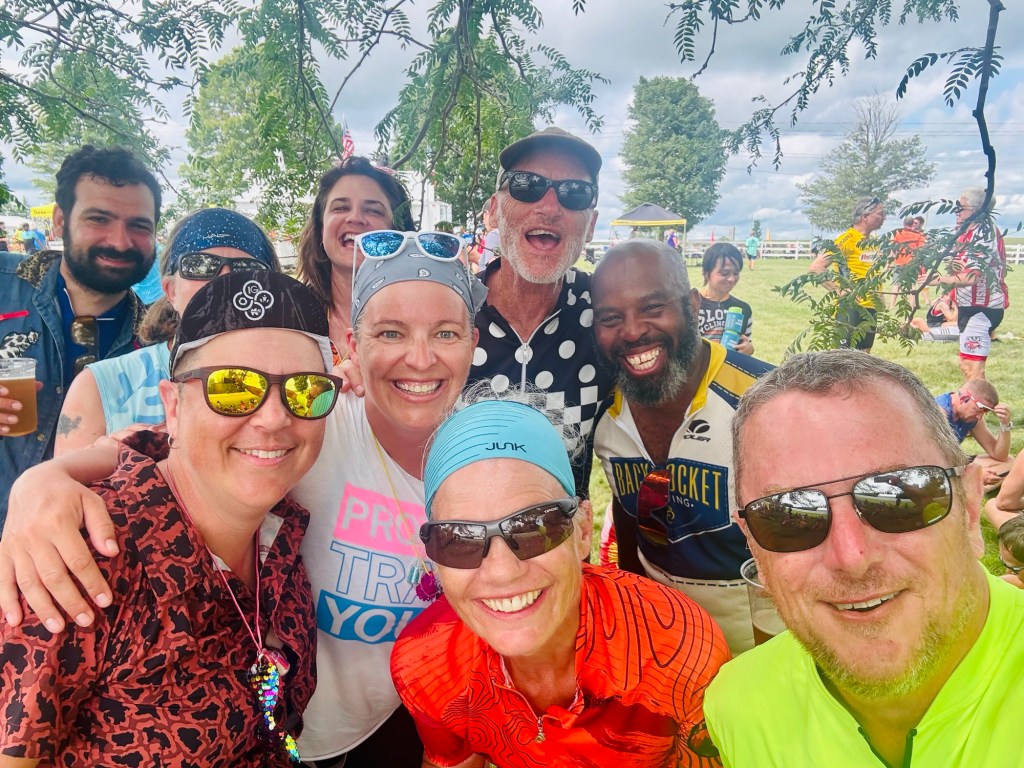
Damian rode with this group of ladies for a stretch on that very hot, windy Wednesday. Unfortunately, they didn’t catch him at his best—and in good-nature, they christened him “Mr. Grumpy Pants.”
But as the universe often does, it found a way of reconnecting like-minded souls. We crossed paths with them several more times over the following days—usually, fittingly, in that magical roving beer garden, which always seemed to appear just when we needed it most. It became something of a social hub, a place where casual encounters turned into lasting connections.
One of those connections, for me, was with Andy—the woman in front, wearing red. As it turned out, we shared a remarkably deep bond rooted in a shared geography and time.
Andy was a child of the ’60s. Her mother, once part of New York’s bohemian scene, had made the unexpected decision to relocate to Europe with young Andy in tow. After a brief stint in Switzerland, they settled in Scotland—specifically, in the town of Cupar in the Kingdom of Fife.
I’ve been to Cupar. It’s a beautiful, quintessential Scottish farming town. If I’m not mistaken, National Geographic once featured a photo of its bakery on the cover of a special issue on Scotland. I remember thinking at the time that they couldn’t have chosen a better image to represent the country.
Andy spent her formative years in Cupar and went to school in nearby St. Andrews. I grew up around the same time, though on the opposite coast of Scotland. Still, we spent a good while reminiscing—swapping stories and memories of our youth before life grew more complicated. Talking to Andy made me happy. There was something grounding, even healing, about that unexpected connection in the middle of Iowa.
This man caused me perhaps the most unexpected distress of my entire week in Iowa.
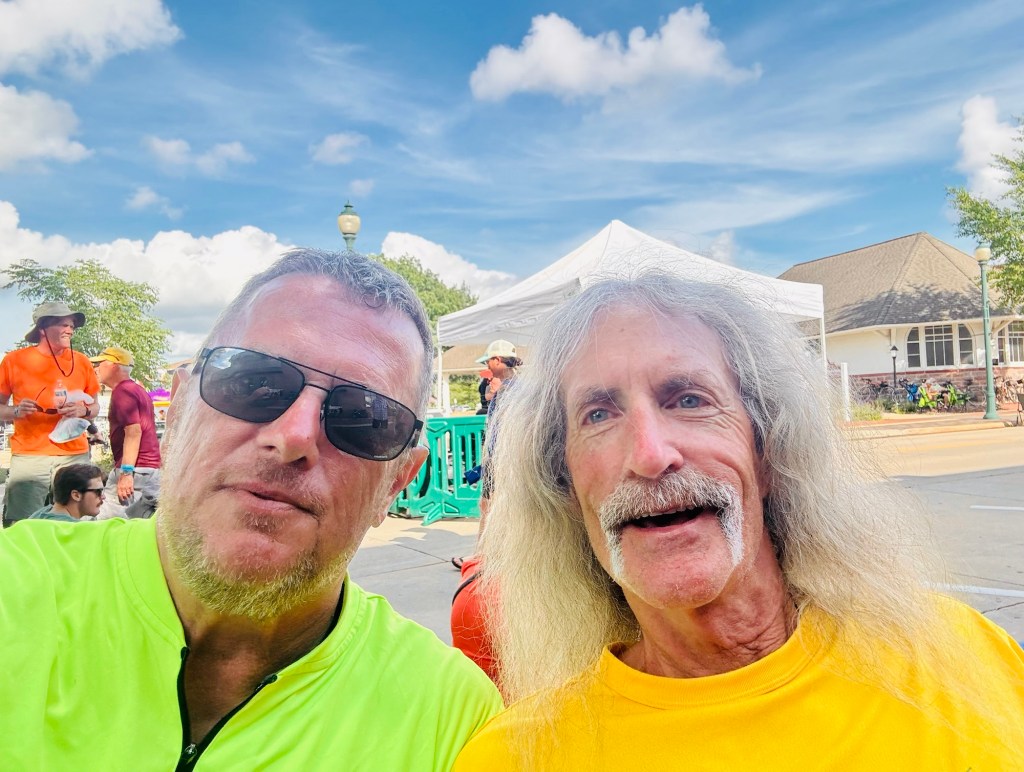
I first noticed him sitting alone on a park bench in the overnight town of Cedar Falls. Our little Panda group was noisily enjoying our first beer after a long, hot day’s ride when I spotted him—quiet, still, and staring into the distance with a vacant look. Something about his presence felt… out of place among the typically vibrant, jovial RAGBRAI crowd. Curious, I wandered over and struck up a conversation.
To my surprise—and delight—he was more than happy to talk. In fact, he turned out to be one of the most interesting people I met all week.
He was a recently retired, third-generation train driver from California. His grandfather had driven steam trains across what I imagine was still the Wild West in his day. His father had followed the same path. And so had he—growing up in California and eventually piloting trains along the Oakland-to-San Diego line.
Passenger rail travel isn’t all that common in the U.S., but he spoke about it with deep affection and longing—especially the beauty of that coastal journey, which he clearly loved. I now feel I must find a way to take that trip myself.
We looked ahead together and imagined a future where the U.S. might finally develop a modern high-speed passenger rail network like those in other advanced nations. The long-promised, eternally delayed, and grossly over-budget Los Angeles to San Francisco line was, understandably, a particular sore point for him.
So why, you might ask, did this thoughtful and engaging conversation leave me so distressed?
Well… I jokingly called him Casey Jones—a warm nod to the 1960s black-and-white TV show about an American steam train engineer in the Wild West, beloved from my childhood. But my reference was met with a blank stare.
“Casey who?”
He’d never heard of the show.
How, I wondered, could a lifelong American train driver not know about Casey Jones—the ultimate steam train folk hero of early television? To be honest, it made me question his entire credibility.
But only for a moment.
Because even if he’d never heard of Casey, he was Casey, in spirit. A modern echo of that railroading legacy—quiet, steady, and full of stories. I’m just glad I stopped to listen.
But, without any question, this character was my favorite
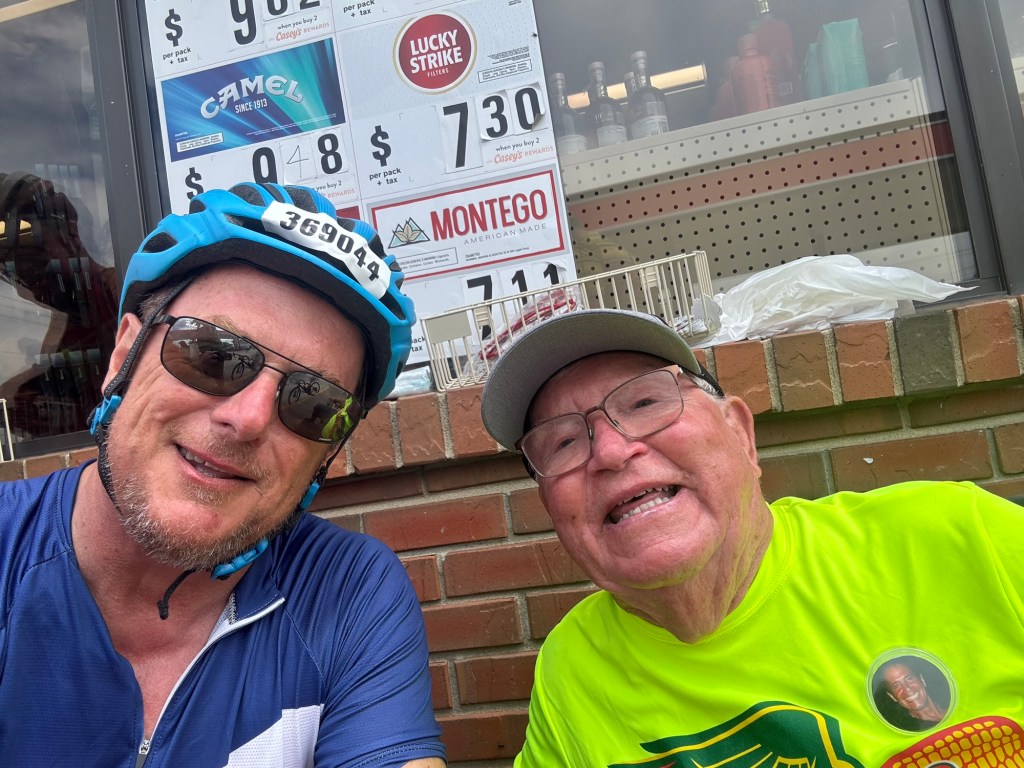
Eighty-six-year-old Glen Peterson of Fairbank, Iowa.
I’d stopped at a Casey’s—not the train driver, the supermarket—to replenish my supplies of Liquid I.V. The gas station forecourt was packed with cyclists; no car was getting near a pump that afternoon. I expressed sympathy to the store manager, but she just shrugged and said it didn’t matter—the town was closed to traffic that day anyway.
As I stepped outside, there was Glen—seated on the sidewalk in a lawn chair, joyfully entertaining the passing crowd. He was, without exaggeration, one of the most cheerful, vibrant souls I’ve ever encountered. I stopped to tell him he was a delight, and he immediately invited me to sit in the empty chair beside him.
I did. I stayed for fifteen minutes or so—and I couldn’t tell you a single thing we actually talked about. All I know is that by the time I stood up to leave, my face hurt from laughing. Glen, unsteady on his feet, insisted on rising to see me off. I tried to stop him, but he was having none of it—and kept me laughing for another five minutes before I finally pulled myself away.
I do remember this: Glen has 1,400 followers on Instagram, under the handle @papepeteia. Most days, he probably entertains just a few locals coming and going from the store. But on that day, he had an audience of 20,000 riders—and he was loving every minute of it.
Would that I live to 86 and carry even half of Glen’s joy, humor, and warmth. God bless you, Glen!
The People of RAGBRAI. Yes—some days were physically demanding, exhausting even. The ride was the true test of fitness and endurance that I’d spent long winter hours training for in the saddle. But in the end, it was the people—the local Iowans, the “Buckeyes,” and those who came from every corner of the United States and beyond—who made RAGBRAI unforgettable. They were the true joy, the true spirit of the ride.
Our own little RAGBRAI crew—let’s call them the Panda Select—were a particular highlight. I only wish we’d connected with them sooner. The all too short time we shared over those last few days—riding together, lingering in that ever-present beer garden, or hanging out in Panda Camp as the sun went down—was something truly special. Brad, Curt, Liz, Dave (aka Julio)—I hope we ride RAGBRAI together again. It was a pleasure and a privilege.
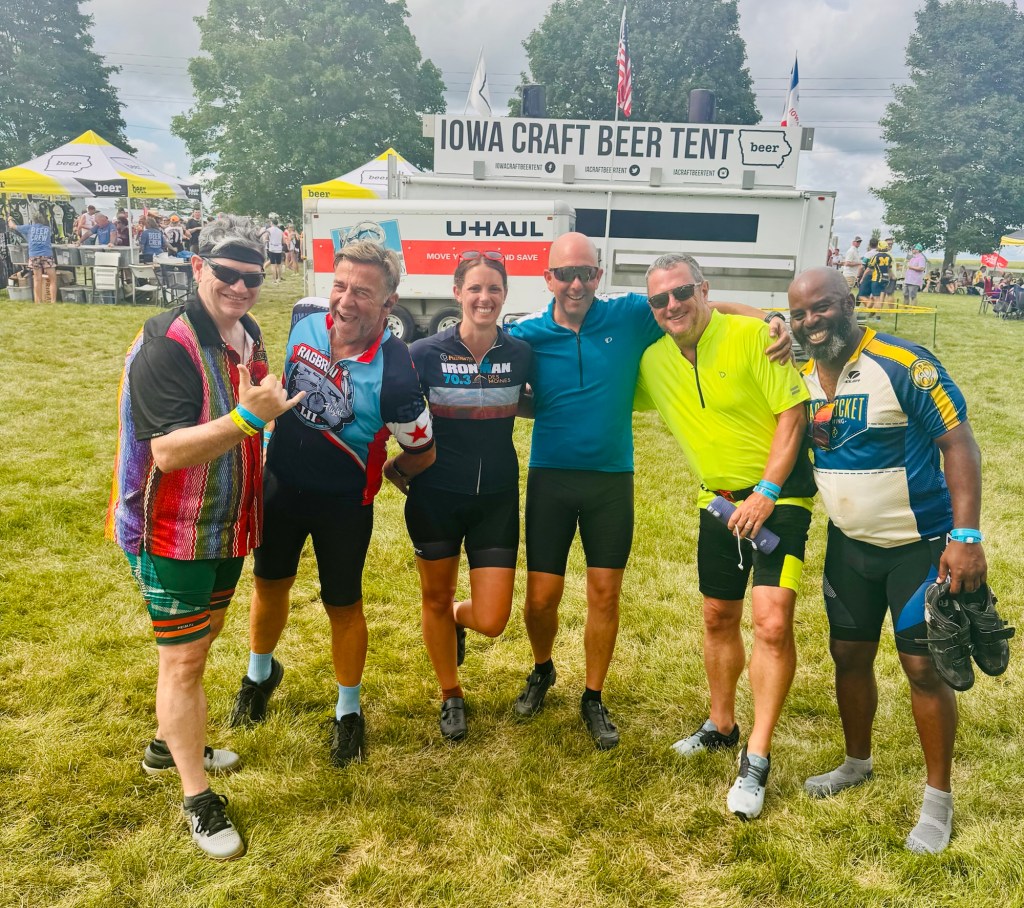
 What! Scotland Qualified!!!