I’d brought Jason a tube of chewing tobacco—apparently unavailable in Chile and to be kept hidden from his wife, Tiffany, who disapproves of the habit (and whom I sadly didn’t get to meet, as she was back in the USA visiting family)—as well as a bottle of a very nice Dalmore single malt Scotch. The whisky was intended as a thank-you gift, but after we’d cleared away the barbecue and Andrew had slipped off to bed, Jason insisted we open it.
I was shocked—no, ashamed—to discover the next morning that we’d put away half the bottle! But that’s what happens when you open a fine whisky and spend the night catching up with an old Scottish friend.
As a result, I was feeling a little fuzzy when the alarm buzzed at 6:00 a.m. But we had a big day ahead—the highlight of the trip, in fact—so I hauled myself, and Andrew, out of bed to find Jason already in the kitchen, preparing bacon and eggs to fuel us for the adventure ahead. Today, the mountains were calling—Jason’s “happy place” high up in the Andes, where we’d fish and take in the spectacular scenery.
I should say, right off the bat, that I am not a fisherman. I’ve never caught a single fish. I’d barely know one end of a rod (or “pole,” as my American cousins would say) from the other. Nevertheless, I have to admit—I was completely thrilled to be heading to the hills with my boy.
Wheels up was precisely 6:30. We jumped into Jason’s truck and headed out, passing fields of cherry, kiwi, and grapes, all shrouded in the early morning mist. It was certainly chilly in Chile at that hour, and we were well layered against the cold.
About 45 minutes later, we made our first stop at a gas station near the town of Coya, where we met up with Victor—Jason’s number two in the business—who would not only serve as our fishing guide for the day but also as the “Grill Master.” A superpower we’d come to deeply appreciate as the day unfolded. We transferred into Victor’s truck, loading our gear into the bed. I found it curious how carefully he strapped everything down—bags, coolers, the lot—but didn’t think much of it at the time.
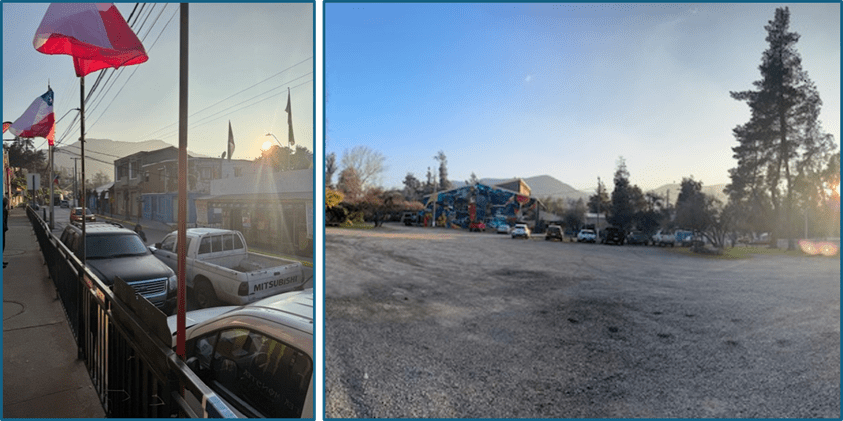
After a brief stop for refreshments in the pretty little town center, we began our ascent into the mountains.
The roads were good—at first. Plenty of hairpin bends as we traversed the steep mountainside, but the surface was smooth, luxurious blacktop. As the mist lifted, the beauty of the Andes came sharply into focus. I was surprised not to see snow on the peaks, considering it was early spring and surely it hadn’t all melted yet. The guys quickly educated me: while these hills were higher than any point in the UK, they were just that—the foothills. The real snowcapped peaks lay further beyond.
We climbed higher and higher. I took note of the hydroelectric plants we passed and the intricate network of canals channeling water between them. What an incredible feat of engineering to construct such infrastructure in this rugged terrain.
Eventually, as we passed one hydroelectric pond, the road changed from smooth blacktop to unstable gravel. Victor seemed to relish the shift, swinging the truck around the bends with a kind of joyful confidence. Only on one or two hairpin turns did I glance nervously over the edge at the sheer drop below. The earth mound barriers would stop us from going over—wouldn’t they?
By now, we’d been driving for about two hours, and the scenery had grown increasingly awe-inspiring. The promised snowcapped peaks now loomed above the foothills, and fast-flowing rivers cascaded alongside—and sometimes beneath us—via rickety wooden bridges.
Then, abruptly, the gravel “autobahn,” as Jason jokingly called it, came to an end. We were now on what could only generously be called a “goat track”—still technically a road, but riddled with so many potholes and undulations that the ride left us more shaken than the piña colada Andrew had enjoyed a couple of nights earlier.
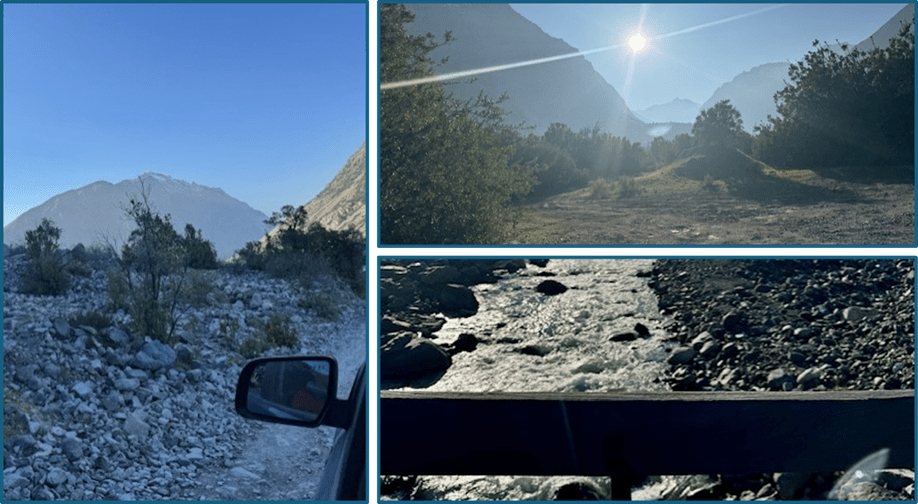
I took a video from the back seat to capture just how violent the turbulence was. When Victor and Jason saw it later, they laughed out loud. They’d driven this route many times, but I don’t think they truly realized how brutal it was until they saw it from that backseat perspective. It was, quite honestly, indescribable.
The bumpy, uneven road continued for another 45 minutes or so, shaking us to the core. We climbed ever higher, approaching—but never quite reaching—the snow line, inching closer to the sky with every turn. After crossing another perilous-looking wooden bridge spanning a raging torrent below, and navigating a few more tight hairpin bends, we finally entered “our” valley: the course of the Río Cortaderal, which we hoped would be teeming with freshwater trout.
Another mile or so along, we rounded a corner and were surprised to discover a neat, whitewashed house trimmed in green, nestled within an acre of carefully cultivated garden and flanked by a smooth gravel path. It seemed out of place. But we were told it was the local police station. Perhaps in name—but in practice, it functioned more as a mountain rescue outpost, there to assist anyone who found themselves in trouble in this remote terrain, and to enforce the fishing season schedule.
Don’t tell anyone: but we were technically there out of season—but Jason knows the officers well; he repairs their trucks—and assured us it would be fine.
I later learned that Jason had even hired one of the officers from this post to work in his factory as head of security and regulatory compliance. Apparently, many Chilean police officers are leaving the force, frustrated that the rights of criminals often seem to outweigh their authority to enforce the law.
Another mile of bone-rattling track brought us to a dead end— a massive, sturdy green steel gate, trimmed with barbed wire. It marked the end of the road for us. Jason had hoped to borrow a key from a friendly officer to gain access to the headwaters of the river, but this time, that favor was a bridge too far.
Surprisingly, the road beyond the gate leads, just a few more miles on, to Noi Puma Lodge, the centerpiece of a vast estate—many thousands of acres of high Andean wilderness—owned by a wealthy Chilean family. Despite its remoteness, the lodge is reputed to be quite luxurious. Friends of the elite make the journey there—likely by helicopter rather than the treacherous goat track—to fish the pristine headwaters.
I asked if they hunted as well—a natural pairing for a high-end lodge, at least in the U.S.—but was surprised to learn that there’s virtually nothing to hunt up here. Perhaps the odd fox, or a rabbit lower down the valley. Apart from a few guanacos—relatives of the llama—in the northern regions of Chile, there’s no large wild game like deer, and so hunting isn’t popular in this part of the Andes.
And so, the big green gate marked our final stop. We pulled over at a passing point near the gate, tucked among a copse of trees that obscured the mountain views. Climbing out of the truck—still involuntarily trembling, like sailors trying to find their land legs after a week at sea—we began unloading our bags from the truck bed.
After the long, noisy, bone-rattling ride, the sudden shift in soundscape—from engine noise to the roar of the nearby river—was striking.
A narrow dirt path wound around the gate (Puma Lodge can bar vehicles, but by law cannot stop pedestrians), and we followed it, carrying our supplies about half a mile up the track. Eventually, we reached a break in the trees where a narrow footpath branched off toward the river.
As we stepped from the shadows of the trees, it was as if someone had drawn back a curtain to reveal a breathtaking canvas—mountains, meadow, and river, all bursting with color, light, and sound. I stood in awe, surrounded by a riot of shades, the roar of the water echoing off the cliffs, the towering, snow-tipped peaks of the Andes rising high above us to the east casting us in its long shadow as the sun inched its way westwards.
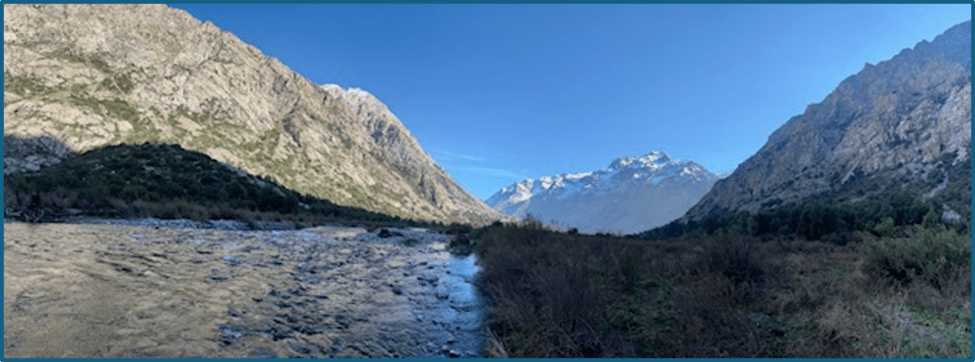
The sheer scale of it all was humbling—utterly spectacular.
I stood motionless for a while, simply taking in the raw beauty of nature. For a moment, I wondered how far away the nearest human being might be. Probably not as far as I imagined—perhaps just over the mountain in the next valley. But for all intents and purposes, the feeling of isolation, of complete aloneness, was so strong it felt as if we were the only people on the planet. The water was crystal clear, the air unbelievably pure, and the silence—apart from the gentle tumble of the river—was so profound it seemed the earth had never been touched by human hands. The goodness of this place soaked me, and I was at peace.
That is, until I snapped out of my meditation and realized Jason and Victor—our hosts—were scurrying around, busy making camp. I was soon to learn that barbecuing is almost sacred to Chileans, deeply embedded in their culture. So, even before anyone thought about casting a line, the first order of business was to build a fire.
Jolting myself back into action, I helped gather rocks for the pit and kindling for the fire. Victor, “The Grill Master” took the lead in constructing it with great care and precision. Only when it was perfectly assembled did he strike a lighter and set it ablaze. Since it would take time for the coals to reach the ideal cooking temperature, we were promptly “shooed” away and told to go fish.
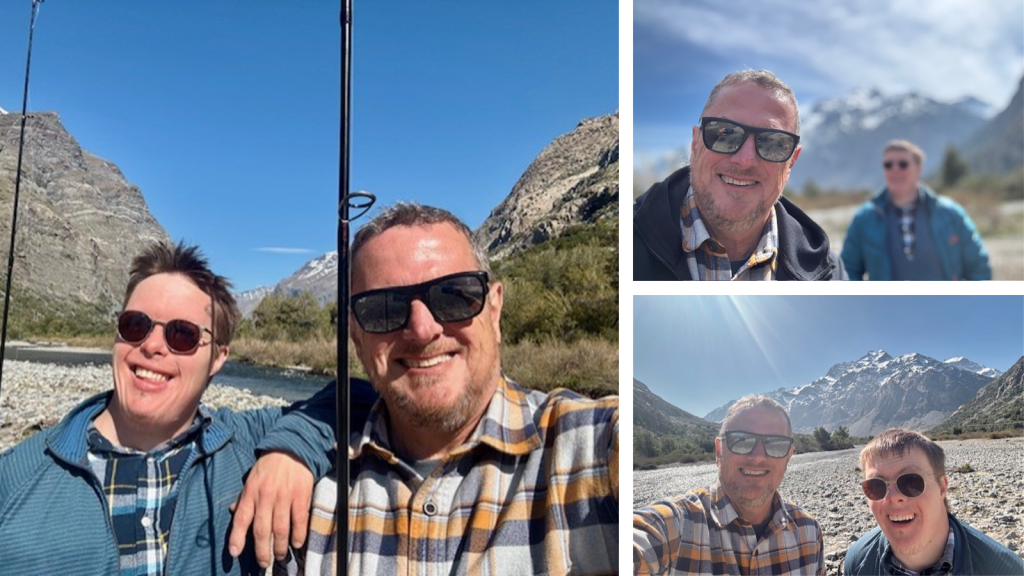
Which would have been fine—except, as I mentioned earlier, I barely know one end of a fishing rod from the other. Fortunately, Jason does and so, after he threaded two lines and attached the lures, we were ready. Although a complete novice, after a quick demonstration I at least knew which end of the rod to hold, and I headed upstream to begin casting. I decided to let Jason teach Andrew rather than hover as his dad. Jason is a patient, tolerant man, and I knew he’d need every ounce of both if Andrew was to succeed in casting his line.
I wandered no more than a hundred yards, beyond a few trees, and as the last sounds from camp faded away, I suddenly felt completely and utterly alone in these towering, remote mountains. I don’t think I’ve ever felt that isolated. Just me and—hopefully—some fat trout.
I made a few casts and, starting to feel slightly more confident, began to think: If I were a fish, where would I be hiding? Wherever they were, they certainly weren’t in the spots I was pitching my line. That’s when I realized that, of all the ingredients for a successful fishing trip, none is more important than a generous helping of patience.
After half an hour or so, I figured I should go check on Andrew. If there’s one thing my boy has, it’s patience. Patience to repeat himself until he’s understood. Patience to keep trying until he gets it right. And in this case, patience to wait for a fish.
To be honest, he was struggling. He couldn’t quite master the wrist action needed to flick the line into the stream. The lure would either fall straight down at his feet or sail over his head, tangling in the rod. My earlier assessment of Jason’s patience was spot-on. Time and again, with calm encouragement, he reset Andrew’s line and urged him to try again.
It wasn’t much longer before the call went up: the barbecue was ready for the meat. We gathered around the fire in a way that, I imagined, echoed our ancient ancestors—cooking food, basking in the warmth. We were still layered against the cold; the sun had yet to crest the easterly mountain. But the shadow line was inching its way steadily across the river.
And then, suddenly, the sun burst around the northern tip of the range, flooding the valley with golden light. The temperature soared—rising by about twenty degrees—and jackets, hats, and scarves were peeled away like the layers of an onion.
First off the barbecue came the sausages—the appetizer in Chilean barbecue culture. Just a quick snack while the main event cooked. I doubt there has ever been a better hotdog. To be fair, it had an unfair advantage: we were starving from the early start and exhilarated by the mountain air. Still—it was tasty.
As we devoured our sausages, Victor loaded up the grill with a frankly ridiculous amount of meat: special Chilean cuts of pork and beef, each prepared in a different style. We were clearly on a high-protein diet today.
Then, once again, we were shooed away to “go fish.”
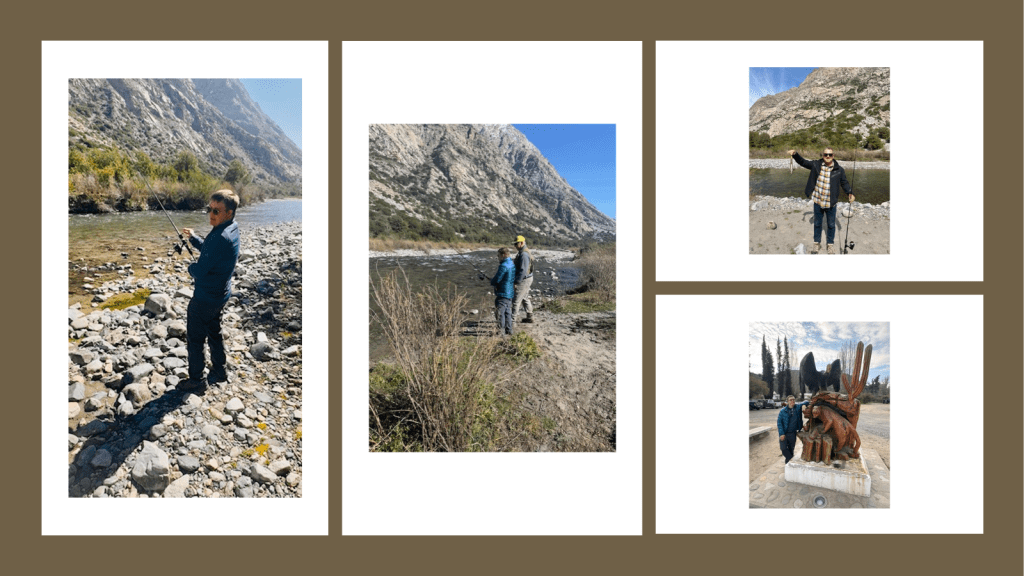
I relieved Jason of his duty, insisting that he must go fish this time. He did, and Andrew and I wandered a few hundred yards downstream to try our luck in another spot.
I made my first cast—and instantly, the line jerked. For a moment, I thought I’d snagged a rock (the cause of many of Andrew’s earlier frustrations)—until a large, golden-brown trout leapt from the water, thrashing for freedom.
I looked around. No sign of Jason—my fishing coach. I was on my own.
I reeled quickly, pulling the fighting fish toward the shore, and grabbed it securely. It was the first food I’d ever caught on my own, and I felt a rush of pride—tinged with a touch of sadness.
As a city dweller, I eat meat, of course. But the harsh reality of where it comes from rarely crosses my mind. Yet here it was, right in front of me.
I didn’t dwell on it for long. It was a beautiful fish, and Andrew was beside himself with glee—we’d finally caught one!
Andrew continued casting, his legendary patience unwavering despite his own lack of success. Like many Downs people, he can be very stubborn—unwilling to take advice or coaching, especially from me. It used to frustrate me terribly. But I’ve come to accept that people learn in different ways, and Andrew is no exception.
It was the same with fishing. I could see his frustration—but I could also see him working through it, trying to figure out his own way of casting a line that accommodated his challenges with coordination and control. And, cast by cast, he was getting better. I felt certain he’d get it eventually.
“Surely the meat must be ready by now,” I said, using that as our excuse to head back to camp. I wanted to show off my catch.
It wasn’t the biggest fish, but I was greeted with loud cheers and high-fives. I was proud of myself—even though, truthfully, there was far more luck than skill involved.
The meat, thankfully, was ready. And it was as good a barbecue as you could imagine—succulent cuts eaten by hand, straight from the grill, in that breathtaking setting. As soon as a space cleared on the grill, it was filled with more meat—an apparently endless supply.
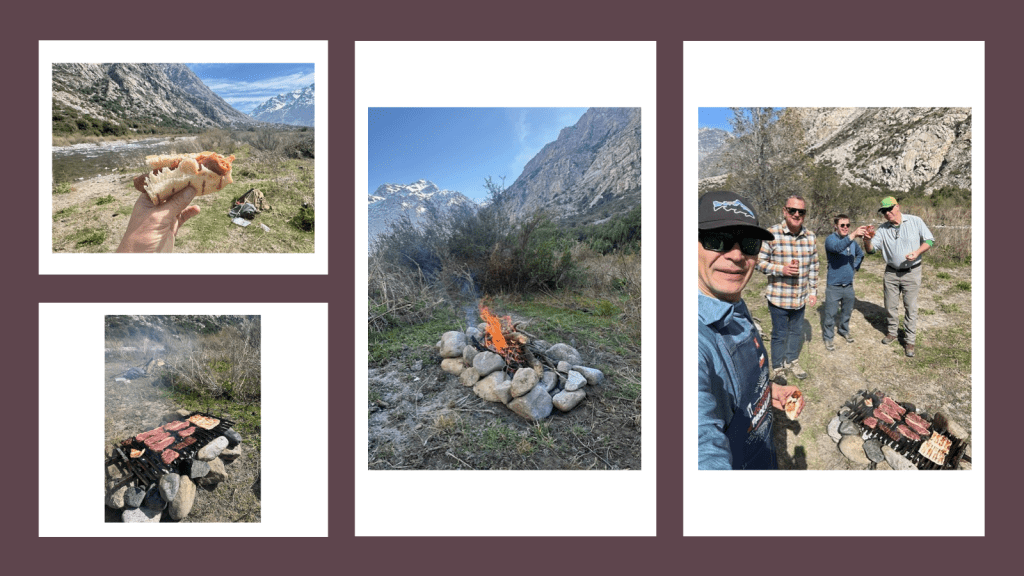
And for dessert? My trout—freshly cleaned in the river from which it came.
As we ate, Victor pointed to the sky and began an animated conversation with Jason in Spanish. I looked up but saw nothing to get excited about. Eventually, they switched to English:
Condors. Riding the thermals. Way up. Above the mountaintops.
I scanned the sky. Nothing.
“No—there!” they said. “Look closely.”
And finally, I saw them. Four tiny black dots dancing like specks of dust against the blue.
The largest flying birds in the world—wingspans over ten feet—yet flying so high as to be nearly invisible. It was another incredible sight in this remarkable country, even if there was practically nothing to see.
Later, back in town, we came across a wooden sculpture of a condor, a puma (mountain lion) and a fox, the iconic wildlife of the Andes. Andrew was dwarfed by the massive bird!
We never did finish all the barbecue. There was simply too much meat for the four of us, although we gave it our best shot.
We spent the rest of the afternoon by the riverbank. Sometimes fishing. Sometimes sitting in the shade. Sometimes chatting. But mostly in silence, watching the sun traverse the northern sky, until the shadow began to draw down the opposite side of the valley—the same side it had risen from that morning.
All the while, Andrew kept casting. He had developed his own style—unconventional, yes, but effective for the most part. I marvel at how he does that in so many things.
Given enough time and patience, he finds a way. He’s unlikely to be world-class, but his way is enough. Enough to bring joy. Enough to bring pride.
I caught four more fish, three of them released back into the river to grow a bit larger. The river is still recovering from extreme rainfall and flooding two years ago, which stripped it of its fish stocks.
I was sad that, despite casting into some of the river’s best spots, Andrew didn’t get a single bite. There’s a lot of luck in fishing. But to his credit, he kept casting—even after we’d broken camp, packed up, and were ready to head back to the truck.
Still, when it was finally time to leave, he was happy with his day. Proud that he’d figured out how to cast. I was very proud of him too. Next time there will be fish.
We retraced our path down that hilariously bumpy road, back along the gravel autobahn, and eventually onto the smooth, black tarmac—leaving the Andes behind us, glowing in the light of the setting sun.
When the book of days is written, this day, THIS DAY, will feature among the best. The kind of day you dip into to comfort your soul when the days are not so good.
We slept long and happily that night.
 What! Scotland Qualified!!!