Although the journey was, for the most part, uneventful, we arrived at our hotel utterly exhausted and collapsed straight into bed—shamefully, without even showering off the dust of the road.
We slept soundly, though surprisingly briefly, given that we were still in the same time zone. It actually took me quite a while during my earlier dealings with Chile to fully grasp that the country lies almost directly south of the eastern United States. I had always imagined it much further west. The upside of this geographical quirk, of course, is that there’s no jetlag. It’s an odd feeling. Usually, when I travel long haul, I’m heading far east or west and spend several days waking at strange hours as my body adjusts. But not this time.
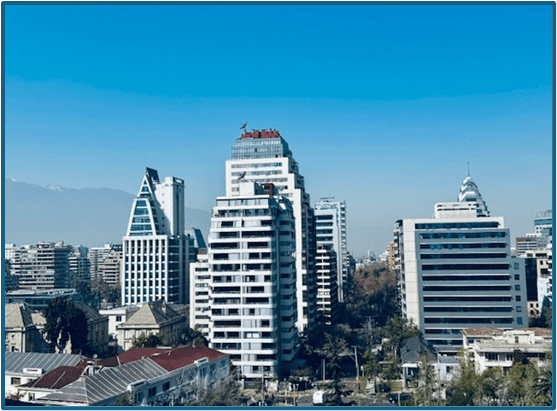
We rose early, refreshed and full of anticipation for our first day in Santiago. Throwing back the curtains, we were greeted by an unseasonably bright, warm, sunny day. The city’s high-rises sparkled against the awe-inspiring backdrop of the Andes, which, to our surprise, were far closer than expected. In Santiago, the mountains are omnipresent—you feel their presence no matter where you are in the city.
Breakfast quickly became one of the highlights of our three-day stay. The food itself was solid—typical hotel buffet fare; the setting was unforgettable, with those towering mountains always in view. Yet it wasn’t the food or scenery that made the biggest impression; it was the staff.
Over the years, I’ve developed a kind of sixth sense for spotting people who have real experience interacting with individuals like Andrew—perhaps through a close friend or family member. Juan Pablo and Sebastián were two such people. They immediately took a shine to Andrew, checking in on him every few minutes to see if he needed anything. Over the course of half an hour, they brought him no fewer than three full breakfasts: sausage, bacon and eggs; French toast; and pancakes. Even they seemed a little surprised at how much my man could put away. Eventually, I had to call a halt—because Andrew would have just kept going!
In any case, the sights weren’t going to see themselves!
Our mission—one we gladly accepted—was to visit Cerro San Cristóbal, the hill rising 800 meters above sea level, crowned by the statue of the Blessed Virgin Mary. We’d been told this was the best place to start our time in Santiago, offering the most spectacular views of the city and the Andes beyond.
We could have walked (lol—who am I kidding? Some people could… but not us!), or taken the cable car. But we chose the funicular railway. Mostly because I like saying the word funicular.
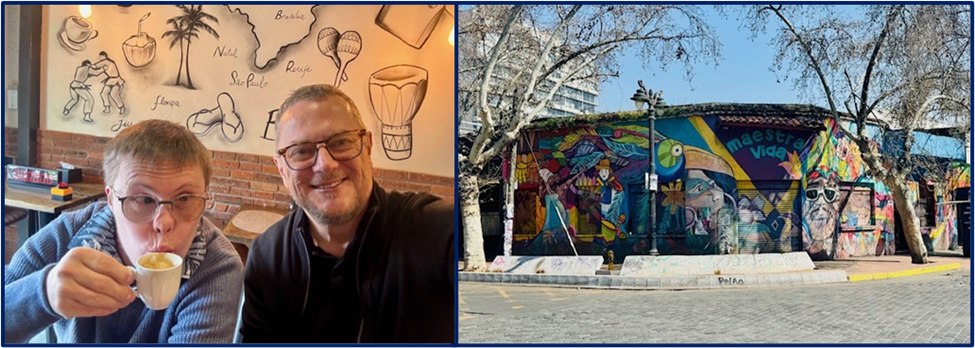
Before boarding the funiculat, we began what I hope will become a daily ritual for this trip: tracking down a proper espresso, in true Latin American style. We found a small coffee shop near the funicular station. The owner, a Brazilian-Chilean with excellent English, welcomed us warmly. We sat at the counter chatting with him about Chile, Brazil, and our visit. It was such a pleasant, unhurried way to start the day.
A silly little moment stuck with me: during our conversation, the owner poured me a glass of water and asked, “With gas or without?”
“Without,” I replied.
Then he asked me what the English word was for water with gas.
Total brain freeze. I just couldn’t think of it.
After about a minute of floundering, his nibs—sitting beside me scrolling through his phone, not even looking up—pipes up:
“Sparkling.”
We laughed. Diego, the owner, was especially kind to Andrew.
Soon after, we made our way to the funicular station. I took a moment to consider the thin steel cable that was about to haul us up the mountainside. 2025 marks the funicular’s 100th anniversary and, as far as I know, there’s never been an accident. Why would today be the day? Shaking off the thought—and shaking my head again, knowing full well Elaine wouldn’t have come within a mile of the thing—we stepped aboard. The gate slammed shut, and off we went.
As with the thousands of rides before ours, it was uneventful—though perhaps less terrifying than expected. That is, until the final 100 yards, where the incline went near vertical and gave me a moment’s pause. The highlight, though, was the enthusiastic whooping and hollering exchanged with the passengers of the other funicular as it passed us on the way down.
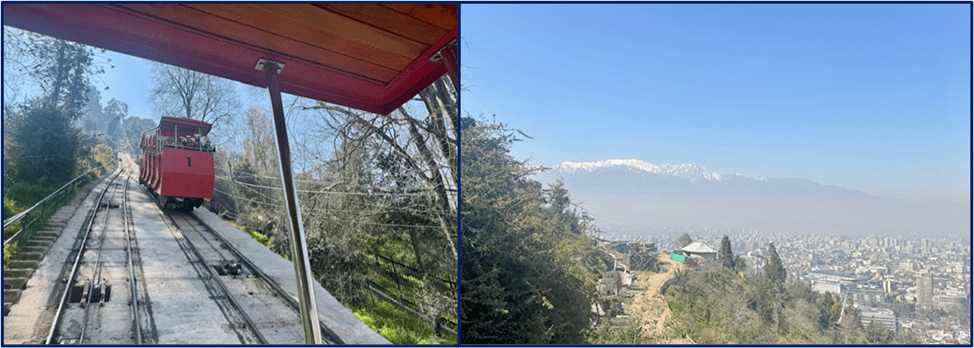
The reward at the top was more than worth it. We emerged onto a high terrace with seemingly infinite views stretching across the city and out to the mountains beyond. It was spectacular. Until that moment, I hadn’t realized just how vast Santiago is—it sprawls endlessly in all directions.
My only sadness? At that altitude, we were above the red-brown haze of pollution that blankets the city. You don’t notice it when you’re in it, but from up here, it was glaringly visible. It makes you wonder about the long-term health effects on the people who live under it every day.
Once we emerged from our initial awe at the view, we turned to see that while the funicular had brought us most of the way up, we were still only about two-thirds of the way to the summit. Were we really going to climb all those steps?
Of course we were.
It took us a while—and several breath-catching stops—but we made it. It’s one of life’s mysteries as you get older. Just recently, I cycled 437 miles across Iowa in 100°F heat without much distress. A few hundred steps up a hillside and I was completely winded.
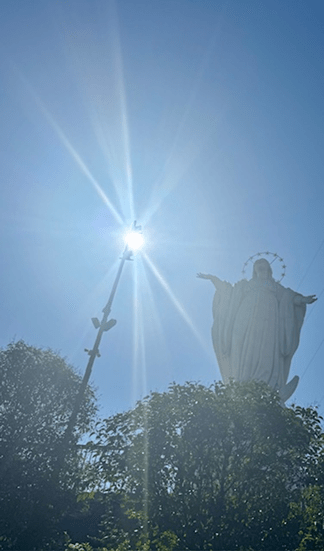
I felt truly blessed when we finally reached the feet of the Blessed Virgin. We sat there in her shade for half an hour, resting and soaking in the stunning panorama of the city below and the mountains beyond.
Then it was time to descend to start the descent back into the city—sadly, beneath that ever-present blanket of smog.
For a good ten minutes, I struggled—unsuccessfully—to operate the funicular ticket machine, unable to locate the ticket office. I laughed at my own incompetence when someone finally pointed out that the (admittedly small) office was directly behind the machine. Hidden in plain sight! Tickets in hand, we eventually made our way back down on the funicular.
ChatGPT—an amazing, if troubling, tool—had created our three-day itinerary in Santiago and recommended a typical Chilean taverna for lunch. We were hopeful it might finally be the place where we’d find that elusive chili we’d been searching for.
Unfortunately, we never managed to locate the taverna. Instead, we found ourselves in the middle of a large city-center shopping mall. Oddly, it felt both entirely familiar and strangely foreign at the same time. Many of the shops were recognizable, the energy and bustle very much like any mall back home—but of course, everything was infused with Chilean culture. I found myself intrigued by every little shop and side stall. What’s ordinary to the locals was fascinating and new to me.
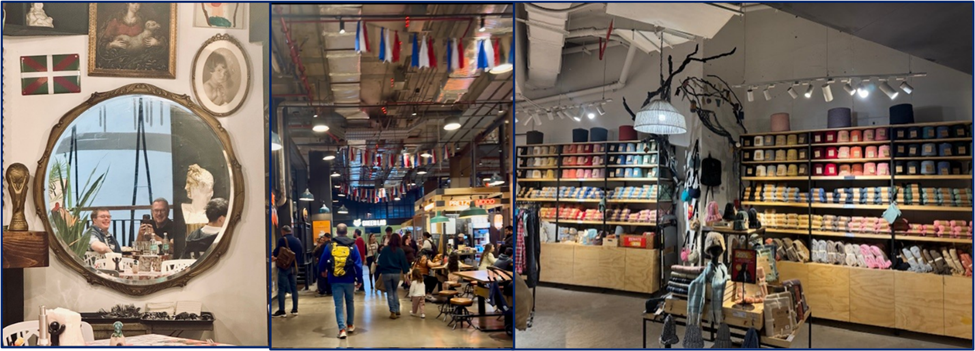
We even found a wool shop for Elaine. She asked me to bring her some. But I know my limits!
I kept especially close to Andrew in the crowd—I’m terrified of losing him in such busy places!
Though the ChatGPT-recommended taverna remained out of reach, we eventually ended up in the basement of the mall, in a bustling Chilean restaurant clearly popular with locals. Not a word of English was spoken—perfect. With the help of Google Translate (a miracle of modern technology that deserves its own story), we studied the Spanish menu and placed our order with the Spanish-speaking server.
It turned out to be a thoroughly enjoyable experience—being so completely immersed in the ordinary, everyday life of the wonderful people of Santiago.
Tired from all our exertions—and with so much already accomplished in just our first half-day in Chile—we made our way back to the hotel for a well-earned nap. Thankfully, I’d set an alarm for 6:00 PM; otherwise, I could easily have slept straight through until morning.
I had splurged on our hotel, booking the W Marriott for our first few nights in Chile. It was far more upscale than anything I’d typically choose in the U.S., but given that we were alone and so far from home, I wanted to be sure of high-quality service until we found our bearings. The W did not disappoint. The staff were exceptionally attentive, and the facilities were top-notch—not least of all the rooftop bar, where we headed to catch the sunset.
While the sun itself, setting behind the hotel to the west, wasn’t directly visible, what was visible was a kaleidoscope of colors projected onto the canvas of the Andes as the light faded. It was breathtaking. I sipped my glass of Malbec while Andrew enjoyed his usual vacation cocktail of choice: a piña colada. The boy is pure lush!
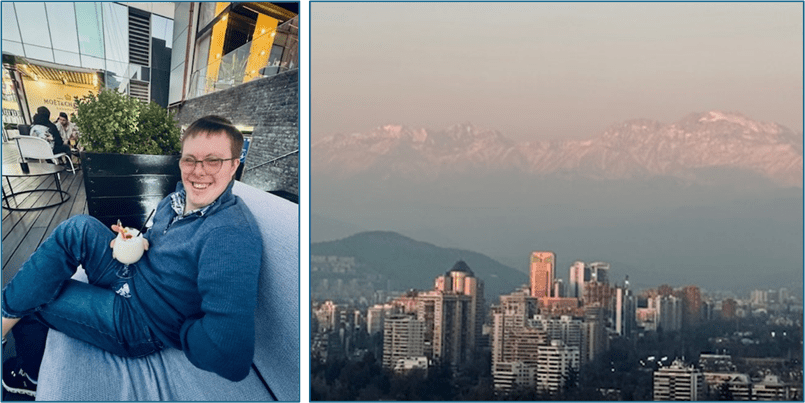
Looking for a simple, traditional Chilean meal, we took the concierge’s recommendation and booked a table at Pinpilinpausha—not a Spanish word, but Basque for “butterfly,” I was intrigued to learn. The restaurant was a cozy little spot just a few blocks from the hotel, with a quiet yet energetic ambiance.
I ordered the sea bass, but was slightly dismayed when the waiter returned shortly after to say they were out. However, he assured me they could prepare the exact same dish using conger. Conger? The massive eel from South American rivers? That conger? My stomach turned at the thought. But the waiter was insistent, even calling it his favorite “fish.” I wasn’t convinced, but overcome by a desire to immerse myself in Chilean culture—and willing to overlook any digestive risk—I agreed to try it.
I’m happy to report that the conger was every bit as good as promised. A white, flaky fish with a robust flavor—nothing like the slimy, oily, bony eel I’ve sampled in other parts of the world.
We left the restaurant tired, full, and content with our first day in Santiago. A good omen, I hope, for the rest of the trip. We would sleep well tonight.
Still, the absence of any hint of chili—not the spice, nor the dish—was ominous. It seems the quest to eat chili in Chile when it’s chilly may prove more difficult than I had anticipated!
 What! Scotland Qualified!!!