Six days on: the same hotel, same breakfast, same server, same Uber—different driver—to the same station. The songs of the same Tartan Army echoed through the cavernous atrium. Different opposition colours, of course—Haitian blue replaced by Moroccan red—but singing the same songs of encouragement for their team. The same train to the same station, Foxboro, and the same statue of Tom Brady, sadly, still cone-less.
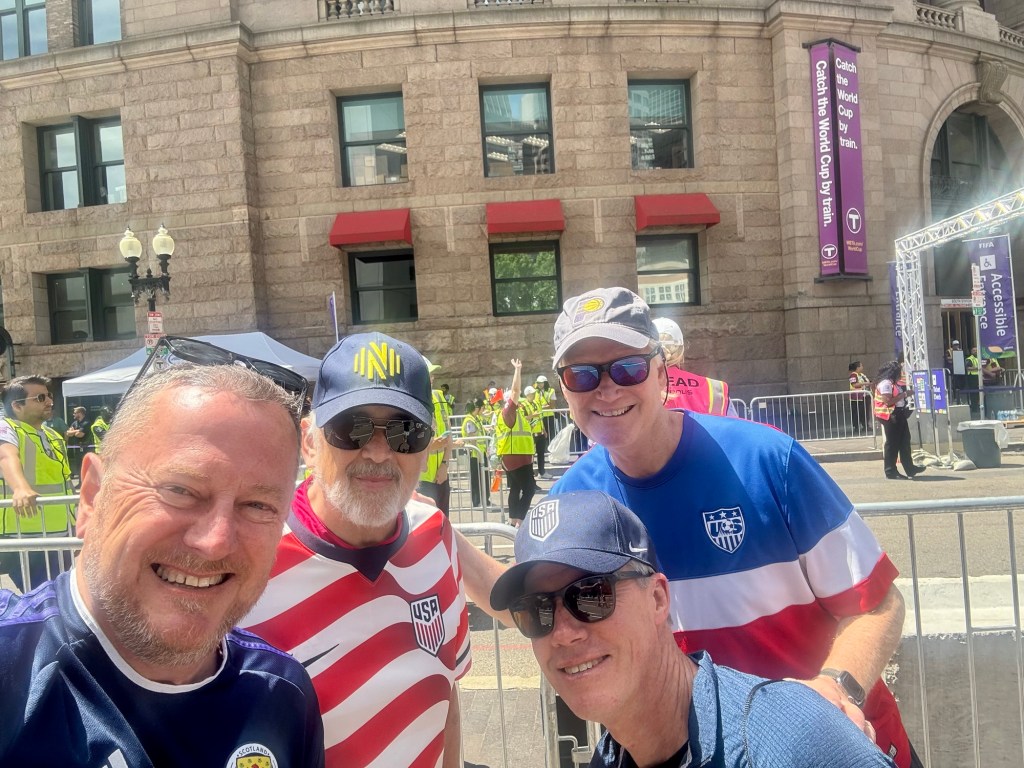
But here the day deviated just a little.
Whereas six days ago we took the last train for the late kick-off, this time we took one of the first in order to reach the stadium in time for USA v Australia, starting in an hour. No anxious fans storming the gates at the last minute, desperately trying to reach their seats before the game like last week. Instead, a more leisurely stroll across the stadium’s vast parking lot to Patriot Place, an area which had passed us by on our previous visit in our rush to get seated. Retail nirvana. A Disneyworld-esque complex encircling the stadium with the sole objective of relieving you of your money.
Passing Victoria’s Secret, I contemplated who buys lingerie at a sporting event.
I also contemplated how, despite arriving on one of the early trains, the Tartan Army had already occupied the Place. The takeover had begun, with Scots filling the open spaces, beer flowing, pipes playing and songs singing. Brig O’ Doon in the 21st century.
This was unexpected and threw a wrinkle into things.
We got there early, thinking we’d have our pick of spots in front of a sizeable screen, settled into a comfortable chair with a cold beer to watch the USA game. Instead, queues for the bars and restaurants were already over an hour long.
With a hint of panic that we’d miss the game, we scattered to search for a place—any place—in the Place.
Erik struck gold. The Scorpion Bar couldn’t seat us for an hour, but they did have standing room in the bar in front of a suitably large screen while we waited.
As we took our spot, right on cue, the place, now packed with the Tartan Army, came alive as we all sang along to Sweet Caroline.
Result!
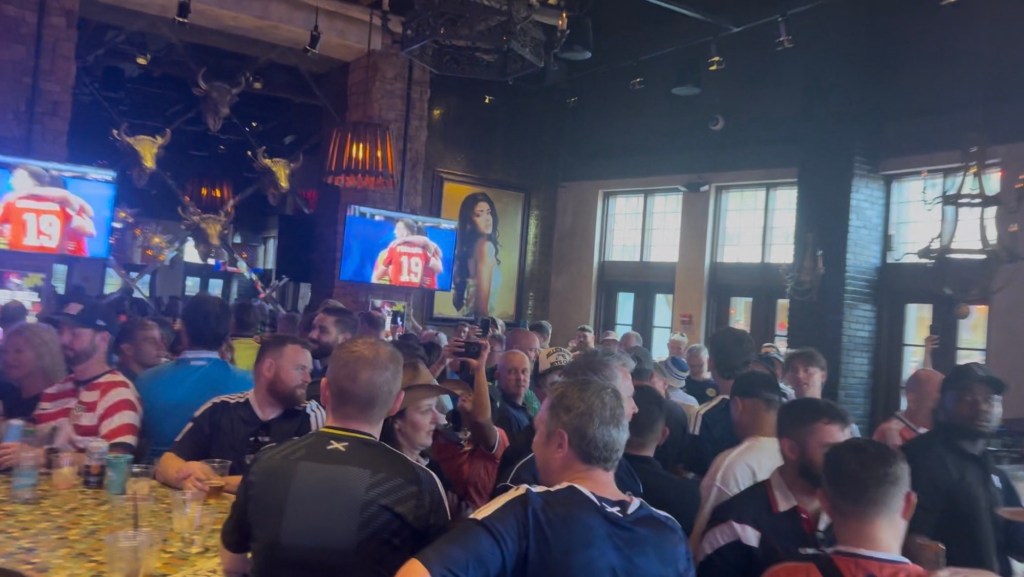
And as I turned around to join the chorus, right beside me was Jamie Garrett.
I knew he was a fanatical member of the Tartan Army and assumed he would be there, but what chance, in the melee of Patriot Place, of him standing right beside me?
It’s 50 years since I last saw Jamie.
We played rugby together at Belmont Academy. We even won the county trophy together. I keep a copy of the now-browning clipping from that day in a box of treasures at home, Jamie and I in pride of place in the team photo.
We reminisced about that photo, Jamie saying wistfully that it felt like only five minutes ago.
I agreed.
But 50 years is a very long time, with very different paths travelled, and our conversation was awkward. After a few minutes we wished each other well and moved on.
I regretted not doubling up on my football shirts and wearing my USA jersey on top of my Scotland one.
But today I feared it would be too hot for more than one shirt, so I went solo with Scotland.
Embarrassingly, my friends proudly wore USA with Scotland tucked beneath.
Right on time, one hour after we arrived, just as the game started, Scorpion seated us for lunch. Annoyingly, it was at a table right beside us that had sat vacant—with a “Reserved” sign on it—the entire time we’d been standing.
As the restaurant required us to leave after 90 minutes, we stayed only until half-time to make sure we could get inside the stadium in time for the second forty five
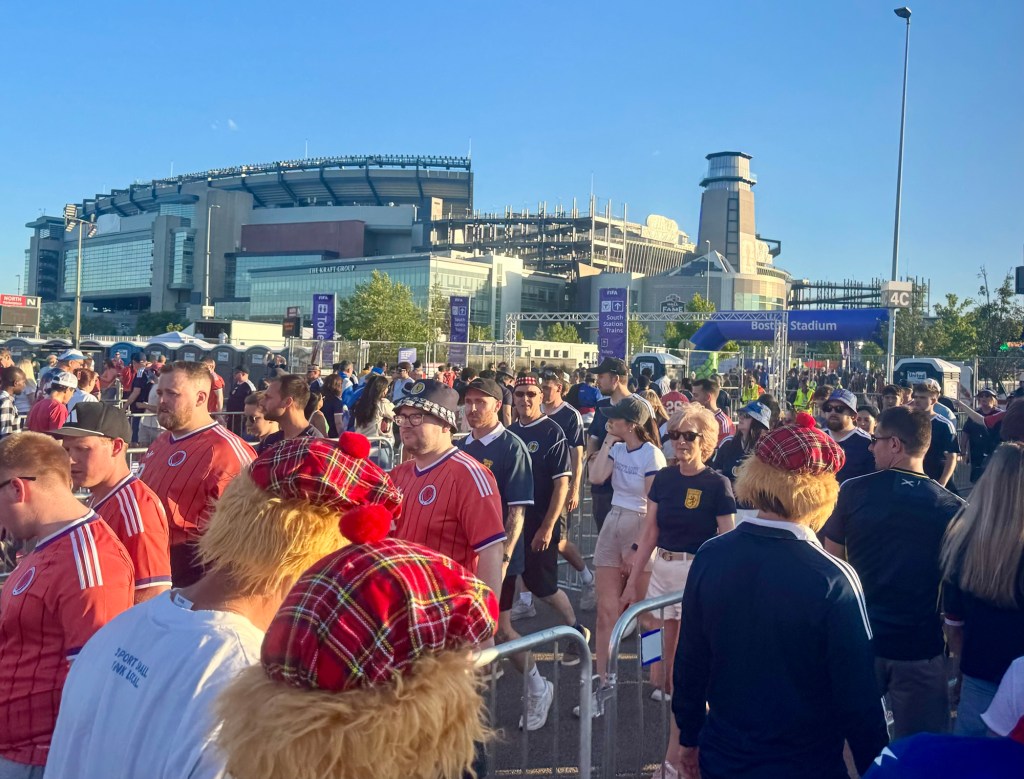
The New England Patriots play at Gillette Stadium. But FIFA controls all branding associated with the World Cup, and so today’s game was at Boston Stadium with the Gillette signage covered by large plastic tarps.
To be honest, the whole branding thing got a little silly when we reached our seats and discovered that the little Gillette logo moulded into each chair had been covered by a small piece of tape.
All 61,000-odd of them.
Who had that massive, monotonous task?
Annoyingly, for reasons unknown, FIFA was not showing USA v Australia on the huge stadium screen, so we had to satisfy ourselves by watching from the very back row of our section on a small TV, with the growing hustle and bustle of the pre-match festivities—including a phalanx of pipers—going on behind us.
USA won 2–0.
An impressive, professional, well-controlled performance.
Pochettino has the team well motivated, well organised and well drilled, and is proving what many of us long suspected—that this squad has potential when he can field his A-team.
Of course, with apologies to those countries, they’ve “only” beaten Paraguay and Australia. But you can only play the team in front of you, and if it’s a smaller footballing nation, it’s essential that you beat them convincingly.
I was convinced.
Would that Scotland could accomplish the same feat.
With that victory, and Turkey’s defeat, the USA has now won the group and, as winners, they will have an easier opponent in the Round of 32.
I fancy the USA to reach the quarter-final, where I believe there is a scenario in which they could play England in Philadelphia on or around July 4th.
It’s almost like FIFA planned it.
Or is that too cynical?
And so to the main event!
Our seats could not have been better. Row three, right by the corner flag, with McTominay, McGinn, Robertson and the rest warming up right in front of me.
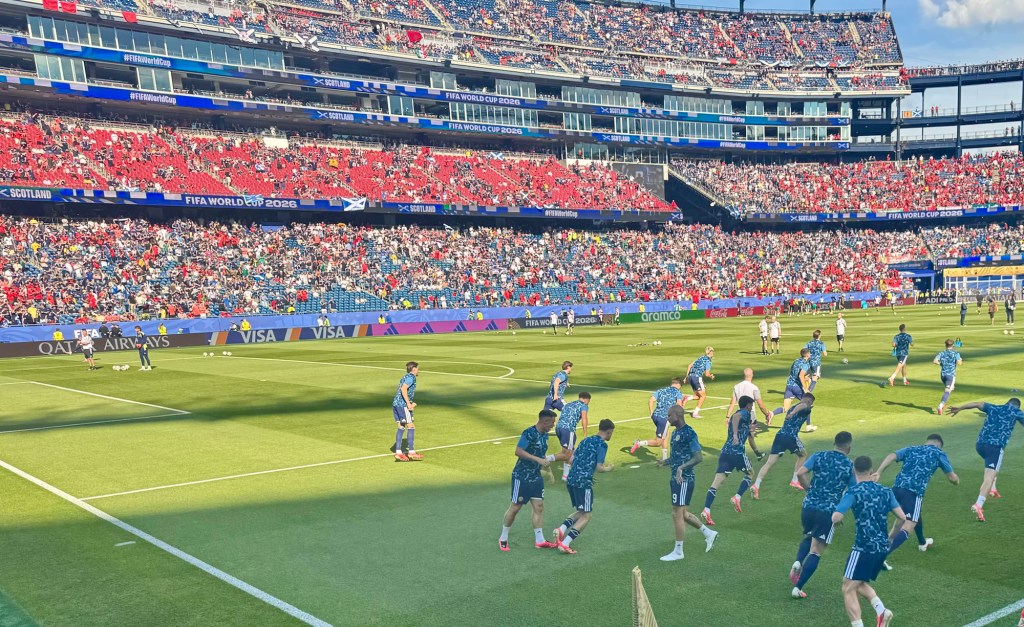
I’m afraid my friends got to see James amongst his ain folk, in his natural habitat, bawling out all the Scottish hits at the top of his lungs. Loch Lomond was clearly the crowd’s favourite, as, annoyingly, they still haven’t managed to play Flower of Scotland in a key suitable for your typical Scotsman.
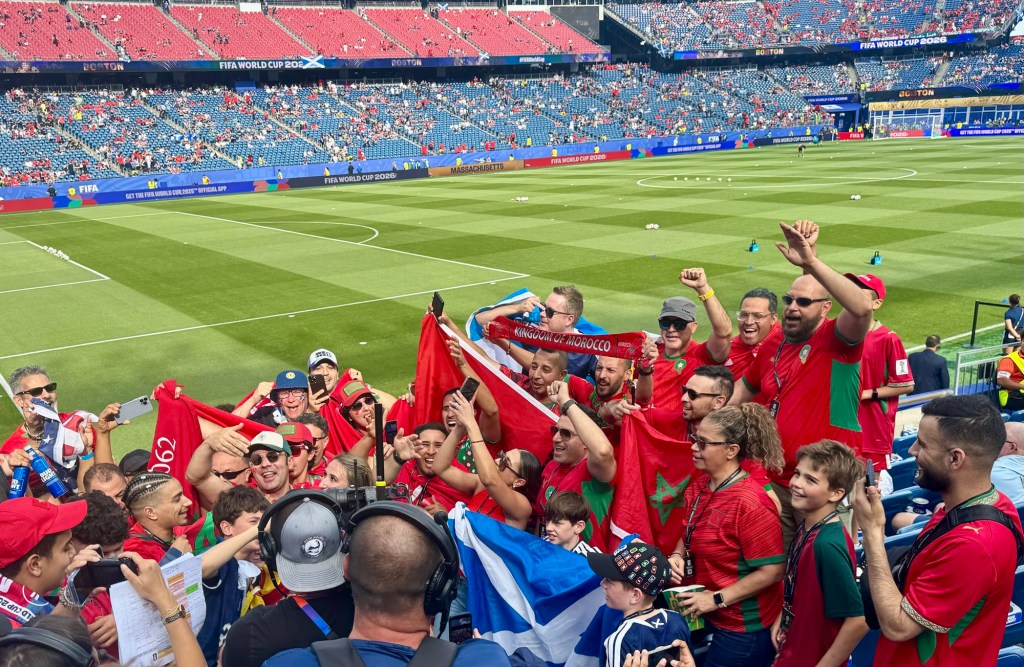
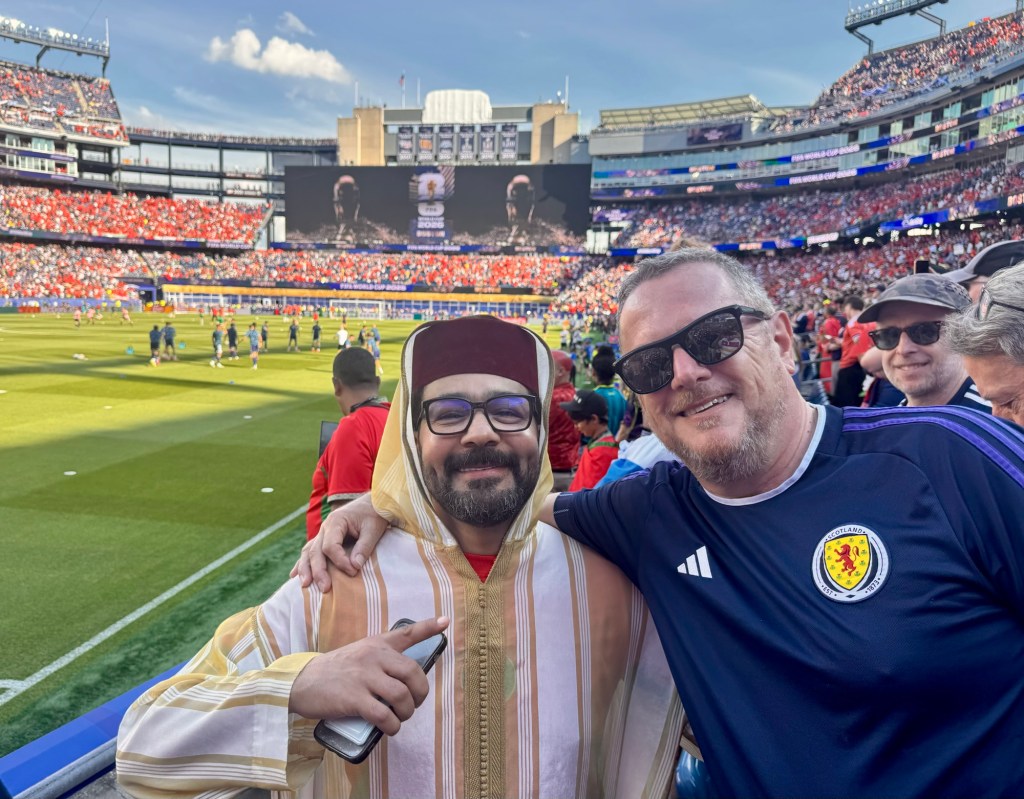
Like last week, my random FIFA tickets had placed us amongst both Scots and Moroccans. The main battalion of the Army, as the home team this week, was now clad in traditional blue behind the goal to our left.
The Moroccans around us were lively and noisy, exuding the confidence that comes from reaching the semi-finals last time and being the current, if controversial, African champions. Apparently they fancied their chances against us.
But after all that singing we were fired up, ready to go, screaming Scotland on and certain of victory—at least for the first minute or so.
For inexplicably, Scotland’s defence was still back in the changing room and decided they couldn’t be bothered covering Saibari as he bolted unmarked onto a through ball and, from an impressively acute angle, spanked it into the roof of the net right in front of us.
Well, let me tell you, that shut us up.
Could Scotland have started any worse?
No.
I was fearful that sucker punch would leave us wobbling and vulnerable to conceding more. But somehow Scotland, looking very nervous, stood up to the onslaught and, as the game progressed, grew into it.
I’m not entirely sure what the right word is, but it was, at the very least, unsettling to see Morocco’s right back and captain, Achraf Hakimi, take the field when a French court has ruled that there is sufficient evidence for him to stand trial on charges of rape.
Hakimi maintains his innocence and is entitled to the presumption of innocence unless and until proven guilty. Nevertheless, I believe Morocco were wrong to select him while such serious charges remain unresolved. Some things are more important than the game.
The Tartan Army clearly shared that view, voicing its feelings with loud boos every time Hakimi touched the ball.
I’ve been highly critical of the hydration break but on this occasion I welcomed it as an opportunity for Scotland to reset.
We were the better team in the second half and were unlucky not to be awarded two penalties.
I try not to criticise referees. It’s a tough job and, if you listen to the fans, they treat both teams unfairly. But on this occasion, I didn’t think the Uzbek referee, coming from a smaller league, was up to the task of a major World Cup match.
At the very least, he had a much more lenient interpretation of the rules than, say, Premier League referees. Something which, to be honest, I would welcome, as in the modern game it’s becoming almost impossible for players to compete for the ball without being yellow-carded.
Still, if we’d known ahead of time that this guy allowed stronger tackles, we might have gone in harder from the start.
But there it was: overall, a good performance, albeit a disappointing result.
We’re not the best team in the tournament and have no great expectations. Clarke gets a lot of criticism for his negative tactics, but I like how he sets up the team with the resources and players he has.
Bringing Dykes and Gannon-Doak into the game was timely and effective. We looked a more potent threat with them on the field and Moroccan legs beginning to tire. We could easily have snatched the priceless point we needed to progress from the group stage for the first time in our history.
I always thought Morocco would be the toughest game in the group and I was pleased we put up a good show against a very good side.
They could go all the way this time and, as I’d dearly love to see Africa win the World Cup, I bought a Moroccan shirt on the assumption that I’ll have many more games to wear it.
Scotland aren’t out of it yet.
A point—or even three—against Brazil next Wednesday, while unlikely, is not unimaginable.
And as the third-place table starts to take shape, those three points against Haiti may yet be enough to see us through.
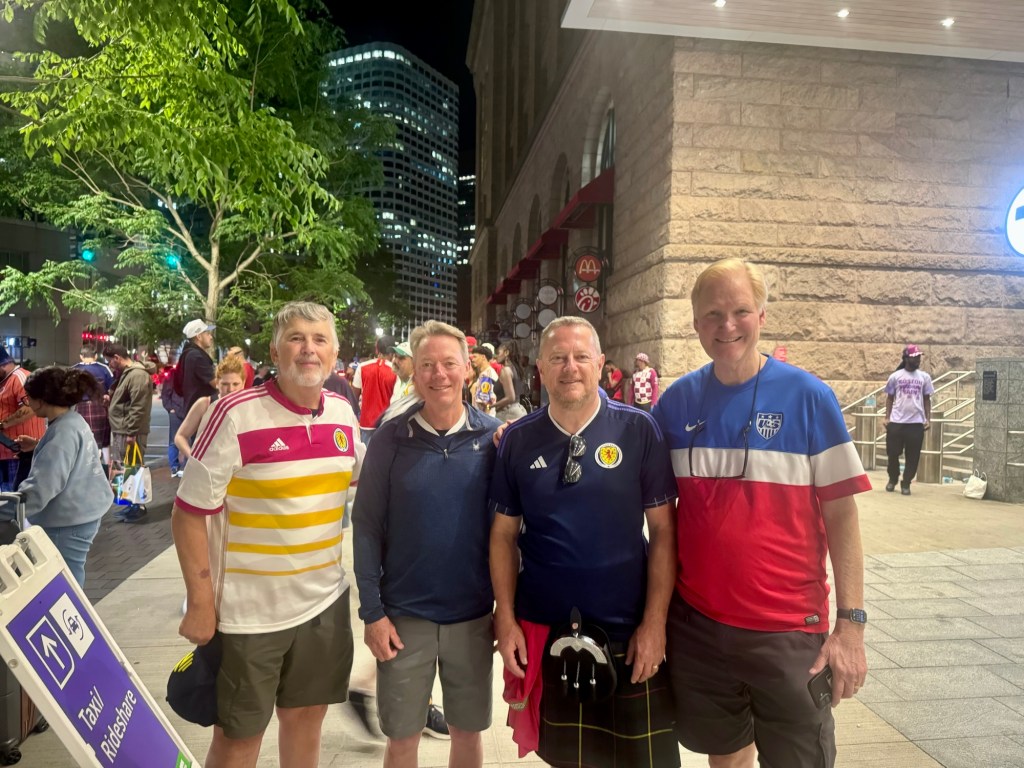
As we slipped back into Groundhog Day—standing in the same line, to catch the same train, through the same countryside to the same stations, and the same Uber back to the same hotel—I talked to some of the Army.
We’re hoping for one particular scenario, one of many at this stage but certainly among the more likely: a Round of 32 match against Germany.
Back here in Boston.
I like to think the good people of the city would welcome the Tartan Army back with open arms.

 What! Scotland Qualified!!!