A cocktail of emotions hung over Panda Camp that morning, casting a subdued mood as we went through our usual pre-ride rituals in the dim, grey predawn light. There was sadness—this was our final morning, and RAGBRAI would soon come to an end. Goodbyes were already being exchanged, many between friends who had barely started to know each other.
Mixed in was a quiet apprehension. This was one of the challenging days that had stood out when we first saw the route map back in April. Though only 62.5 miles from Oelwein to Guttenberg—where we had camped by the Mississippi just a week ago—the final stretch loomed large. The last twelve miles featured hills that, compared to the rolling terrain we’d faced all week, looked grueling on the way up and downright terrifying on the way down. The steep descents, already intimidating, were likely to be made even more treacherous by the heavy rain in the forecast.
No, these weren’t Tour de France, red polka dot jersey, King of the Mountain hills. And, we knew we’d make it up one way or another, and, God willing, back down safely. But after more than 400 miles, the idea of having to get off and push? That would feel like defeat. It would be—yes—sad. Sad is the right word.
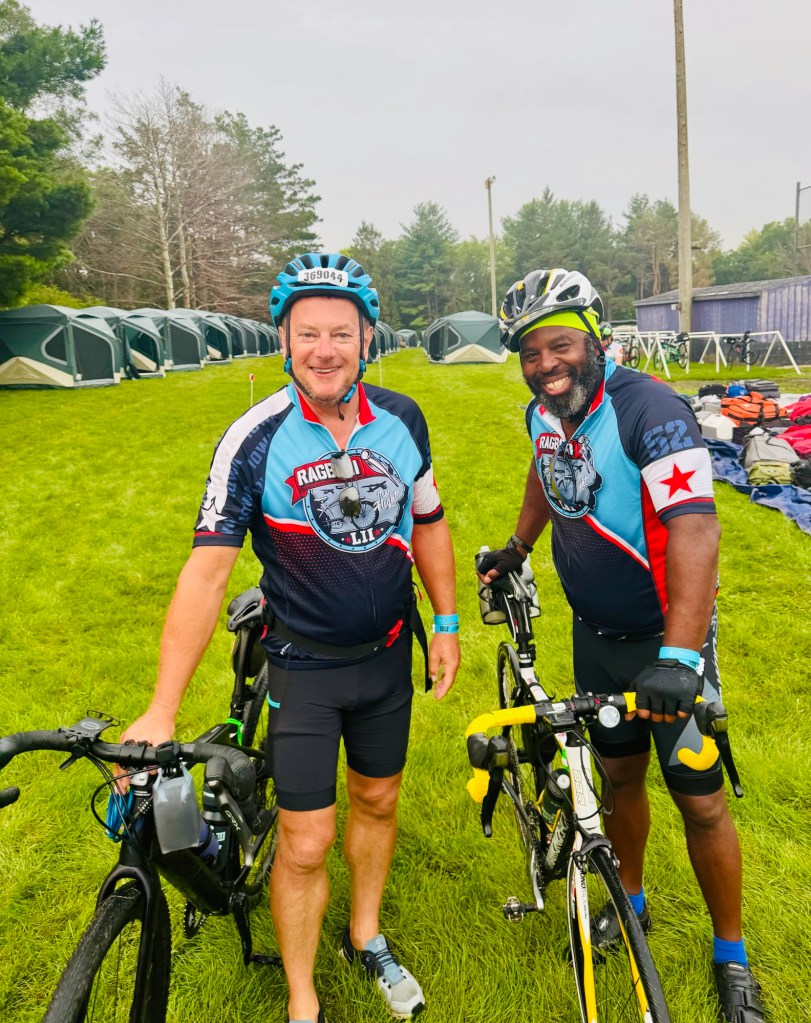
And so, as the promised rain began to fall, we cast one final backward glance at Panda Camp, whispered our farewells, and plunged—wheels first—one last time into the familiar river of bicycles flowing east.
Apart from the rain, which grew steadily heavier with each passing mile, the morning ride was routine and pleasant. The only real disappointment was having to do without our favorite food vendors—Coffee and Nosh, and Mr. Porkchop among them—as they, like many others, had opted out of the final day. Most riders were on tight schedules, hurrying to meet rides to the airport or to return to their vehicles at the starting line, with little time to stop for sustenance.
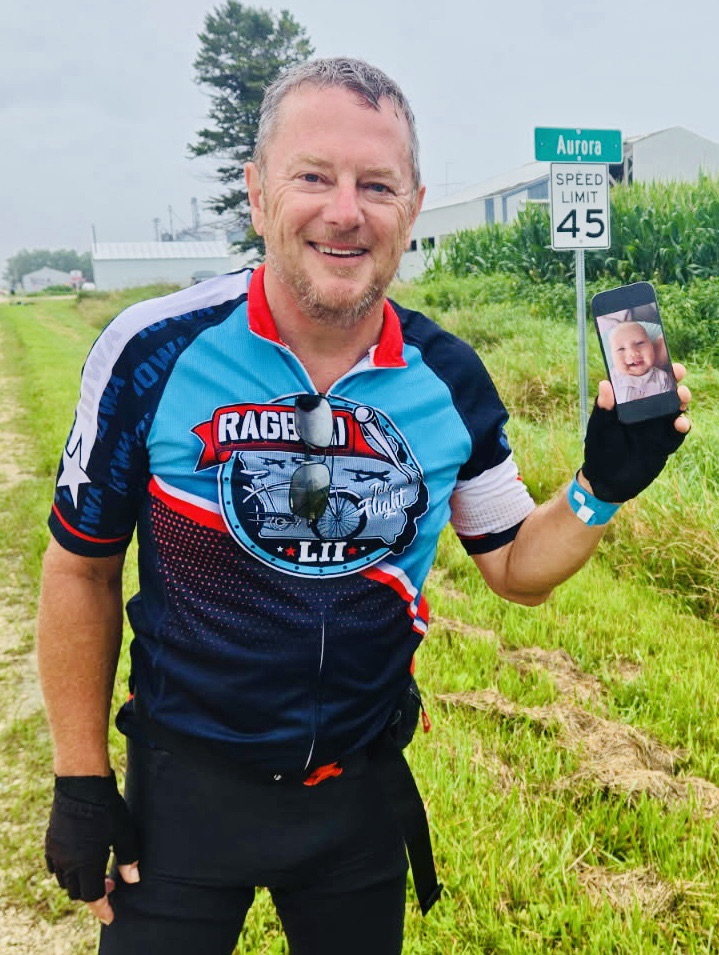
We made a few brief stops for photo opportunities in the small pass-through towns that had become familiar by now—each one swelling with visitors and offering its own enthusiastic welcome. Aurora stood out, of course, sharing its name with my two-month-old granddaughter. As we pulled in, we waited a few moments while a young couple posed for a similar photo.
“Which Aurora do you know?” I asked.
“My niece,” the man replied. “She’s two. Lives in Poland—of all places.”
We took our own photo: a smiling shot of Aurora beneath the town sign bearing her name, a cheerful image that brightened an otherwise grey, rainy day.
I paused again in Dundee, Iowa—population 178 (at least when the RAGBRAI circus isn’t passing through). It reminded me of Dundee, Scotland—if only in name. That Dundee is the fourth largest city in Scotland, with a population of 150,000. As we rolled in, a man stood in the middle of Main Street handing out commemorative stickers. Naturally, he picked up on my accent, and yet another “Scotland” conversation followed. You’d think I’d tire of it—but I don’t. Scotland will always be home, and I’m always happy to talk about it.
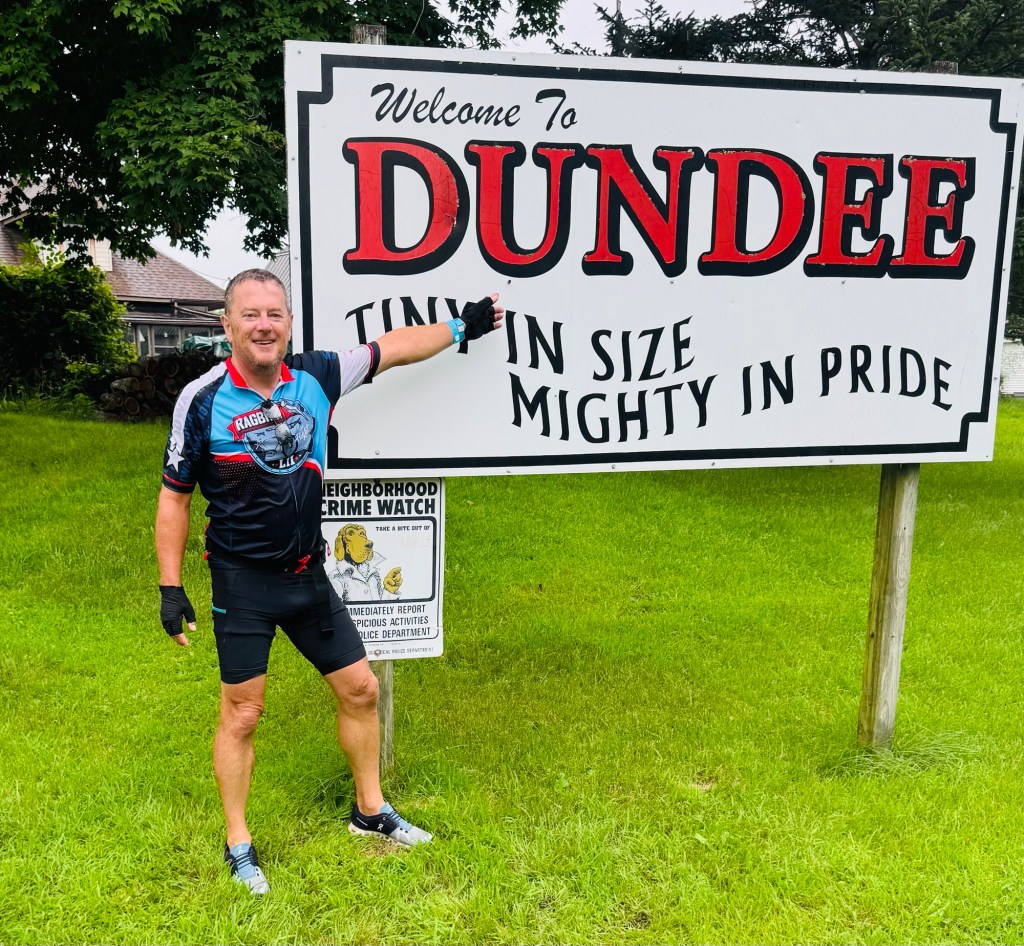
It always makes me smile to come across these little places in America with names that echo the familiar corners of back home. Elaine has a theory about towns like Dundee. She imagines a family in a covered wagon, heading west a couple of centuries ago in search of a better life. At some point, Elaine says, the wife had simply had enough and snapped!
“No further,” she declared. “You and your go-west-young-man nonsense,” she shouted at her husband as another cartwheel broke, the children cried, and the food ran low. “We’re stopping here,” she said, and staked her claim with the name of the town they’d left behind.
And that, according to Elaine, is how Dundee, Iowa came to be.
Happily, one vendor still trailing the RAGBRAI caravan was the roving beer garden, which we found again just east of Dundee. Despite the rain—by now nothing short of torrential—we had to have one for the road. And, of course, magically, we instantly ran into the rest of the Panda Select crew.
Owing to tight schedules and the relentless downpour, the beer garden was quieter than usual. Only a few hardy souls lingered, huddled together beneath the sun canopies which, today, served better as makeshift umbrellas.
Stupidly,—for some unknown reason— unlike all the other days, I hadn’t packed a poncho in my saddle bag. But, in any case, to wear one would have been frowned upon by all the other cyclists. Rain doesn’t bother cyclists—we simply get wet. And wet we got. Soaked, through and through. I couldn’t help but laugh as we pushed off once more into the river of riders—now almost a literal river. It was impossible to get any wetter.
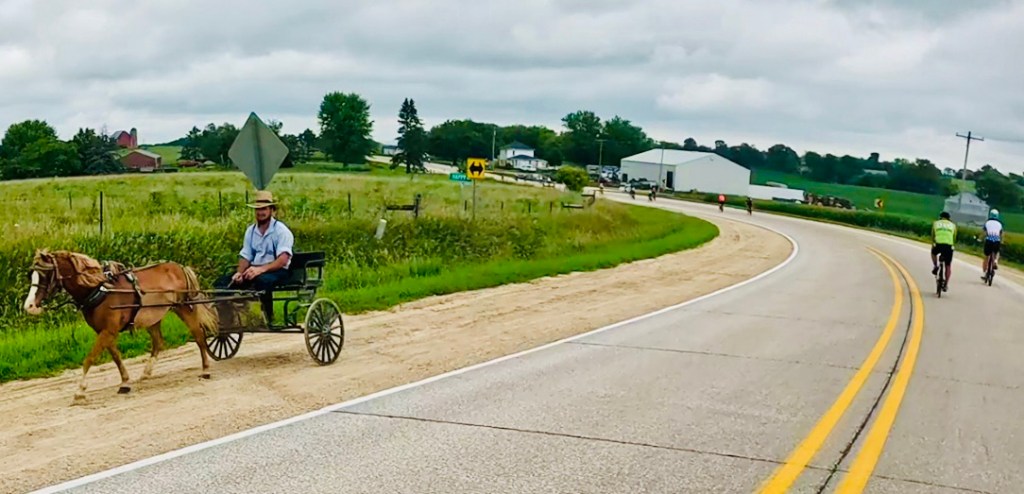
Pushing ever further eastward, inching closer to the hills that still lingered—quietly but persistently—in the back of my mind, I was surprised to see that the roadside stalls lining the route, which had been a constant since Orange City, were now staffed by members of the Amish community. Clad in their plain, traditional clothing, the Amish stood in stark contrast to the more modern, sometimes flamboyant style of vendors we’d encountered earlier in the week. I hadn’t realized Iowa was home to such a large Amish population.
Instead of the usual warning calls of “car up,” riders ahead were now calling out “buggy up,” a subtle but unmistakable reminder that we had entered a different kind of world.
I always feel a bit awkward in the presence of the Amish. It’s like walking through a living museum—witnessing artifacts from another time. To me, it’s incredible—and a remarkable endorsement of the Amish way of life—that their culture has endured in such numbers in the modern world. But there’s a strange discomfort in looking too long, a worry that to observe might feel like intrusion. As much as I wanted to, I didn’t stop. And I regret that. Because even from a distance, it was clear that these Amish families, in their own quiet, self-contained way, were just as eager as anyone we’d met all week to welcome us into their corner of Iowa.
We paused for a short lunch in Edgewood, the designated meeting town for the day, before continuing on to Garber—the final small stop before the much-anticipated and worrisome hills. Our strategy was to take a good rest there and hydrate thoroughly before attempting the first major ascent.
The descent into Garber offered an ominous preview of what lay ahead. At the bottom of the hill, near a crossroads just a mile or so before the town, law enforcement officers were waving frantically and shouting at riders to slow down. Moments later, an ambulance roared past, heading back up the hill in the opposite direction, lights flashing urgently.
We later learned it was responding to a cyclist who had fallen and suffered a shoulder injury. Fortunately, it turned out to be a relatively minor accident—but it was a stark reminder that the final stretch would demand focus, caution, and respect for the road.
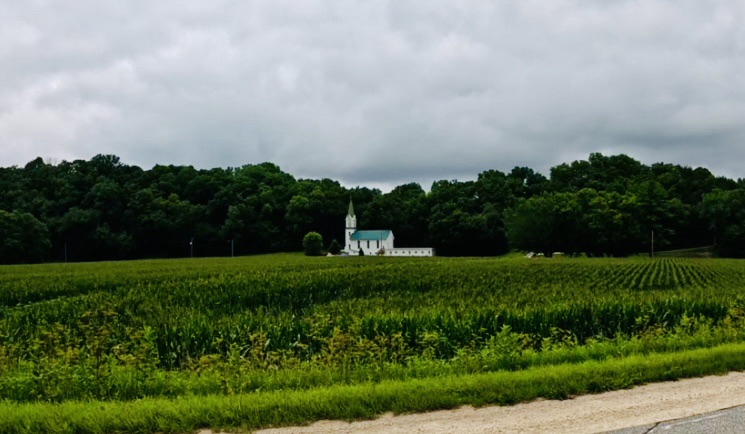
Remounting our bikes, we continued on our way—but our strategy quickly unraveled. Garber turned out to be so small that we barely noticed we had passed through it. I was too busy admiring the town’s charming church, tucked away in a small grove beyond a cornfield, to realize we were already there. We zipped past the vendors and entertainment—which, unexpectedly, were set up on the opposite side of the road—and before we knew it, we were already partway up the first of the big hills.
There was no chance I was turning around to go back for refreshments.
In hindsight, it was a lucky distraction. Had we stopped in Garber, we might have spent unnecessary time anxiously dwelling on the climb ahead. Instead, after briefly conferring with fellow riders to confirm where we were, we realized we were already halfway up that first ascent.
And to be honest—it was a doozy.
Yes, it was steep. Far steeper than anything we’d encountered during the week. But for me, the real challenge wasn’t the gradient—it was the length. The road twisted through a series of tight, winding curves, each one deceptively suggesting the summit was just around the corner, only for another bend to stretch the journey further.
My thighs began to burn, and the persistent twinge in my right hamstring—something that had nagged me all week—now felt like it might snap under the strain. I wasn’t alone. The river of cyclists that had flowed so freely and energetically all week slowed to a crawl, bunching up into a determined, grinding procession inching its way toward the top of that endless hill.
At last, we crested the summit, and the road plunged steeply downward, launching us into a mile of glorious, thrilling, adrenaline-pumping descent into the valley below. The rain-slicked pavement glistened, and I took the descent with a healthy dose of caution, mindful of the very real risk of slipping or falling.
Others—mostly the younger riders—were far less restrained, careening past me at unnerving speeds. Later, in various RAGBRAI posts, some boasted of having exceeded 50 miles per hour—on a bicycle. Far too fast for my comfort, especially under such wet and unpredictable conditions.
This wasn’t the Tour de France. And watching those young riders tear down the hill with such reckless abandon, I couldn’t help but worry. The risks they were taking seemed entirely unnecessary.
At the bottom once again, we faced another climb—this one even steeper and longer than the last. And unlike before, we no longer had the element of surprise that had come from breezing unknowingly past Garber. This time, we knew exactly what was ahead.
It wasn’t long into the ascent before riders around me began to dismount, pushing their bikes up the unforgiving slope. The gradient was simply too much. I pressed on, passing them one by one. Of course, it wouldn’t have been the end of the world to admit defeat. There was no shame in walking. No judgment. But still, it would have felt like a small heartbreak not to ride the entire route.
I desperately wanted to reach the summit on two wheels—but the fire in my thighs had me doubting I could.
Then, just as I hit my lowest point, an older gentleman with a shock of white hair appeared beside me, pedaling slowly but steadily. He struck up a conversation. I don’t even remember how we got there, but somehow, I found myself telling him my story about my old coach, Ernie Thursby, and the brutal 200-meter wind sprint sessions he made us run when I was a kid. They were so tough I’d often throw up at the end. It was a memory I hadn’t revisited in years.
As I finished the story, we crested the summit. The climb was done.
By the time I caught my breath, the white-haired man had vanished—disappeared into the crowd of riders ahead. I doubt I could have picked him out of a police lineup. Coincidence? Serendipity? I don’t know. But somehow, even now, Ernie had one final role to play.
In my mind, I had always imagined those final miles would be deeply emotional. At some point, I had even expressed a vague desire to Damian that I wanted to ride them alone. A solitary finish, I thought, might give me the space to reflect.
But as I crested the summit of that final hill, there was Damian—waiting. He’d powered ahead on those punishing climbs, yet now he stood by the roadside, offering a firm fist-bump.
“We started this together,” he said, “and we’re going to finish it together.”
I knew there was no point arguing—least of all because I was far too exhausted. And in truth, I’m glad he didn’t let me go through with that foolish idea of finishing alone. His presence and encouragement had been constant throughout the journey. To separate now would have been wrong.
So off we set, side by side, toward the finish.
But the bit was now firmly between my teeth. Those final miles were every bit as emotional as I’d imagined. My mind flooded with memories of people gone too soon and of challenges faced and overcome. The rain still fell, and my legs still burned but I channeled the emotion into that final burst towards the finish driving the bike ever faster. Later, Damian told me he realized I was having “a moment.” All he could do was tuck in behind, find my slipstream, and hang on.
I was jolted back to reality by the flashing lights of a police car, marking the start of the final descent into Guttenberg. All week long, we’d heard warnings—from pre-ride briefings, safety sessions, and Panda Camp gossip—about the dangers of this stretch, especially in wet conditions. And now, standing at the edge of it, it was clear: they hadn’t exaggerated.
The drop was everything they said it would be—and more.
Who knew Iowa had hills this steep? A relic, I later learned, of the glacial scouring that carved the Midwest during the last Ice Age. Even with full brakes engaged, it was difficult to control speed on the slick, rain-soaked surface. Several riders sped past, clearly out of control, their bikes wobbling dangerously as gravity took over.
Then Damian let out a sharp exclamation. Both his pedal clips had sprung loose, leaving him with no foot contact on the bike. He clung to the slick handlebars, struggling to maintain control. Thankfully, he managed to slow down, pull over, and regain his grip—shaken, but unharmed.
Others weren’t so fortunate.
An older couple riding a tandem struck a bicycle pump that had fallen from a bike ahead of them. They somersaulted down the road, sustaining terrible injuries. At the time of writing, both are still alive but reportedly in critical condition.
For all its joy, camaraderie, and celebration, RAGBRAI is also a serious challenge. This year alone, there have been two fatalities, at least three riders hospitalized in critical condition, and numerous other injuries requiring emergency care.
We owe deep gratitude to the emergency services who responded so swiftly and compassionately. And for all those injured, we hope—and pray—for full and speedy recoveries.
You’ll note that there are no photographs or videos of these finally hilly miles……there’s a good reason for that!
And then, suddenly—after braking to a nervy halt at a dangerously positioned stop sign at the foot of the hill, navigating a slick railroad crossing, and taking a sharp left turn—we were there.
437 miles. Seven days. All kinds of weather. And now, back where we had started—on the banks of the Mississippi in Guttenberg.
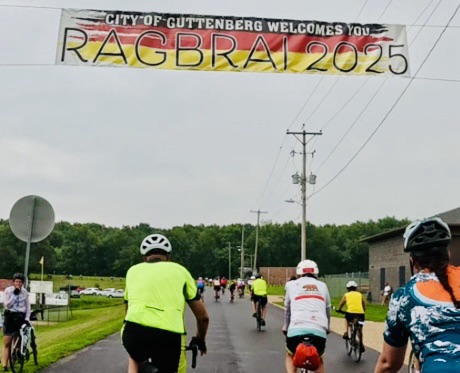
There was no fanfare. No fireworks. Not even a medal. Just a steady stream of weary, rain-soaked riders passing beneath a modest welcome sign, each wrapped in their own quiet reflection.
It was the end of a journey—one that, in the grand scheme of things, might seem arbitrary, perhaps even meaningless. But to us, it meant something, and we all felt a quite pride at the accomplishment
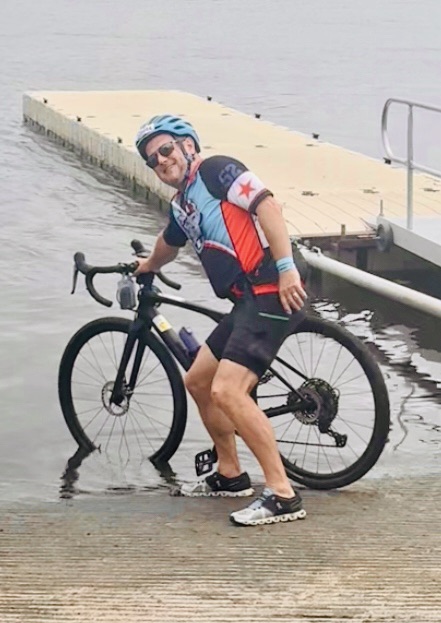
In keeping with tradition, and along with thousands of others, we made our way to the riverside and, after dipping our front tires in the Father of Waters, hoisted our bikes over our heads in celebration.
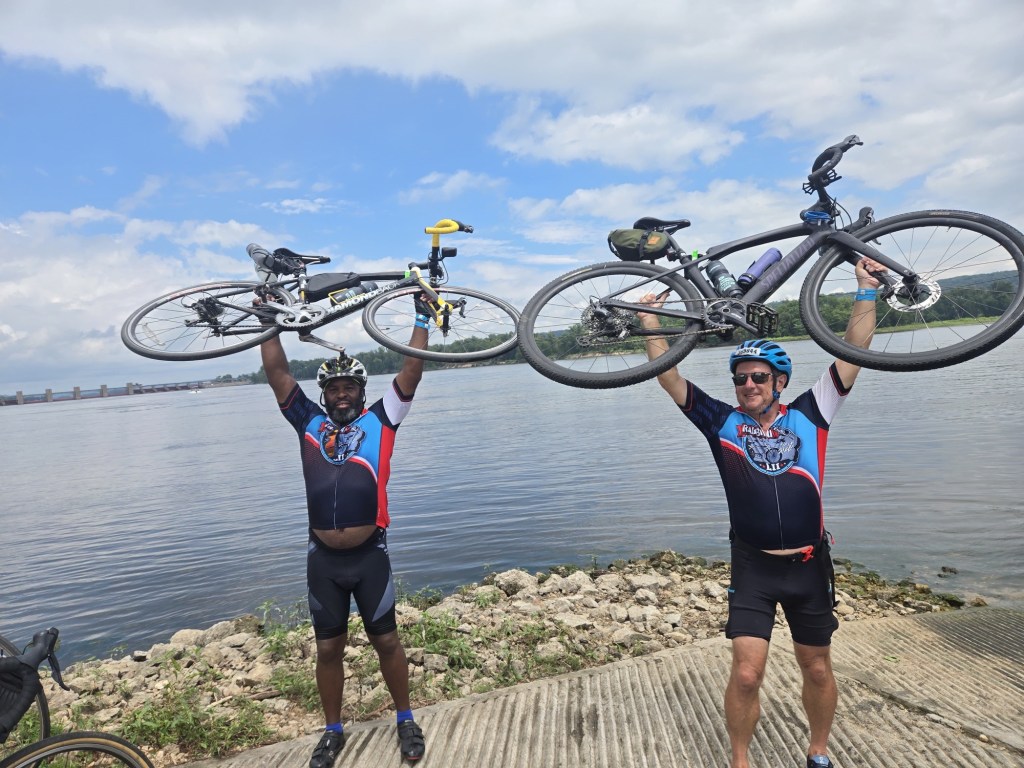
After basking in my own self-satisfaction for a few more moments, I grabbed a Chick-fil-A sandwich from the food truck at the top of the ramp—the first recognizable brand I’d seen in a week—and took refuge under a shade tent to catch my breath. The rain had finally stopped, and the sun was beginning to push through the clouds, as if rewarding us for making it to the end.
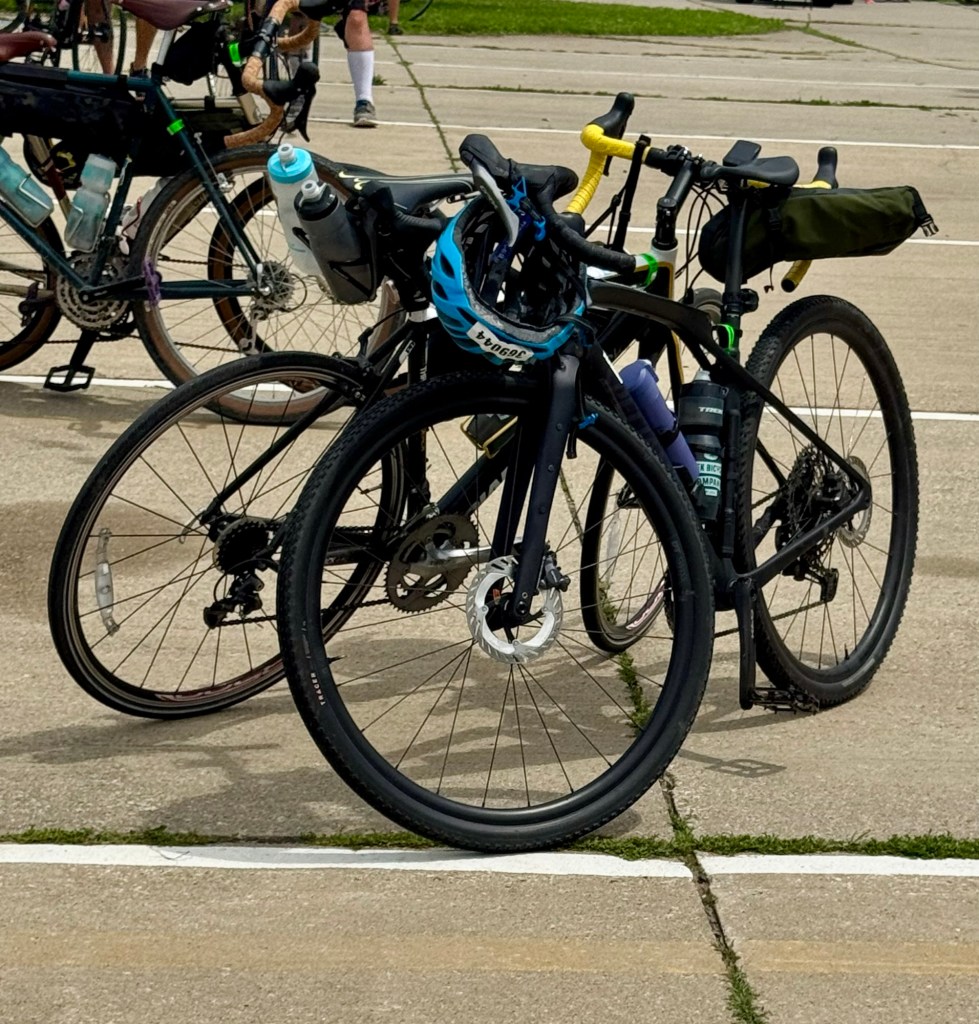
Across the levee, I spotted our bikes—propped up against each other. Not resting against a wall, perched on a curb, or lying in the grass, but balanced upright, supported solely by one another—the way real cyclists leave their rides.
I nodded inwardly with quiet satisfaction.
I guess we are real cyclists now.
As we left the riverside to begin our own private celebration—one we had proposed and planned weeks before—we noticed a man sitting quietly in a lawn chair near the exit, far removed from the crowd of riders gathered to dip their tires in the Mississippi.
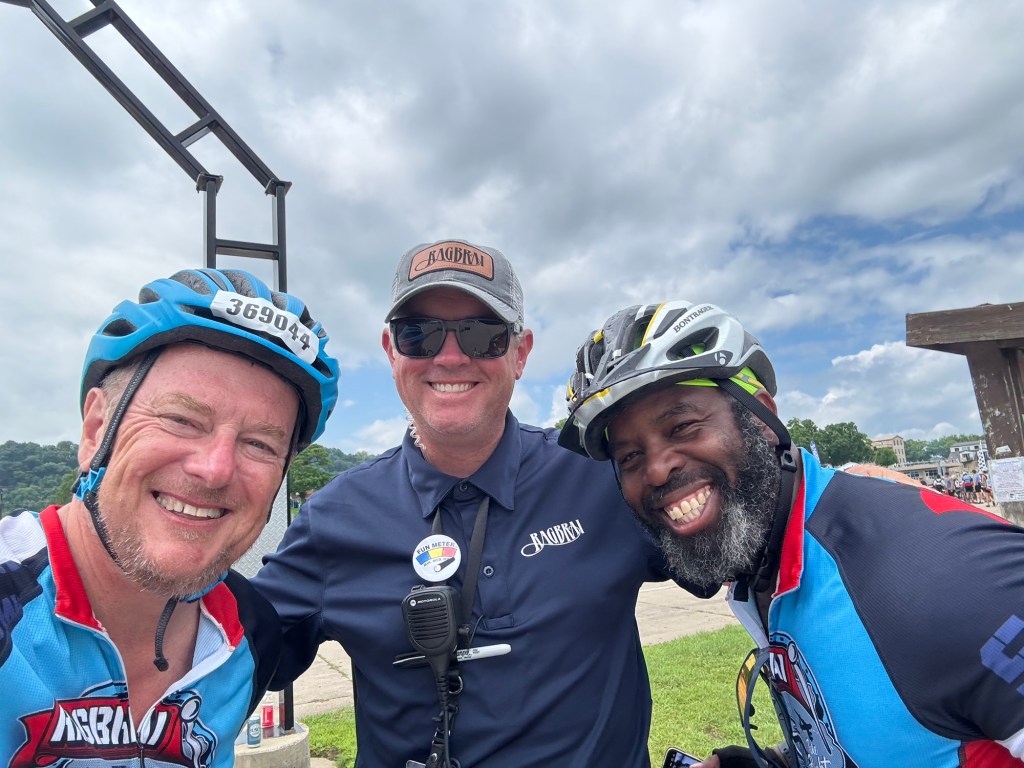
We recognized him from the safety briefing last Saturday in Orange City. Matt Phippen, RAGBRAI’s ride director. A native Buckeye, and the man whose tireless drive, energy, and leadership make the entire event possible.
We stopped to thank him, snapped a quick selfie, and congratulated him on a phenomenal job—well done and deeply appreciated.
In my naiveté, and based on the public face of RAGBRAI, I had imagined Matt leading a merry band of Buckeyes—volunteers working shoulder to shoulder, fueled by community spirit and a love for Iowa—pulling together against the odds to put on this extraordinary event.
But of course, in today’s world, things are rarely so simple.
RAGBRAI is a sports marketing brand owned by Ventures Endurance Events, LLC, which is, in turn, owned by Gannett Co., Inc.—the parent company of the USA Today network. Peel back a few more corporate layers and you find that the ultimate owner is Fortress Investment Group, a private equity firm managing half a billion in assets.
RAGBRAI is, in every sense, big business—with the resources of a major corporation behind it. And realistically, of course it is. A handful of well-meaning Buckeyes couldn’t have pulled off something of this scale and complexity.
And I’m okay with that.
Because without those resources—without the marketing reach, the infrastructure, the logistics, and the funding—Damian and I would likely never have heard of RAGBRAI, let alone had the chance to be part of it.
It reminds me of how I felt about Johnnie Walker whisky for many years after Diageo, a multinational drinks corporation, acquired the brand and closed the historic factory in Kilmarnock—the town near where I grew up, where it had been made for over two centuries. I was appalled at how a company could so coldly turn its back on that history. I didnt drink their whisky for many a long year.
But a couple of years ago, I was persuaded to visit the Johnnie Walker Experience—a sleek, immersive museum in Edinburgh dedicated to the brand. And it opened my eyes. I saw the scale of Diageo’s investment and the resurgence it had sparked in the Scotch whisky industry across Scotland.
Which brings me to that long-planned celebration.
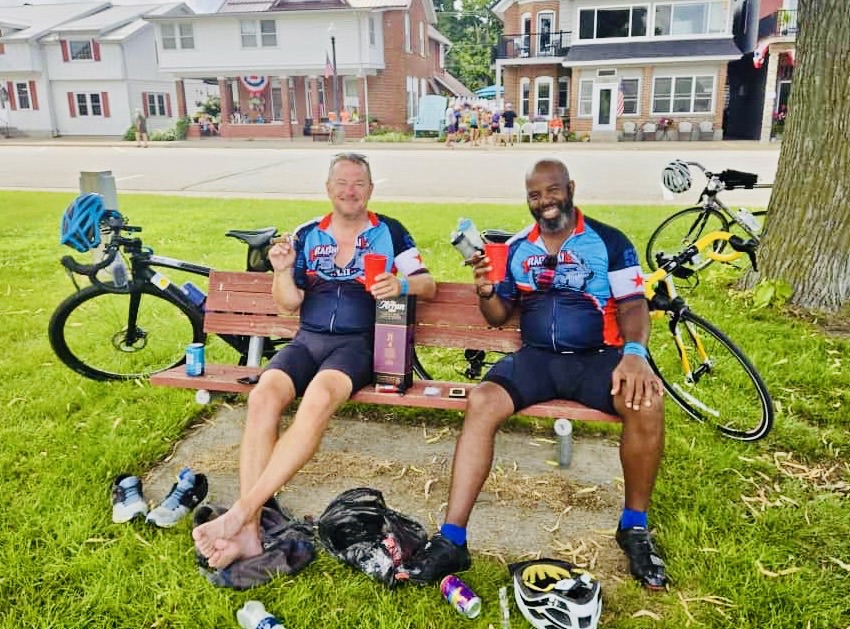
In our imagination, we would find a bench in the shade of a large tree on the banks of the river—just yards, as it turned out, from where our tents had been pitched the previous Friday—and enjoy a big cigar and a glass of good Scotch.
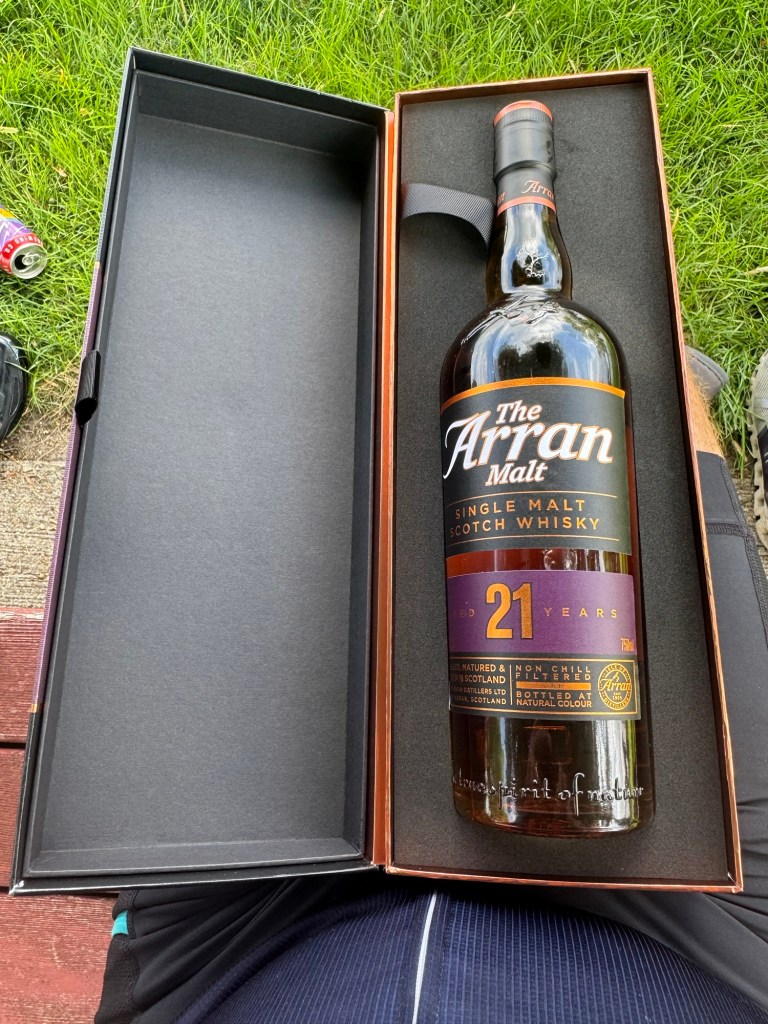
Naturally, I was to choose the Scotch while Damian would fetch the cigars. So, the day before we left for RAGBRAI, I went into my local liquor store looking for something memorable with which to mark our triumph. That little store never fails to surprise me. It’s a veritable treasure trove of every conceivable beverage. This wouldn’t be the first, and hopefully not the last, time it had produced the perfect bottle for an occasion.
There, tucked away on the top shelf at the very back of the store, was a 21-year-old Arran single malt whisky. Not a Johnnie Walker brand, but a newer, independent distillery founded in 1996, part of the resurgence in Scotch whisky production, and the first (legal) single malt on the island in 150 years. Perfect.
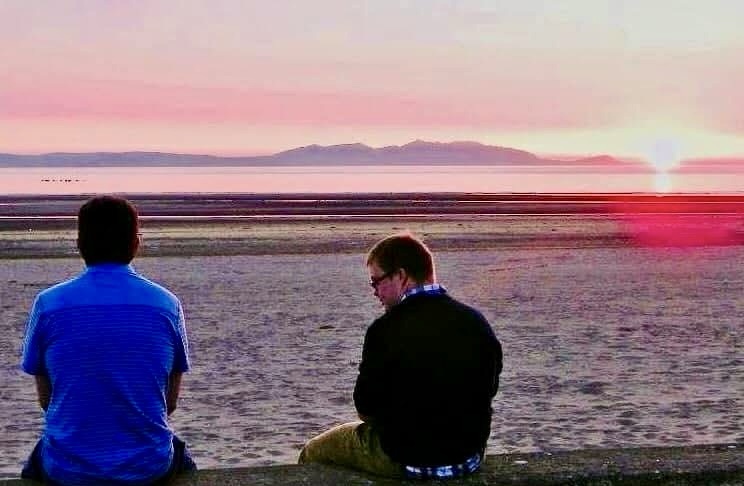
As I puffed on that cigar, sipping the “nectar of life,” and marveling at the mighty Mississippi before me, my mind conjured an image of another beautiful stretch of water I knew as a boy—the Firth of Clyde, and a glorious sunset behind a distant island.
Arran.
 What! Scotland Qualified!!!