World Cup and sleep just seem to go together. Like pie and beans. Or Irn-Bru and a deep-fried Mars bar. It must be the heat or the constant activity. But there I was again, finally shaking myself awake at gone 9 a.m. while the rest of the Army was already preparing for manoeuvres.
I had actually woken earlier with the sun streaming through the window, but a quick check of the clock told me it was only 5:30. This far east, Boston is one of the first places in EST to welcome the dawn. I grunted and went back to sleep.
We always knew that, with a 9 p.m. kick-off for the big game tonight, today would be a slow burn. So after a leisurely, if late, breakfast—née brunch—we had time for a little sightseeing and made our way down to Boston Harbor.
Andrew, bless him, mixed up his historical harbours and was a little confused when we told him that Boston, not Pearl, was where the tea was thrown into the water. Nevertheless, he was thrilled to be so close to history and would happily have tipped some in himself had any been to hand.
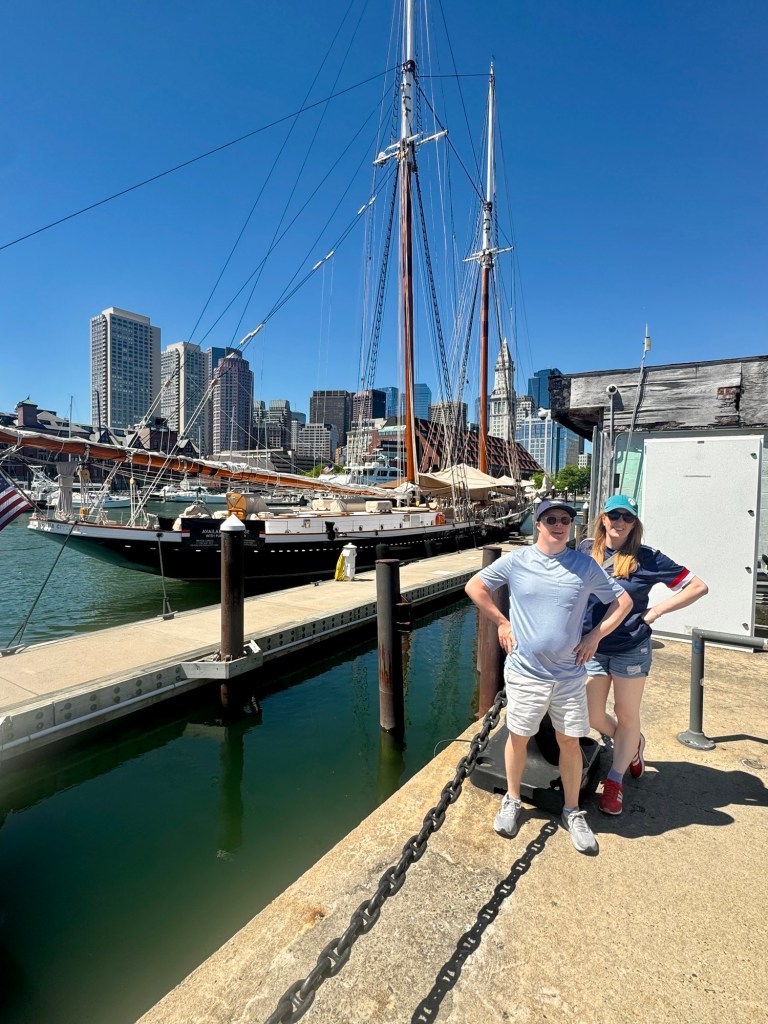
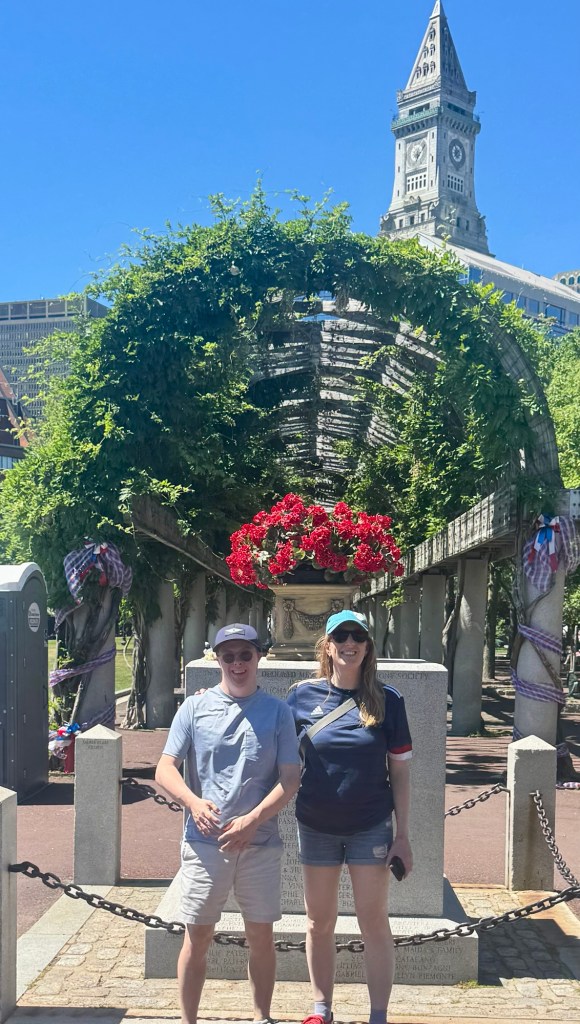
The walk along the shoreline in the morning sunshine, past ships both modern and tall and through beautifully maintained gardens, was the perfect relaxing way to light the burn.
I had not spent much time in Boston before, but this short visit has whetted my appetite. The city is definitely worthy of further exploration.
The path eventually led us back into the city proper, where the coffee shops lining the avenues were beginning to fill with a Tartan Army that, at that time of day, was somewhat more subdued. “No Scotland, No Latte” would have been a more appropriate—if subdued—chant.
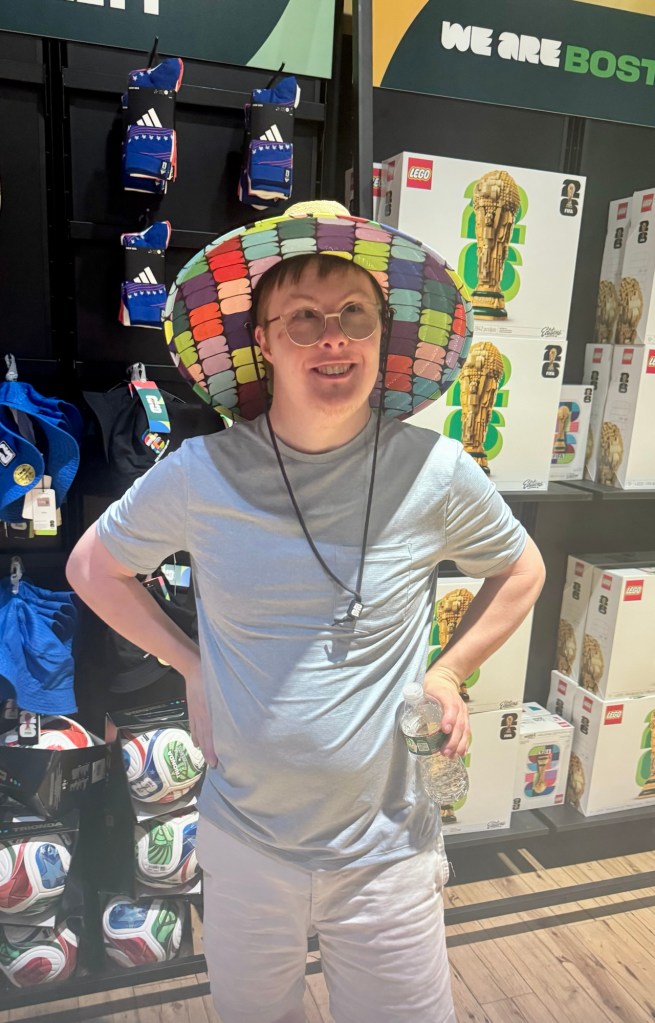
Those conversations I have mentioned with people from around the globe are all very well and inspirational in their own way. But to be among yer ain folk, with your hopes and expectations pinned to your ain team rather than some surrogate, is an entirely different experience, and I took every opportunity to enjoy it.
My accent regressed by the minute and I apologise in advance to my friends and colleagues, to whom I will likely be unintelligible for the next few weeks.
There were impromptu chats with people from all over Scotland, here simply for the love of the game and of our country. Places from my childhood—Wishaw, Kilsyth, Paisley, and even one fellow from Ayr, an old boy from the very same high school as me.
Funny how paths diverge.
Me, an executive in the chemical industry in Carmel, Indiana. Him, a yoga teacher in Bali, Indonesia.
There but for the grace of God—or perhaps the grace of a careers guidance teacher—go I.
Another couple hailed from the Orkney Islands, so far north in Scotland that I suspect it would take them longer to get home from Glasgow than it would to fly from Glasgow to Boston. Elaine’s brother lives up there and I know it is a beautiful but very remote part of the country. I admire their commitment in making the journey.
Some kind of tractor beam—or perhaps, having spent so much time there yesterday, it was simply the path of least resistance—drew us back to The Dubliner, our favourite, or to be more precise, only pub in Boston.
The line to get in today was even longer than yesterday.
But, ever the optimist, I walked past the queue and asked the guard how long the wait was.
“Are you wanting food?” he asked.
From yesterday’s experience I knew the correct answer and didn’t hesitate.
“YES!”
And, just as yesterday, he ushered us straight past the queue and into the bar.
The hostess, however, scuppered our little ruse this time.
“No, he was wrong. There’s a two-hour wait,” she informed us, with just a little too much relish.
She clearly enjoyed wielding her power.
Oh well.
Now, Lorna would later display scruples and morals which I did not know she possessed—certainly her father doesn’t. I don’t know whether it was all part of her cunning plan, but conveniently she announced that she needed to use the conveniences.
The rest of us loitered near the hostess stand, gradually inching closer to the bar where, once inside, there was no queue at all.
Melting into the throng and out of sight of the power-crazed hostess, we remarkably discovered a set of recently vacated stools right at the bar.
We pounced.
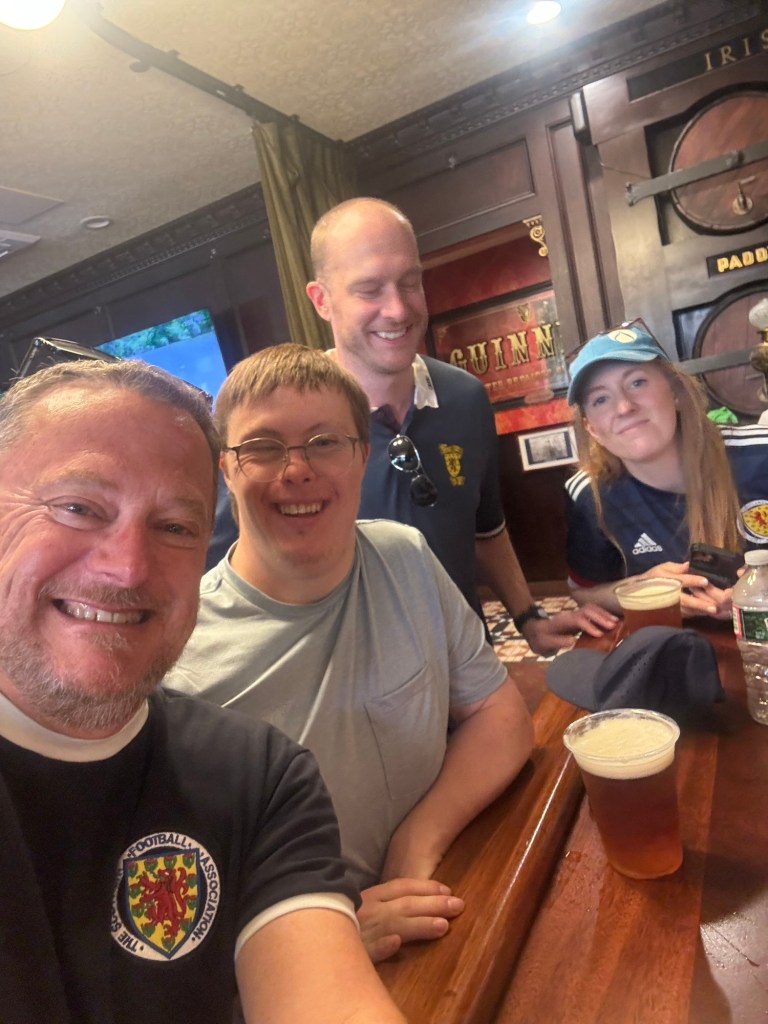
And that, ladies and gentlemen, is how we ended up staying in that exuberant Irish bar for the next two hours, singing and partying with the Army while chatting to the very friendly barman, Shane.
Most Irish bartenders I have met in America are here on six-month work visas, enjoying a gap year adventure after college. Shane, however, was American by birth and, although raised in Ireland, held a US passport and had been working there for two years.
To be candid, he was working his backside off. The place was absolutely mobbed.
Unbeknownst to us, The Dubliner had been raided just two days earlier by both the licensing authorities and the fire department for overcrowding.
Five hundred and sixty people in a space licensed for 290.
That would explain the lines outside.
Since arriving in Boston, I had been looking for one of those Scotland bucket hats.
I don’t suit hats. Never have. I have one of those big Celtic heads.
Despite my best efforts, I couldn’t find one anywhere. The entrepreneurs of Boston are missing a trick. It seemed nobody had informed them that 30,000 Scots were descending on the city because there was virtually no Scottish merchandise to be found.
Still, I thought perhaps a bucket hat might work.
An older gentleman appeared beside me in a kilt and a blue-and-white Scotland bucket hat.
“Nice hat,” I said. “I’ve been looking for one all morning.”
“Well, you can have this one,” he replied, promptly placing it on my head.
Mark, from Aberdeen as I later learned, and I wrestled with the hat for a while. He insisting I take it and me insisting that I couldn’t possibly accept.
In the end I relented and accepted the generous gift, but only on the condition that I bought him a beer.
A worthy deal.
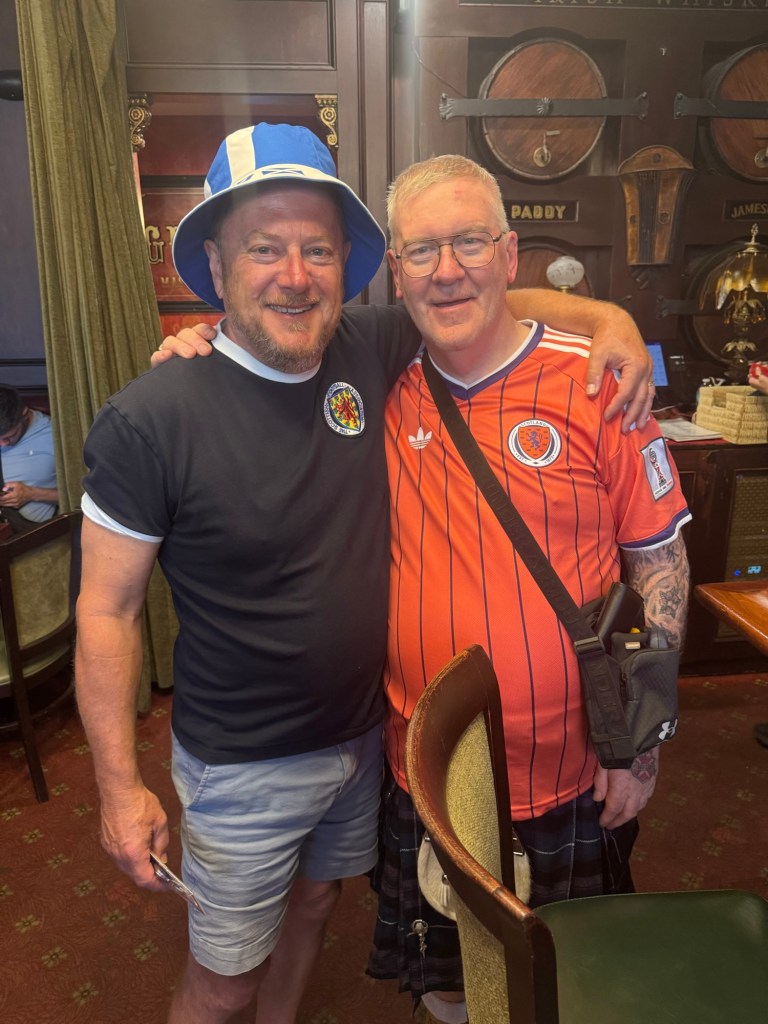
Except, as Lorna later pointed out, in the excitement of my new hat—and having already closed my tab—I walked off without paying.
Shane, our friendly bartender, apparently understanding the circumstances, simply said, “Don’t worry about it.”
And here is where Lorna’s superior morals and scruples make their appearance.
She was indignant and appalled that her father had:
(a) skipped a two-hour queue,
(b) stolen a bucket hat from an old man, and
(c) fled without paying for the beer with which he had bartered for the hat.
Shamefully, I do not know where she acquired such fortitude.
It must be her mother.

 What! Scotland Qualified!!!