For me, the greatest joy of the World Cup is the casual encounters with random strangers from all over the globe. I’ve had countless such encounters over the three tournaments I have attended. Most are people like myself from countries fortunate enough to enjoy the freedoms we often take for granted. Many others come from places I will likely never visit, where safety and security are far less certain, yet somehow they still find a way to be there.
For the most part, like everyone else, they just want to talk about football. But they rarely miss the opportunity to tell a Western face about the political situation back home. My conversations with a Sudanese man, a couple of Palestinians, a Libyan, and a Balochistani (I’ll let you look that one up) spring most vividly to mind.
Of course, these encounters provide only a snapshot—and likely a one-sided one at that—of their experiences. Nevertheless, it is good to hear about issues firsthand rather than through the filter of what I have often described in this blog as a very mediocre media. It is uplifting to hear people speak so fondly of their homelands and their people despite the challenges they face.
“Are you going to the game?” asked Nativita, the Uber driver who picked Andrew and me up to take us to the airport.
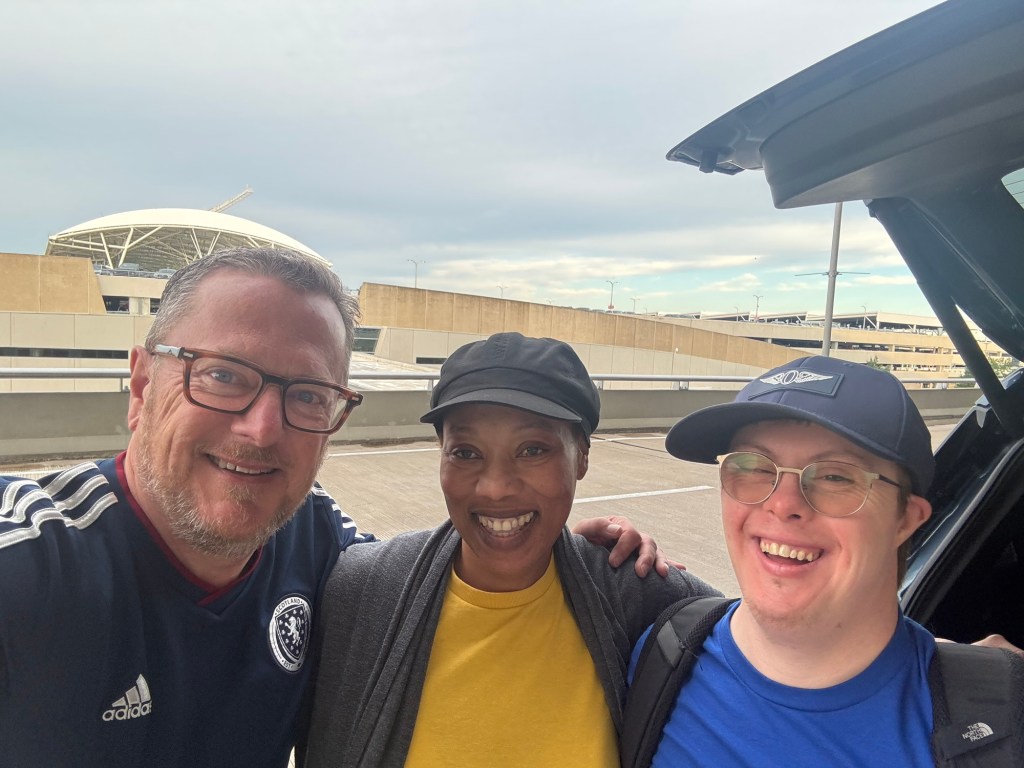
It was an unnecessary question. Surely the kilt was a dead giveaway.
“Yes, we are. Heading up to Boston for the Scotland–Haiti game tomorrow.”
“I’m Haitian,” she said.
The drive to the airport has never felt so short as the conversation flowed with ease. Of course she was as thrilled about the World Cup as I am. After all, it is the first time Haiti has qualified since Germany in 1974—coincidentally the first tournament I can clearly remember, and the one where Joe Jordan’s memorable goal, mentioned in an earlier blog, secured Scotland’s place.
She said the entire Haitian-American community was overjoyed. I asked whether she knew anyone in that community in Boston. She didn’t, but she did recommend that we seek out the Haitian neighborhoods during the World Cup celebrations and sample Prestige, their preferred brand of rum.
Nativita came to the USA as a child with her parents 38 years ago and still returns occasionally to Haiti . She bemoaned the lawlessness of the gangs that control much of the country, particularly the capital, Port-au-Prince. At the same time, she spoke of the beauty of the country, the warmth of its people, and the richness of its culture. Tomorrow, Haiti would be alive with joy and excitement for the game that she was driving us to see.
I hope we meet many more people like Nativita in Boston.
That kilt? Yes, I hesitated to wear it for the flight today. It tends to draw attention at the best of times, but it was certain to stand out while walking through a crowded airport.

Most people’s reactions are amusing. You catch them looking, but a split second before you make eye contact, they hurriedly look away, one or two with a wry smile. In the end, I chose to wear it because bringing cultures together is what the World Cup is all about. Even if Indianapolis appears not to care about the Cup, I felt it my duty to bring a small piece of it to the city as I strode proudly through the terminal, ignoring the curious glances.
Only one person said anything—an Englishman, of course.
“Never mind, you’ll be alright,” he said.
I struggled to interpret the emotion he was expressing. Concern? Sympathy? Worry? I think my cheery conversational retort took him by surprise because, quite clearly, I definitely was alright.
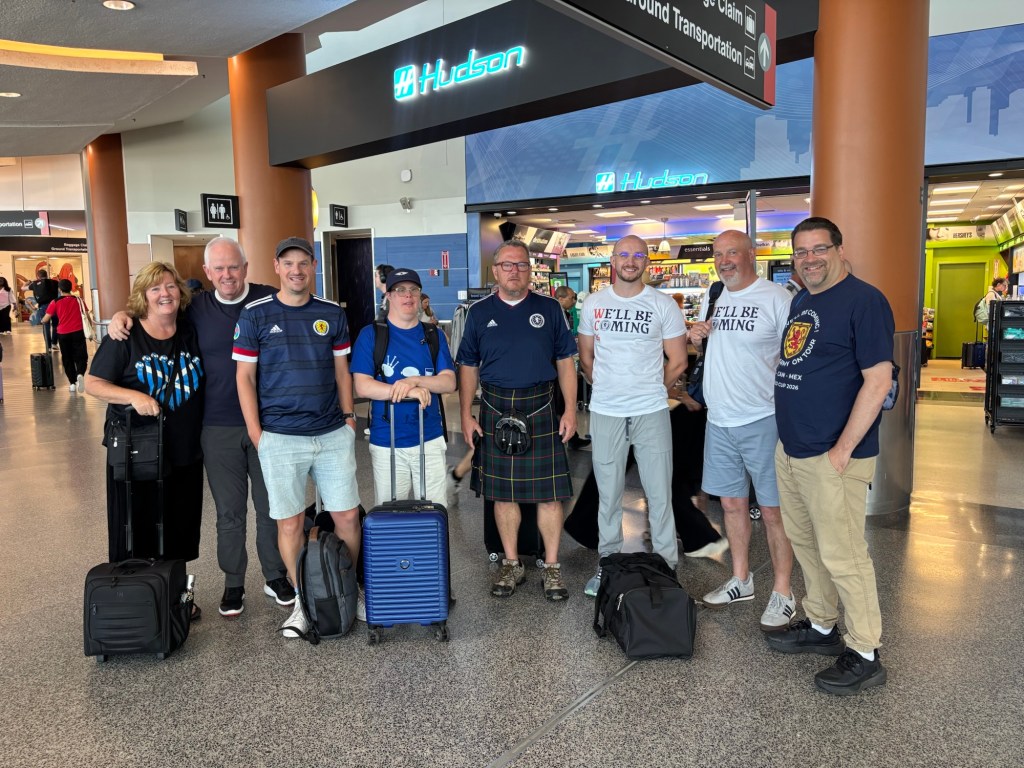
If I was the only man in a kilt in the airport, I certainly wasn’t the only Scot. The plane seemed to be half full of them—if not in numbers, then certainly in presence. After a breakfast mimosa each, Andrew and I were eager and willing to start the World Cup party with our new friends right there and then.
Suddenly, after the dearth of enthusiasm in the build-up, the Cup had finally started.
It only intensified the moment we touched down in Boston, where the airport was filled with the sound of those familiar Scottish accents and with Bostonians eager to greet us. One young man approached me.
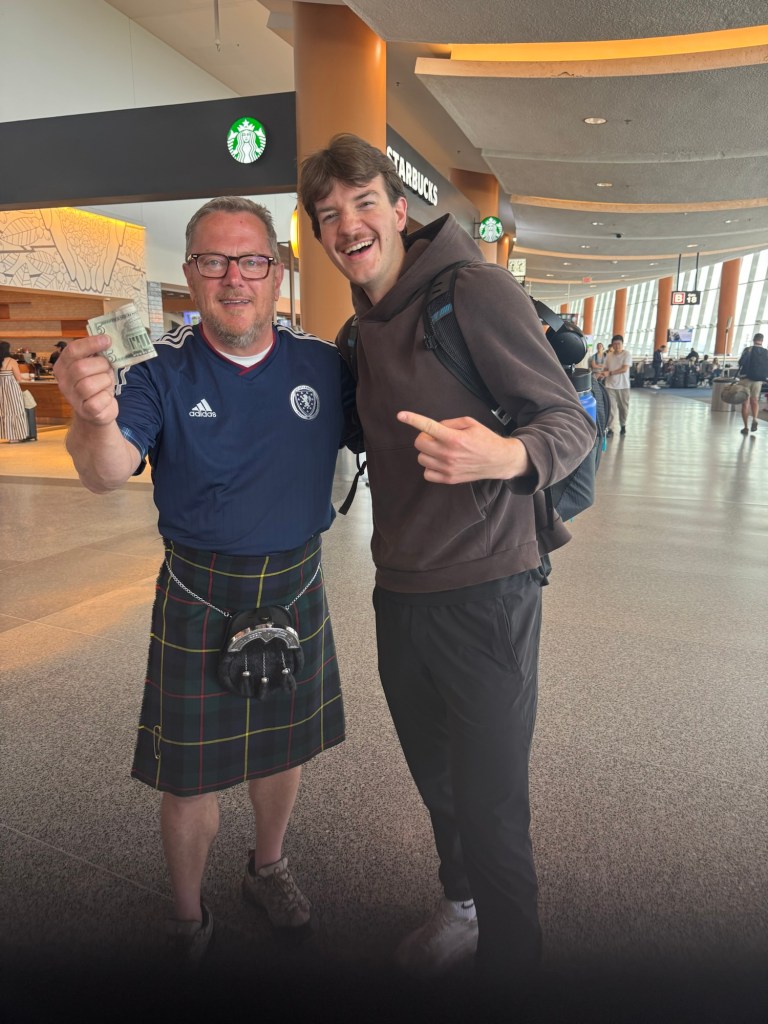
“It’s my lucky day,” he said. “My mom told me to look out for a man in a kilt at the airport today and buy him a beer.”
I was always warned not to take money from strangers, but for this fellow I made an exception.
We haven’t even left the airport yet and still have to meet up with the Tartan Army descending on the city. But, as in Brazil, Russia, and Qatar, after all the controversy and uncertainty, the buzz goes exponential when the fans arrive and the games begin

 What! Scotland Qualified!!!