I don’t think it even counts as jet lag anymore. I’ve travelled so much over the past three months, crossed so many time zones, that my body has no idea what time it’s on—and frankly, it’s just over it. But whatever you want to call it, I found myself awake—no, not just awake but AWAKE—at 5 a.m. again this morning.
There’s no point lying there fighting it, trying to coax myself back to sleep when my brain is raring to go. So by 5:30 I was sitting in the lobby of the Radisson Blu on Argyle Street, a sleek, modern place right in the heart of the city. We’d sat there the night before, having a welcome beer with David and watching the glamorous people of Glasgow arrive in their black tie and ball gowns for a charity fundraiser. Very swanky.
At 5:30 the lobby was deserted except for the night-shift clerk and the porter—a kindly old gent who reminded me of the men I knew as a boy. Short, wiry, grey of hair, with an energetic spirit and a mischievous grin. A real Weegie. He pointed me toward the coffee machine (and the basket of wee biscuits), and we chatted for some time about our shared memories of the city fifty or more years ago, and about the choice I—like millions of Scots before me—had made to cross the ocean for a different life.
He was a motor-sport fanatic, and his ears pricked up when I mentioned that I lived in Indianapolis. We talked about Jim Clark, Scotland’s most famous racing son, and his green Lotus, which has pride of place in the Indianapolis Motor Speedway Museum. The porter was a wealth of knowledge on the subject.
Our conversation wandered from motor sport to Glasgow’s architecture, parts of which have doubled as Gotham City in recent Hollywood Batman films. The architecture mirrors the state of the city itself: sleek, modern buildings like the Radisson, and directly across the street, a derelict sandstone tenement—a silent testament to Glasgow’s former glories.
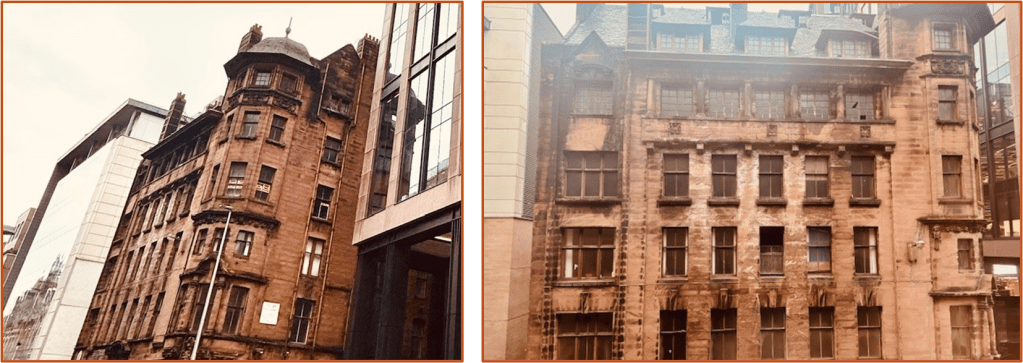
I found that building fascinating. On the surface it was a shambles, with broken windows and a crumbling façade. But look closer and you see the intricate detailing carved into the soft stone, the shift in style as the structure rises through its five storeys—the lower floors clearly meant for wealthy owners, the hobbit-like attic rooms reserved for the servants.
I wondered about its history, but the porter didn’t know. The building was shrouded in mystery. It dated from the late 1800s, but its present owner was as enigmatic as the building itself. Many had tried to buy that prime piece of real estate, but he wouldn’t sell. Not even Morgan Stanley—the financial-services giant whose modern building forms the other side of the architectural “sandwich”—had managed to prise it away from him.
The only snippet the porter could offer was that the building featured a wee “dooket” designed by Charles Rennie Mackintosh, the famous Scottish architect. A “dooket”—a small, secluded section of a building, little more than an alcove. A peculiarly Scottish word I hadn’t heard in many a long year.
I smiled and told him that now, for sure, I was home.
We talked and I wrote for a while, and as the lazy mid-winter sun finally dragged itself above the horizon, the lobby began to fill with people heading to breakfast. Before long the others joined me—Andrew motivated, as he was throughout the whole trip, by the promise of a full Scottish breakfast.
Later, I mentioned this to an English woman who asked what the difference was between a full Scottish and a full English. I paused for a second, but the answer came to me almost immediately.
In England you’re served eggs, bacon, sausage, black pudding, mushrooms, grilled tomato, and perhaps fried bread—a feast fit to energise a king for the day. Well… an English king, maybe.
But a Scottish king adds to all that: haggis, square sausage, and a tattie scone.
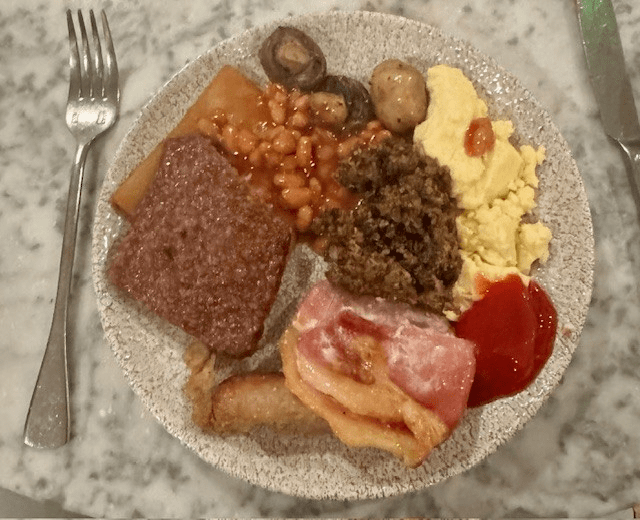
My own Scottish prince was more than ready for the challenge. Thankfully, the hotel was wise enough to provide breakfast plates that were—at least to Andrew—regrettably small, clearly, and wisely, designed to moderate consumption!
Today’s main event was the Rangers–Falkirk Scottish Premiership game at Ibrox Park—an unusual 2 p.m. kickoff. When I originally planned the trip, I’d assumed it would be an evening match, so I’d set the day aside for sightseeing around my former stomping grounds. But with the earlier start, I had only a couple of hours to spare—just enough time to retrace my steps to my alma mater, Strathclyde University, where I studied Applied Chemistry from 1979 to 1983.
Scottish universities, especially in those days, didn’t have the campus culture of American colleges, so almost every day for those four years I would catch the train from and to Ayr, about an hour each way, to attend classes. Surprisingly, Glasgow Central looked very much as I remembered it from all those years ago. The shop fronts had changed, of course, but the sounds, the smells, and the atmosphere were exactly the same as Andrew and I wound our way around the platforms.
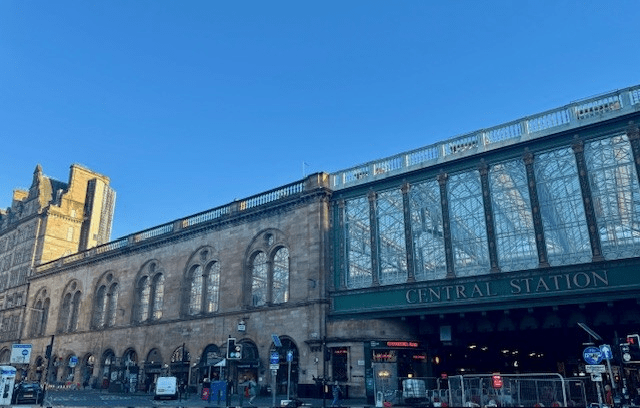
It took about twenty minutes to follow my old path from the station: along Gordon Street, past the beautiful Gallery of Modern Art on Royal Exchange Square—now glowing with Christmas lights—around George Square (not across it, as I would have done back in the day, since it’s currently being refurbished), annoyingly denying me access to check whether the Duke of Wellington’s obligatory traffic cone was in place, and then past the Glasgow City Chambers toward the university.
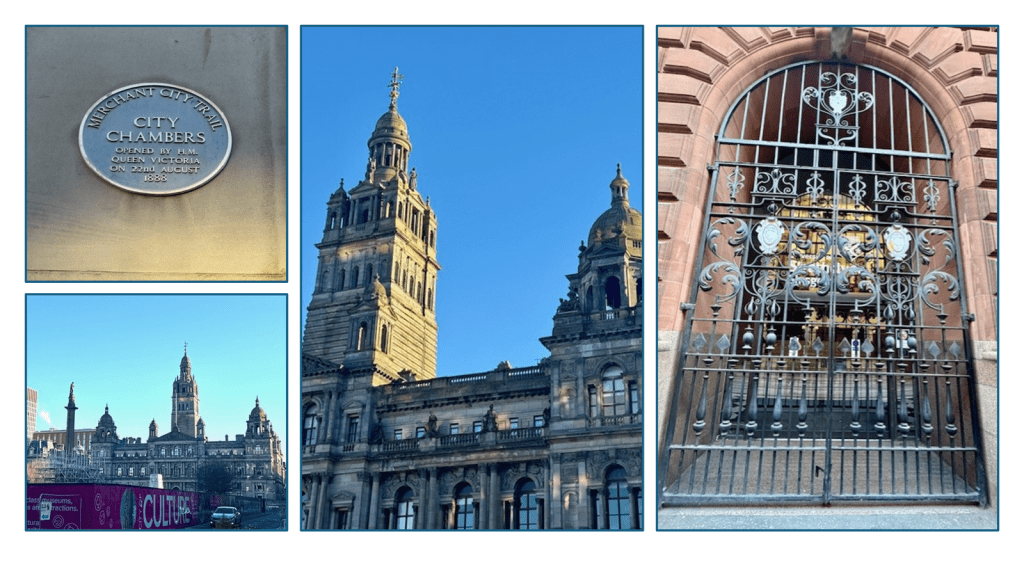
I must have made that walk nearly a thousand times back then, yet as a young man I don’t recall ever pausing to appreciate the beauty of the buildings I passed. Glasgow remains a stunning city today, and it’s astonishing to imagine the wealth and power it must have possessed in its heyday to create such magnificent architecture. A small, discreet plaque quietly notes that the City Chambers were opened by H.M. Queen Victoria on 22nd August 1888.
If historic Glasgow inspired, sadly my alma mater did quite the opposite. The original Royal College building, echoing the architecture of the city’s grand structures across the road, still presented a proud façade for the university. But the newer buildings—the campus expansions of the 1960s and ’70s—had exactly the opposite effect. Dilapidated, poorly maintained, and in some cases crumbling, the irony was not lost on me that the buildings housing the Faculty of Engineering were in such disrepair, particularly when compared to the glorious Victorian buildings, which had so admirably stood the test of time.

 What! Scotland Qualified!!!