Andrew has always loved chilli—especially in winter, when it’s, well, chilly. So, years ago, when he learned there was actually a country called Chile, he was delighted. “Perfect,” he said. “Let’s go eat chilli—in Chile—when it’s chilly.” He’s repeated that line many, many times, always with a chuckle. Nothing at all silly about that – is there?
So, on a whim—well, not entirely a whim—Andrew and I are off to do just that: eat chilli, in Chile, when it’s chilly.
To be fair, it wasn’t completely spontaneous. Elaine and her friend Laura had been planning a trip to the UK since the start of the year. The plan was for Andrew and me to stay home and mind the dogs. Or so she thought. But, as usual, my mind wandered to other options. That long-considered Chile trip came to mind. “Why not?” I thought. One thing led to another, plans were quietly made, and here we are.

The timing worked out rather well. We drove Elaine and Laura up to Chicago O’Hare Airport and, after dropping them off, checked into a nearby hotel for the night. A bit of bowling and Buffalo Wild Wings in Chicago would’ve been enough of an adventure for most. But, as Andrew said, that was just the warm-up.
Very early the next morning, we were back at O’Hare ourselves, boarding a flight to Panama City on Copa Airlines—the Panamanian national carrier. I hadn’t heard of it before and, admittedly, I was a bit wary. A budget-friendly airline from a “developing” country flying us such a long way? But my concern quickly faded. Copa, a Star Alliance member, turned out to be excellent: brand-new 767s, attentive (maybe a little too attentive) staff, and impressive efficiency. A thoroughly pleasant experience.
After five smooth hours, we landed in Panama City—a place I’d never really thought much about, beyond its famous canal. But after some light reading and chatting with the crew, I realized Panama might be worth exploring in future. It’s modern, safe, culturally rich, and boasts beautiful beaches on both its Caribbean and Pacific coasts. The only real drawback? It’s in the deep tropics—hot all year round. True to that, during our three-hour layover, a proper tropical storm blew through—an incredible sound and light show. I hadn’t factored that into our travel plans, knowing how much Andrew dislikes bad weather. He was brave, though clearly unsettled, and eager to get on our next flight and leave the storm behind.
Flying in tropical regions often means turbulence, and this flight didn’t disappoint. The six-hour journey to Santiago took us directly along the spine of the Andes, and the first 30 minutes were a white-knuckle rollercoaster ride through heavy clouds and unstable air. Once we broke through and leveled out, the rest of the flight was smooth.
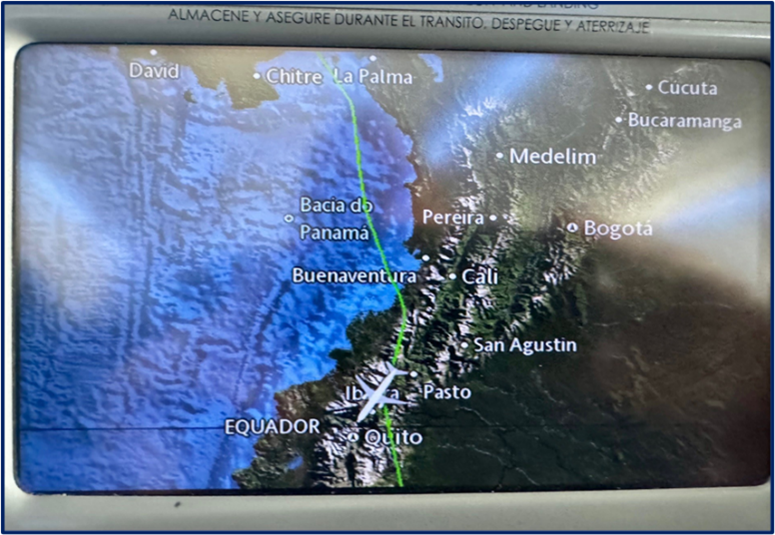
Crossing into the Southern Hemisphere brought with it a few curiosities. I attempted to test the theory that water spins down the plughole in the opposite direction south of the equator—but, perhaps surprisingly, discovered that doesn’t work at 30,000 feet. The seasons, of course, are flipped: we were leaving northern autumn for southern spring. It will be odd but lovely to see cherry blossoms in September. One thing I truly didn’t expect, though, was seeing the sun high in the northern sky at midday. It’s a strange, disorienting feeling.
With the turbulence behind us, the cabin lights dimmed and the quiet lull of a long-haul flight settled in. I drifted in and out of sleep, sipped on an endless glass of Malbec, watched a movie, wrote a little. Andrew, the best travelling companion imaginable, read and watched films beside me.
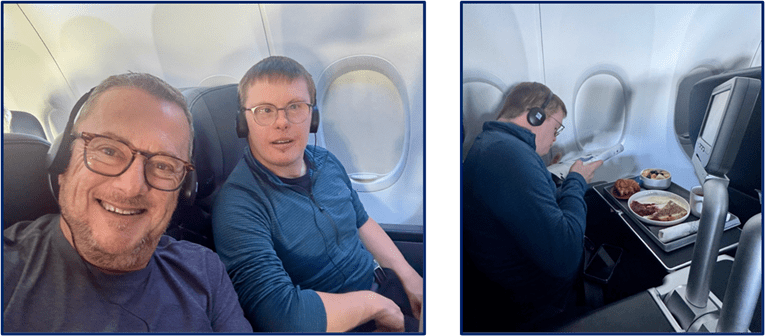
About four hours into the flight, I noticed Andrew was uncomfortable—grimacing in pain. This had been my biggest worry: the two of us travelling alone, and something going wrong. From years of experience I quickly diagnosed the problem. I asked if he needed the bathroom. He did—but he wouldn’t go because the seatbelt sign was on. [Later, a flight attendant explained that the seatbelt sign is kept on for the entire flight along the Andes route, just in case.] Despite my encouragement, Andrew refused to move.
In desperation, I pressed the call button. A flight attendant arrived quickly. At my prompting, he assured Andrew it was perfectly fine to use the restroom, even with the sign still on. Relieved, Andrew finally went. I followed discreetly, just to make sure he was all right.
The flight attendant—his name was Daniel—was visibly moved. He took my hand and, in broken English, explained that his day job was teaching philosophy at a university in Panama. As part of his academic work, he had studied the unique bond between parents and “special children”, which he described as “like no other, yet so natural, and normal”. Unbeknownst to me, he had observed that bond between Andrew and me throughout the flight, and he was effusive in his praise. He spoke with such sincerity and emotion, I was taken aback.
Of course, Elaine and I know what we have. After all these years, it’s simply part of life. We are proud of Andrew, of our daughters, and of the family we’ve built. But when Daniel asked—no, insisted—on giving me a hug, tears were shed.
Back in my seat, in the quiet glow of the cabin, flying through the night sky, I reflected on how the daft notion of eating chilli in Chile when it’s chilly—has become something much more profound. These next nine days, I’m certain, will be filled with emotion, meaning, and moments that affirm the very bond Daniel so beautifully recognized.

 What! Scotland Qualified!!!