It was a short night. The adrenaline from the day’s exertion, the anticipation of tomorrow’s challenge, and the chorus of snores from nearby tents—combined with the lingering heat that never fully abated—made for a restless sleep.
I should mention that I don’t recall hearing Damian snore even once all week—though I’ve never known anyone who could fall asleep as quickly as he does. I’ll let him speak to my sleeping habits!
In any case, I was awake before the 5 a.m. alarm, eager to be on the road by six. Panda Camp was an eerie yet purposeful place at that hour—just before sunrise, with indistinct shadows moving quietly between tents, portapotties, the food station, and the bike stand as riders prepared for the day ahead. Now and then, a flashlight flickered through the darkness as a few of the truly early starters—the serious cyclists—slipped out of camp before first light. The only constant was the low, steady hum of the generator powering the essentials in the small kitchen at the rear of the Panda trailer.
Strangely, I developed a taste for an early morning hard-boiled egg—seasoned with just a soupçon of salt and pepper. Not something I’d normally go for, but it was a convenient and protein-rich way to start the day. More important than carbs for cycling, or so they say—before jumping on the bike.
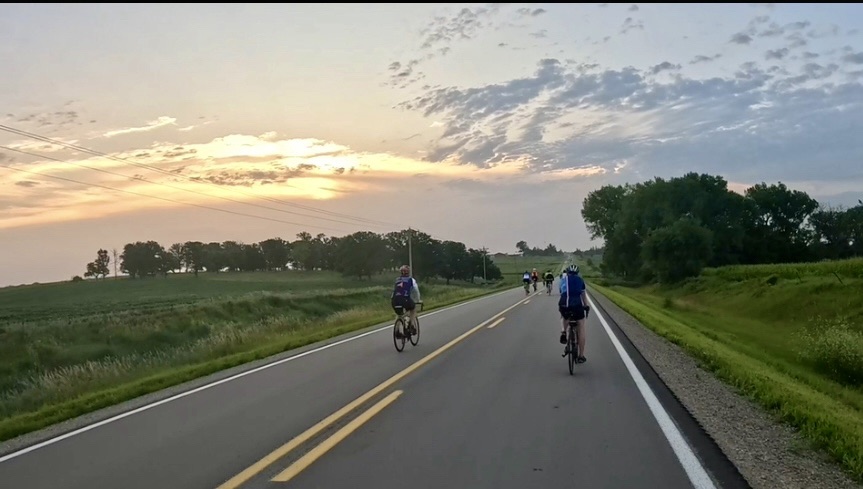
The first flush of dawn lit the sky as we cast ourselves once more into the stream of bicycles flowing east out of Forest City. It was, without question, my favorite time of day to ride—when the air is cool and still, and the world feels at peace.
Surprisingly, there were no cornfields or soybeans in sight, at least for the first few miles. Instead, the landscape evoked memories of England’s green and pleasant land. We passed small villages shrouded in early morning mist, tucked among leafy copses and beside quiet ponds—scenes that felt more like the Shires than the Iowa heartland.
But the rolling hills soon returned —longer, steeper now, and more demanding than the day before, even without the wind and heat. And once again, Ernie’s voice echoed in my head: Finish the session.
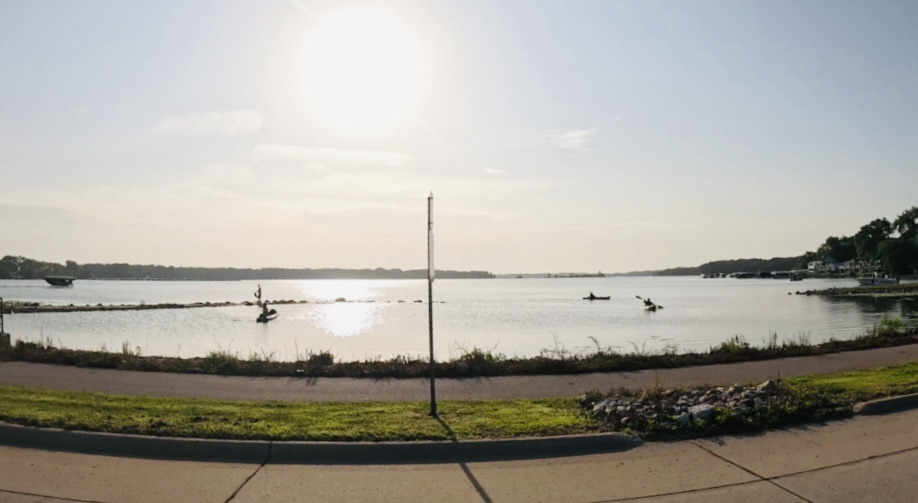
The relative serenity lasted for about ten miles—until two things happened. The route took a sharp 90-degree turn to the south, and the sun broke through the morning mist. It was as if someone had flipped on a giant hairdryer. The heat surged, and the wind picked up, setting the tone for the grueling 60 miles ahead.
As with the day before, our strategy was to push hard early, stopping only briefly in the pass-through towns of Ventura, Meservey, and Alexander—just long enough for a butt-break and to refill our water bottles, which we drained constantly in our efforts to stay hydrated. Liquid I.V. became my new best friend, as my body relentlessly craved electrolyte replenishment.
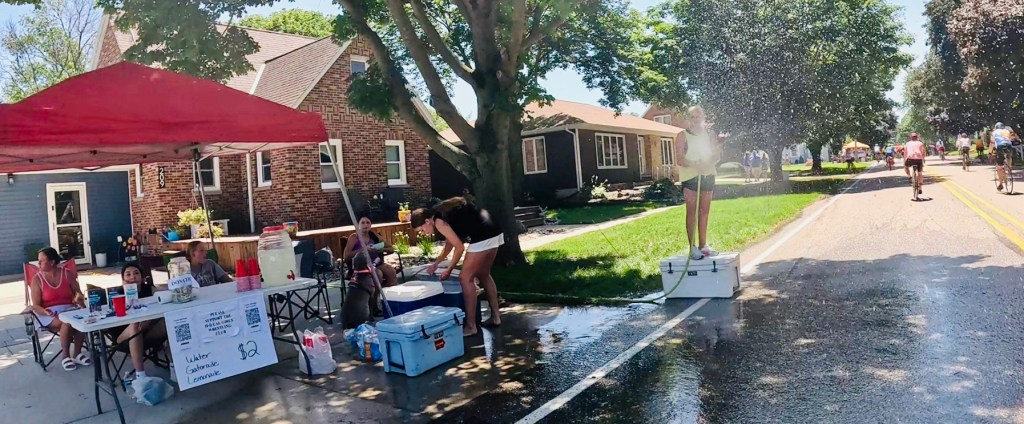
We took advantage of every opportunity to cool down, lingering under the hosepipe showers kindly offered by locals along the route. Their simple act of spraying us down with cold water became one of the day’s small mercies, offering fleeting relief as the heat continued to build.
Shortly after 11 a.m., we rolled into the meeting town of Latimer—our main stop for the day—with 51 of the day’s 73 miles behind us. Factoring in water and “butt” breaks, we had probably averaged only12 mph—our slowest segment of the week so far—thanks to the persistent headwind and those unforgiving, rolling hills. We were grateful for the break and took our time to rest and recover before tackling the final 22 miles.
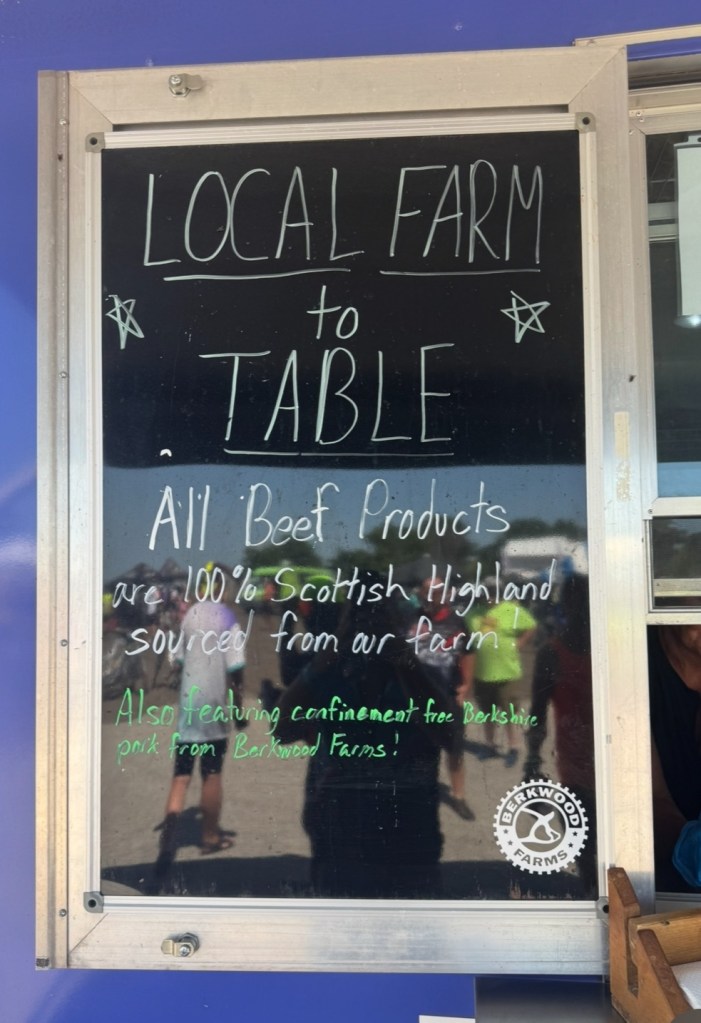
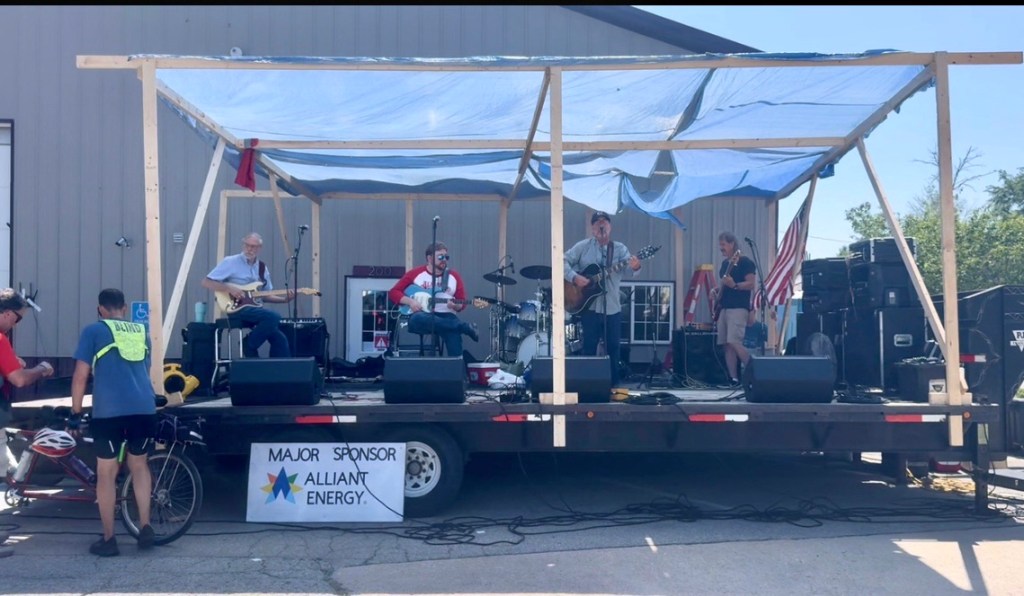
Regardless of the weather, every town along the route hosted a celebration, and Latimer was no exception. The party was already in full swing when we arrived, complete with one of the best bands we’d heard all week performing a nonstop catalog of country hits. A wide array of food trucks lined the square, but one in particular caught my eye: it proudly advertised “All beef products, 100% Scottish Highland, sourced from our farm.”
That’s a rare find in America—especially in the Midwest, where Kansas and Texas beef are practically local. Naturally, I struck up a conversation with the owner. She explained that her husband had studied abroad in Scotland and became enamored with Highland cattle, especially Aberdeen Angus. So much so, in fact, that he decided to raise them back home on their family farm, alongside the usual corn and soybeans.
In a nod to transatlantic friendship, I ordered a Philly cheesesteak made from Scottish beef—an American classic with a Highland twist. It was absolutely delicious. I ate it under a shaded tent in the town square, washing it down with a couple of beers while chatting with a woman about my age who was clearly a RAGBRAI veteran.
Morbidly, she delighted in recounting a long list of bike crashes she’d witnessed over the years. Even if the wind had eased up that afternoon, I think I might have ridden a little more cautiously after that.
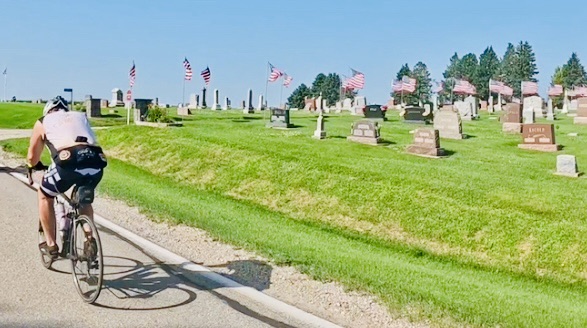
We delayed the inevitable as long as we dared before setting out once more—into the hottest, windiest part of the day. As we climbed the hill out of town, the American flags in the cemetery stood out sharply, billowing directly toward us in defiance, a clear signal of the headwind we were about to face.
As the miles wore on, lines of cyclists began to form—strangers falling into rhythm, working together to shield one another from the wind. There was something deeply comforting, even inspiring, in that quiet cooperation. A reminder, perhaps, that despite what we sometimes believe, mutual aid and shared effort are not the exception, but the natural state of the human condition.
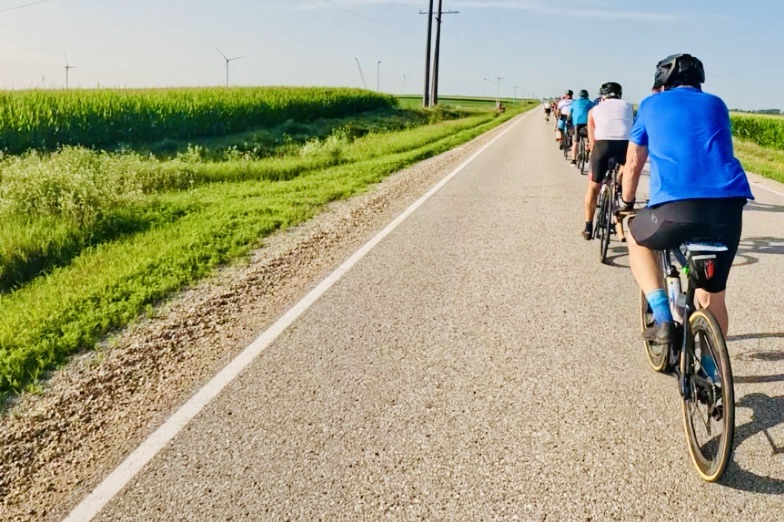
If our strategy in the morning had been to ride hard and bank miles early, our approach in the afternoon was entirely different. With no more official RAGBRAI stops over the final 20 miles, we knew from experience that there would be plenty of unofficial ones. So we adopted a “stop-hop” strategy—riding in short segments of no more than five miles at a time to pace ourselves through the brutal heat and wind.
And it worked.
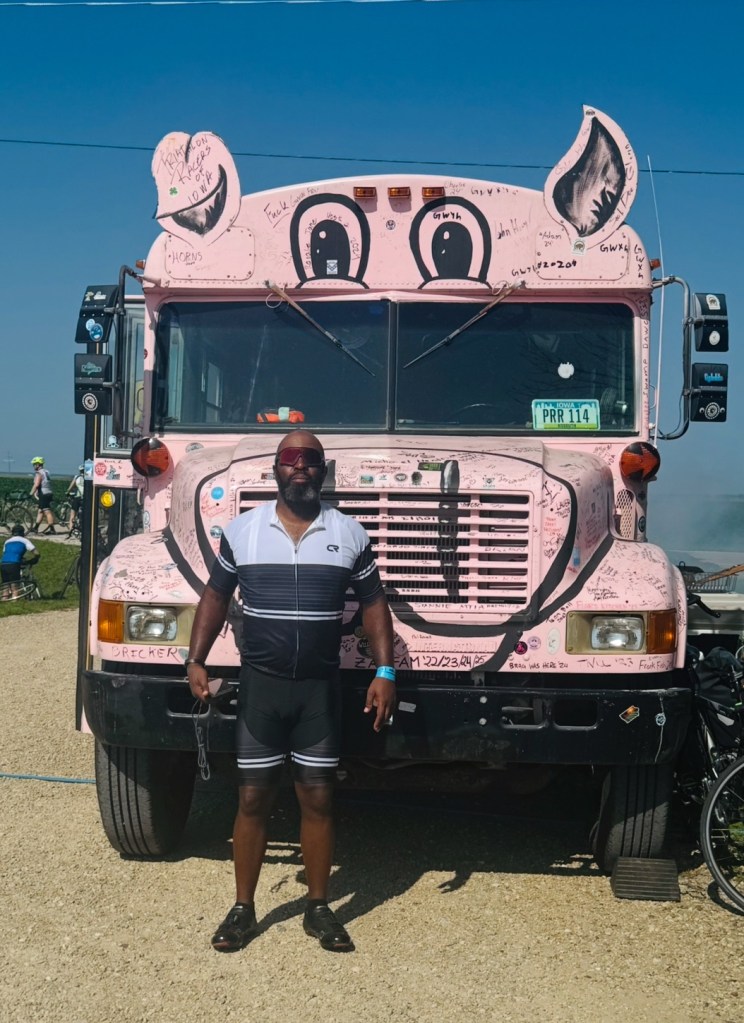
Less than five miles after Latimer, we came across Mr. Porkchop again. Having only recently polished off my Scottish Philly cheesesteak, I wasn’t quite ready for another indulgence—but it was comforting to know he’d be back later in the week. We rested under the shade of a tree, refilled our water bottles (which we were draining at an alarming rate), and moved on.
Another five miles down the road, we stumbled upon that roving beer garden once more. It was still ten miles from the finish—far earlier than I’d normally consider a beer—but the shade and relaxed vibe were too inviting to resist. We grabbed a cold one and found a seat in the shade of a barn, striking up a conversation with a group of fellow cyclists. (That conversation stuck with me—I’ll write more about it in a later blog post.)
Once again, we lingered longer than we probably should have. Eventually, we forced ourselves back onto the bikes to tackle the final stretch. But we hadn’t gone more than 100 yards when I noticed the group we’d just been chatting with pulled over to fix a flat. I stopped to offer help—not that they needed it—but in doing so, lost contact with Damian.
So I cycled those last miles alone.
I paused every so often, hoping Damian might catch up, but as the fatigue set in, the miles grew more difficult—and lonelier. I didn’t even have the energy to latch onto the increasingly rare pacelines that passed by. My main challenge that memorable, punishing afternoon was the sweat pouring from my head and stinging my eyes, blurring my vision and breaking my focus.
At one point, I stopped at a roadside stall, bought a bottle of water, tilted my head back, and poured the entire contents over my face, hoping for some relief. It helped—briefly.
Eventually, all I could do was put my head down, cue up my music, and slip into a trance, concentrating only on the rhythm of my wheel—one rotation at a time, each turn bringing me a little closer to the finish.
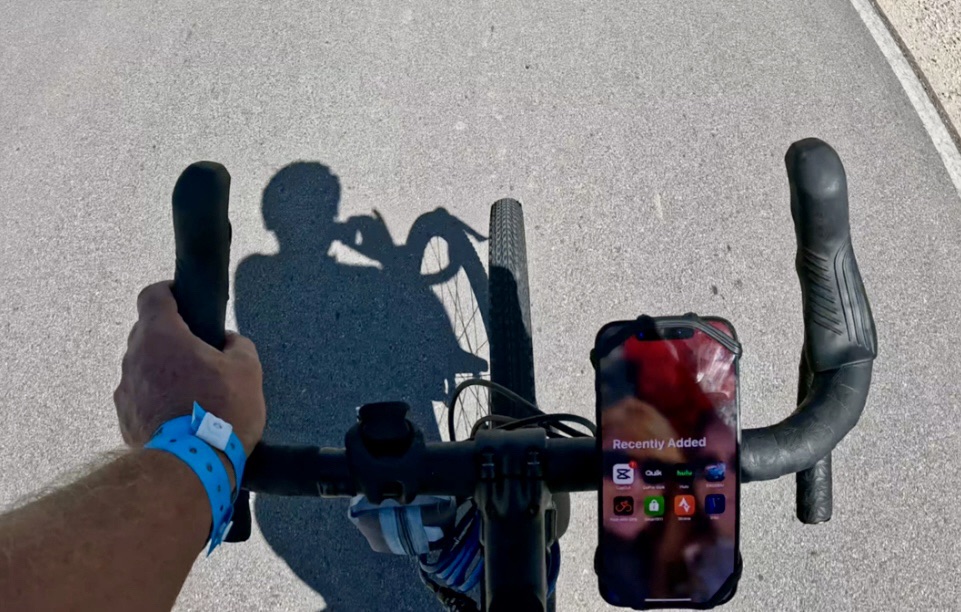
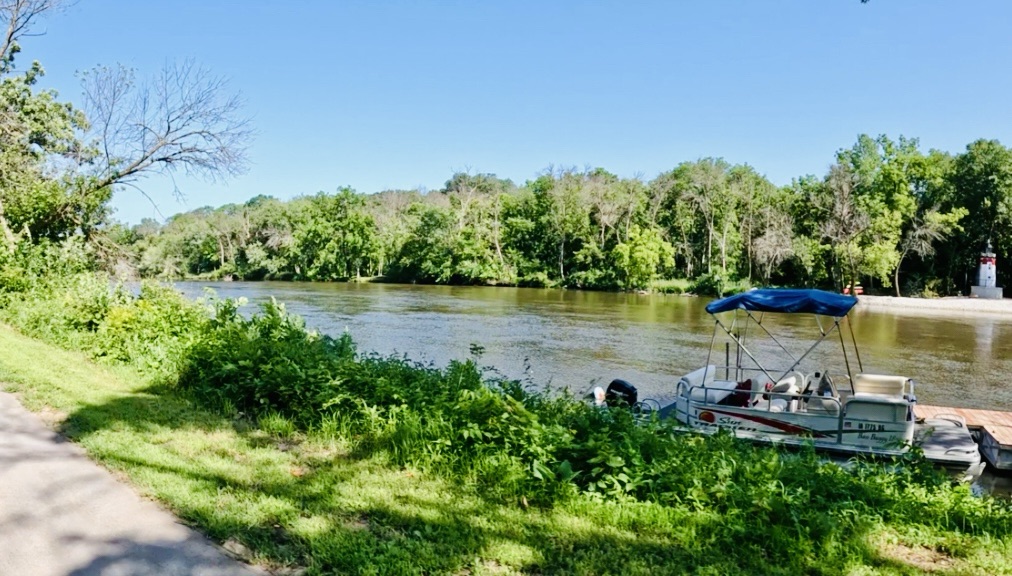
I was stirred from my trance as I rounded a corner and, for the first time that day, the road dipped into a consistent downslope. I coasted for nearly a mile, descending gently to the banks of the beautiful Iowa River, where I was finally sheltered from the relentless wind and shaded from the burning sun. The road meandered along peacefully, and as my body began to regain its senses, I allowed myself to think of the finish line.
But the course designers had one final surprise.
As I turned into Iowa Falls, I was met with a brutal half-mile climb—the steepest and most punishing of the entire day. Reaching the top, utterly exhausted, I didn’t have the energy to search for Panda Camp straight away. Instead, I pulled into a Casey’s supermarket for one last Gatorade and a Twix.
The guy at the checkout took one look at me and said, “You know, no one is paying you to do this.” He laughed and shook his head. I had no response. I just stood outside in the shade of the building, drained the Gatorade in one gulp, and took advantage of the rare strong Wi-Fi signal to send a few messages letting people know I was okay.
I rode into camp a short while later and found Damian waiting. Having taken fewer stops after the beer garden, he’d arrived well ahead of me and was beginning to worry.
For me, the next two hours were arguably the hardest part of the entire week. Now stationary, without the cooling breeze from the bike, I felt unbearably hot. Even after taking a shower, I was immediately drenched in sweat again. I probably drank more fluids in those two hours than I had during the entire day’s ride. But eventually, the sun began to dip, and the heat finally lost its edge.
In the days that followed, RAGBRAI veterans told us that this had been one of the toughest days in the event’s 52-year history. The next two days would be easier—unmistakably more of a party. But this was the kind of day we had truly signed up for. A test of endurance. A test of will. And I was proud to say I passed.
Ernie would have been pleased. I didn’t even throw up.
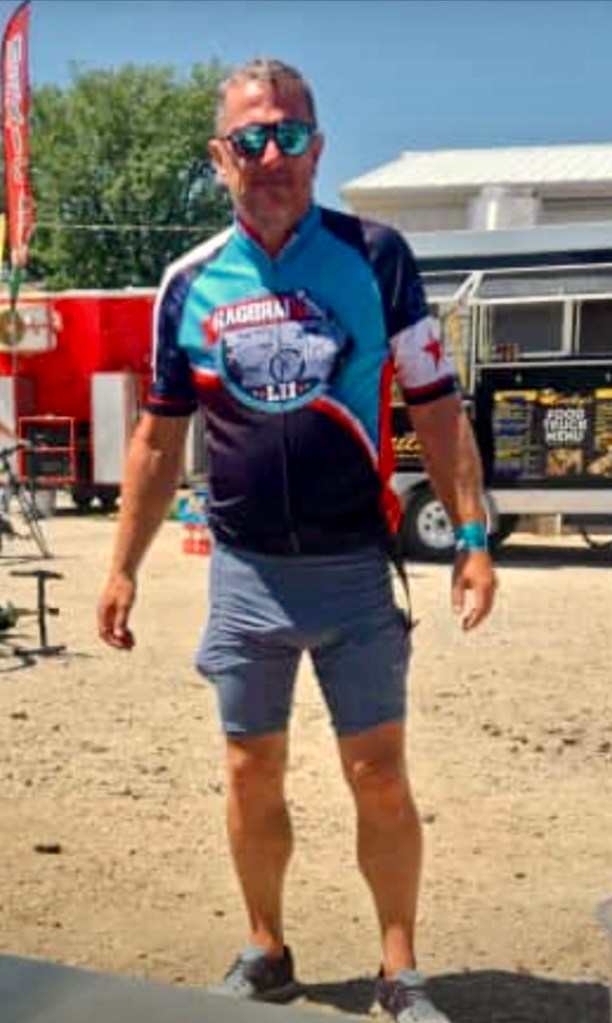
Not surprisingly, I was in my tent and asleep early that night. But the RAGBRAI gods weren’t quite finished with us.
I woke with a start to the sound of a massive thunderclap. Storms had been forecast for midnight—I checked my phone: 11:50. Pretty accurate, as forecasts go. The storm rumbled on through the night. I’d wake now and then to a particularly loud clap of thunder, spend a few moments watching the flicker of lightning dance across the canvas roof, and listen to the heavy rain drumming steadily outside.
Under normal circumstances, I might have been more concerned—outdoors in a proper storm, with nothing more than a thin layer of canvas between me and the elements. But that night, I genuinely didn’t have the energy to care. I rolled over and, despite the sound-and-light spectacular raging around me, somehow managed to fall back asleep. Remarkably well, in fact.

 What! Scotland Qualified!!!